Last week, ME Research UK highlighted an editorial article, published in the journal Frontiers in Medicine, which summarises a collection of research entitled “Unraveling the biological mechanisms of chronic fatigue: a multifaceted approach”, and includes two papers from ME Research UK-funded research projects, led by Dr Kumar, and by Prof Barnden respectively:
- Dr Kumar’s paper looked at how the brain processes sensory information in people with ME/CFS. The study found that the early stage of filtering sights and sounds seemed to work normally, but a later brain response linked to attention and thinking was reduced. This suggests that sensory problems in ME/CFS may come from the way the brain deals with information, rather than from problems with the eyes, ears, or other sensory organs.
- Tanoj Singh, alongside Prof. Barnden and other members of the team, used detailed brain scans to compare people with ME/CFS, those with long COVID, and healthy controls. They found changes in the brain in people with ME/CFS, and in those with long COVID, but the changes were in different areas. This suggests that the two conditions may have some similarities, but they may also affect the brain in different ways.
Other research discussed in the editorial highlighted:
- People with ME/CFS may have reduced activity of TRPM3 channels – tiny protein “gates” in the cell membrane that allow calcium, an important signalling molecule that helps immune cells communicate, activate, and function properly, to enter the cell – in natural killer (NK) cells, a type of immune cell. If TRPM3 channels do not work normally, calcium signalling may be disrupted, which could reduce the ability of NK cells to fight infections.
- Problems with sodium–potassium pump activity in muscle cells that could contribute to muscle weakness, cramps, fatigue, and worsening energy failure in severe ME/CFS.
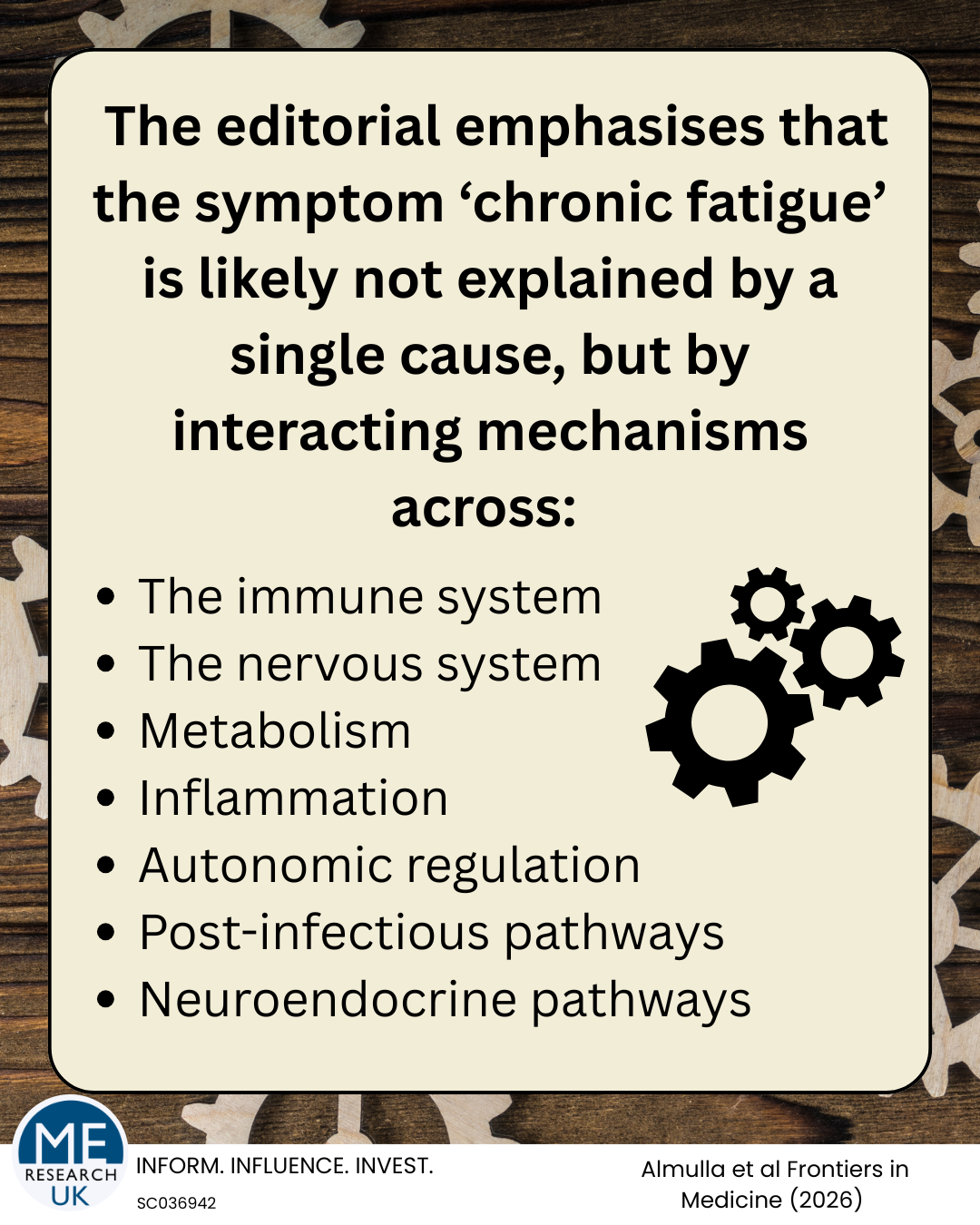
Overall, the editorial emphasises that ‘chronic fatigue’ is likely not explained by a single cause, but by interacting mechanisms across the immune system, nervous system, metabolism, inflammation, autonomic regulation, and possibly post-infectious or neuroendocrine (manages the communication between the nervous system and the hormone system) pathways.
The central message is that illnesses involving persistent fatigue—like ME/CFS and related post-viral syndromes—require an integrated research approach, a strategy that combines multiple methods, data sources, or academic fields to study a topic, rather than narrow single-marker explanations.
Key points from the editorial article include:
- Chronic fatigue is biologically complex, involving overlapping immune, inflammatory, neurological, metabolic, and autonomic abnormalities.
- A multifaceted research strategy is needed to understand the symptom of fatigue, combining clinical observation, molecular biology, immunology, neurobiology, and systems-level analysis.
- Heterogeneity is a major challenge – patients may share the symptom of fatigue but differ in underlying mechanisms, triggers, severity, and comorbidities.
- Biomarker discovery remains important, but it is likely that no single biomarker will explain all cases of ‘chronic fatigue’.
- Better mechanistic understanding could improve diagnosis and treatment, especially by helping identify patient subgroups and targeted therapeutic pathways.
In short, the editorial frames chronic fatigue as a complex, multisystem biological problem and calls for integrated, interdisciplinary research, centred around collaboration and knowledge sharing, to clarify mechanisms, identify biomarkers, and develop more precise treatments.