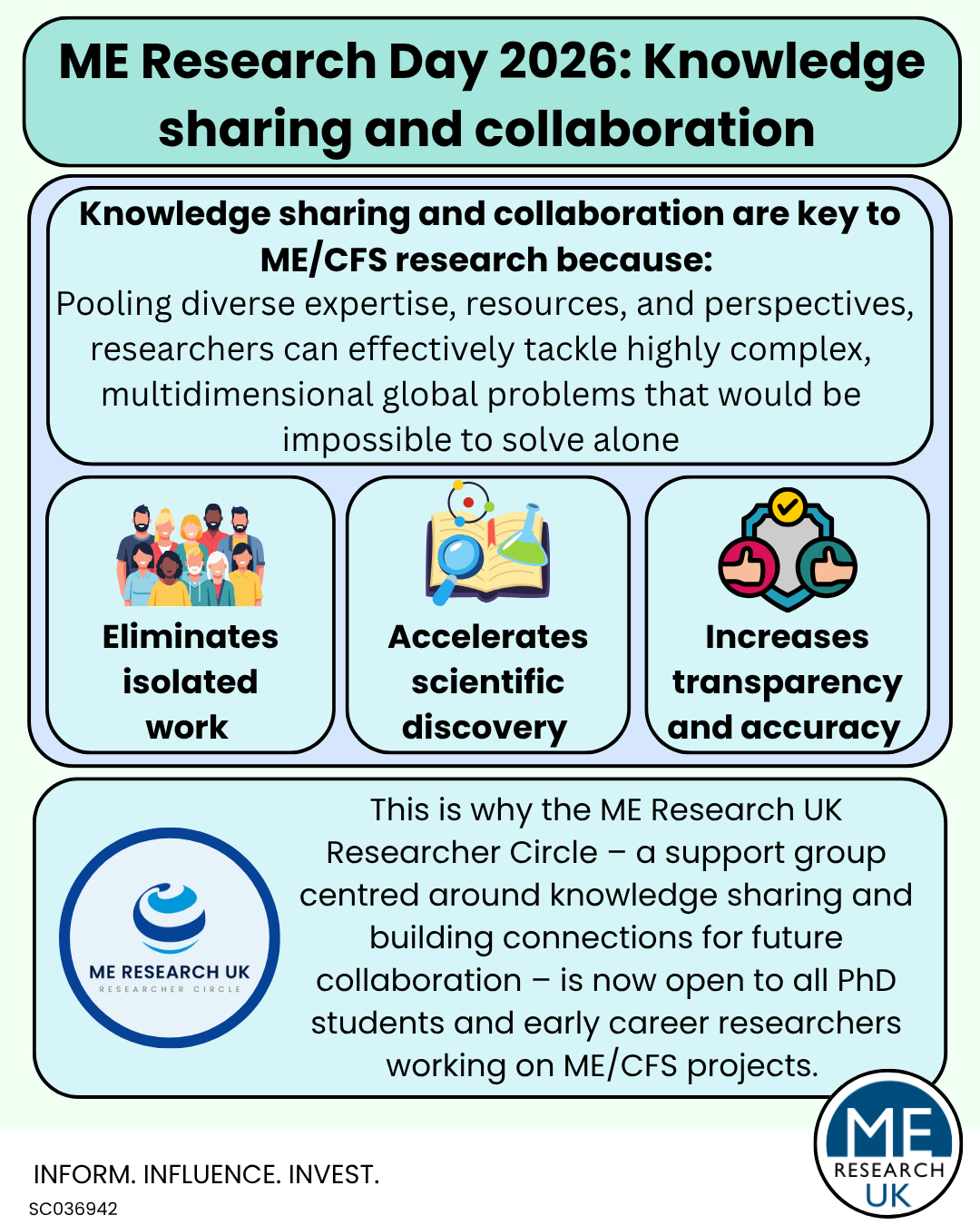
Collaboration and knowledge sharing are vital for accelerating discovery in ME/CFS research. By breaking down information silos—where data or expertise is confined to a particular team or department—these practices can support progress across many areas of research, including understanding disease mechanisms, identifying biomarkers, and developing treatments.
Importantly, knowledge sharing and collaboration also help build a more cohesive and inclusive research culture, in which the lived experiences of people with ME/CFS directly inform research priorities. This can help to ensure that knowledge generated throughout the research process is more readily translated into policy and practice. The active, collaborative process of turning research and evidence into real-world action and policy is known as ‘knowledge mobilisation‘.
The value of knowledge sharing and collaboration was recognised at the 2025 “NIHR/MRC Post-Infection Conditions Research Showcase“, where one of the main aims was:
“Facilitating collaboration and networking between researchers from diverse fields and disciplines, and generating discussion on how to build capacity and galvanise more research activity and collaboration in the field.”
Given these benefits, incorporating collaboration and knowledge-sharing activities into grant applications may help strengthen proposals and improve their chances of securing funding. For example, Professor Simon Carding, who is working on research funded by ME Research UK and recently, as part of a larger team of researchers, secured major Horizon Europe funding for a new international project focused on ME/CFS – DISCOVER – ME, stated:
“The importance of collaboration among international researchers is exemplified by the European ME Research Group (EMERG) comprising an experienced, multidisciplinary consortium of ME/CFS researchers from across Europe that has now been awarded a multi-million Euro grant from the European Commission to undertake the most ambitious and comprehensive mechanistically grounded, and patient-centred investigation of the disease to date.”
Knowledge sharing and collaboration are not only important for the success of research projects and grant applications; they are also valuable within supervision teams and are key skills for early career researchers to develop as they prepare for research careers. This was recognised by Prof. Lode Godderis, who spoke about mentorship, peer learning, and knowledge sharing within ME Research UK-funded research and related activities:
“Interdisciplinary supervision and collaboration across different backgrounds stimulates innovation – exposing researchers to different perspectives consistently improves both the quality and relevance of the research.”
This is why ME Research UK created the Researcher Circle: a support group designed to encourage knowledge sharing and build connections that can lead to future collaboration. Initially established for PhD students working on ME Research UK-funded projects, the Circle is now open to all PhD students and early career researchers working on biomedical ME/CFS projects.
For more information on the Researcher Circle and how to apply click here