What is knowledge sharing?
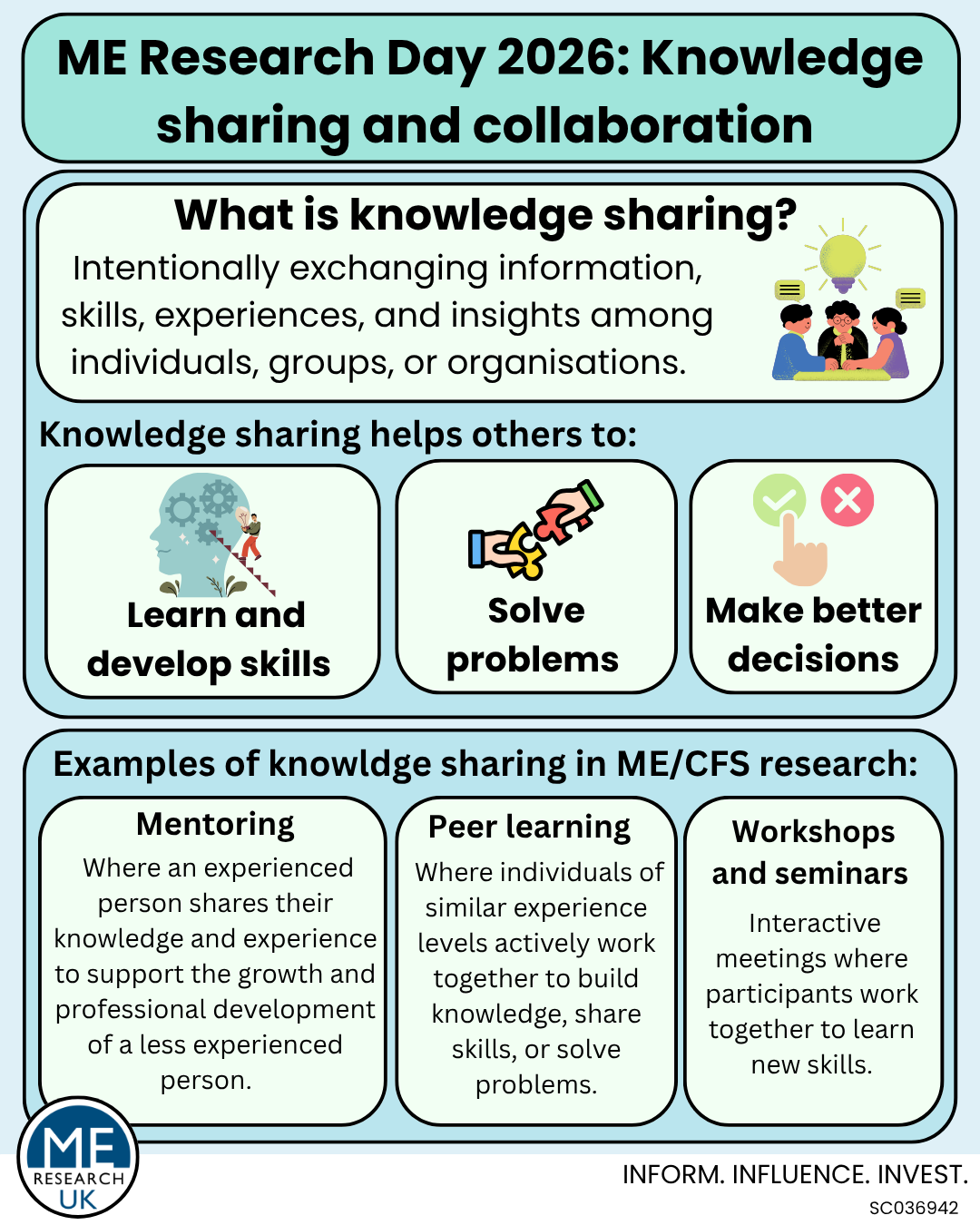
Knowledge sharing is the intentional exchange of information, skills, experiences, and insights among groups, individuals, or organisations.
Knowledge sharing is essential at all stages of research, spanning both career progression—from undergraduate and postgraduate students to PhD candidates, postdoctoral researchers, principal investigators, and professors—and the full scope of a project. This includes idea generation, patient and public involvement (PPI), project design, grant writing, project development, data analysis, interpretation of results, and dissemination.
Types of knowledge sharing
The type of knowledge that can be shared comes in 2 forms:
Explicit knowledge: This is the sort of knowledge that can be documented, and communicated easily through documents and reports.
Tacit knowledge: This is more personal and experience-based knowledge, including (but not limited to) skills and judgement. Tacit knowledge is often shared through direct interaction, mentoring, or guidance that is based on context-specific experience.
Both types of knowledge sharing are invaluable, and lead to benefits such as learning and development of new skills, improved problem solving, and better decision making.
In research, knowledge sharing happens in a number of ways, such as:
- One to one: Where an experienced person shares their knowledge to support the growth and professional development of a less experienced person, often this is known as mentoring.
- Peer learning: where individuals of similar experience levels actively work together to build knowledge, share skills, or solve problems.
- Workshops, group meetings, or seminars: Interactive sessions where participants work together to learn new skills.
It is worth noting that although knowledge sharing can be a formal process it does not always need to be. For example, it could be two colleagues meeting over a coffee for one to share experiences of a particular method or research tool with the other.
What are the benefits of knowledge sharing?
There are many benefits of knowledge sharing in research, these include:
- Increased learning and development: By exchanging practical experiences, insights, and skills, colleagues are able to accelerate skill development and improve knowledge retention.
- Improved problem solving: Combining different perspectives can lead to more creative problem solving.
- Enhanced decision making: Where teams integrate their collective intelligence, rather than relying on individual instincts, decision making is often faster and less biased.
- Challenges assumptions and disrupts ‘fixed thinking’: Knowledge sharing exposes individuals to new data, diverse perspectives, and conflicting evidence, all of which can lead to the disruption of existing thought patterns and learned behaviors. For example; cross-cultural collaborations might reveal that behaviors or communication styles assumed to be universal are actually culturally specific.
- Increased efficiency: Time is often saved as teams are able to learn from each others’ experiences, ensuring that they navigate challenges more effectively and avoid past mistakes.
What challenges may be faced during knowledge sharing?
Similarly to collaboration, there are several challenges associated with knowledge sharing in research, including:
- Time and resource constraints: Time-pressured projects and limited funding can mean that documenting explicit knowledge for sharing in the future is not a priority.
- Information silos: When teams work collaboratively within their own areas but remain disconnected from other teams, knowledge can become isolated. This can make it difficult for others to access information or identify relevant expertise.
- Data overload: Large volumes of poorly organised explicit knowledge can create confusion rather than clarity, making it harder for people to find and use the information they need.
- Knowledge as “power” and lack of trust: In some settings, people may be reluctant to share knowledge if they perceive it as a source of influence, status, or job security. A lack of trust between individuals or teams can further discourage open knowledge-sharing.
- Fear of sharing mistakes: People often share experiences of successes more readily than failures, meaning that valuable lessons learned from mistakes or unsuccessful approaches may remain hidden.
- Technological issues: When digital platforms and systems do not communicate effectively with one another, information sharing can become fragmented, duplicated, or unnecessarily complex.