International Men’s Day 2026: What do we know about the differences between males and females with ME/CFS.
NB: When considering information concerning groups of people with ME/CFS and those with long COVID, it is important to remember that ME/CFS is a symptom-based clinical diagnosis not a mechanistic one. It is clear there is a high degree of shared pathophysiology between ME/CFS and long COVID, and the two diagnostic labels are not mutually exclusive. Importantly, some individuals with long COVID meet ME/CFS diagnostic criteria or could have a dual diagnosis.
For International Men’s Day (IMD) 2026, ME Research UK looks at research published since November 2023 on differences between males and females with ME/CFS. This article builds on our 2023 IMD article, highlighting selected findings rather than providing a full review of the research published during this time.
A note on language: Much of the research discussed here looks at biological sex, or sex recorded at birth, rather than gender identity—how a person describes their gender. Some studies do not clearly distinguish between the two, a problem highlighted at the 2026 ISLC-PAIS conference. Using ‘sex’ and ‘gender’, or ‘male and female’ and ‘men and women’, interchangeably can make findings harder to interpret and compare. In this article, ME Research UK has used terminology in line with those used in the research papers.
Even without illness, there are differences in how male and female bodies work. These differences can help explain why some diseases are more common in one sex and why responses to medicines and treatments can differ.
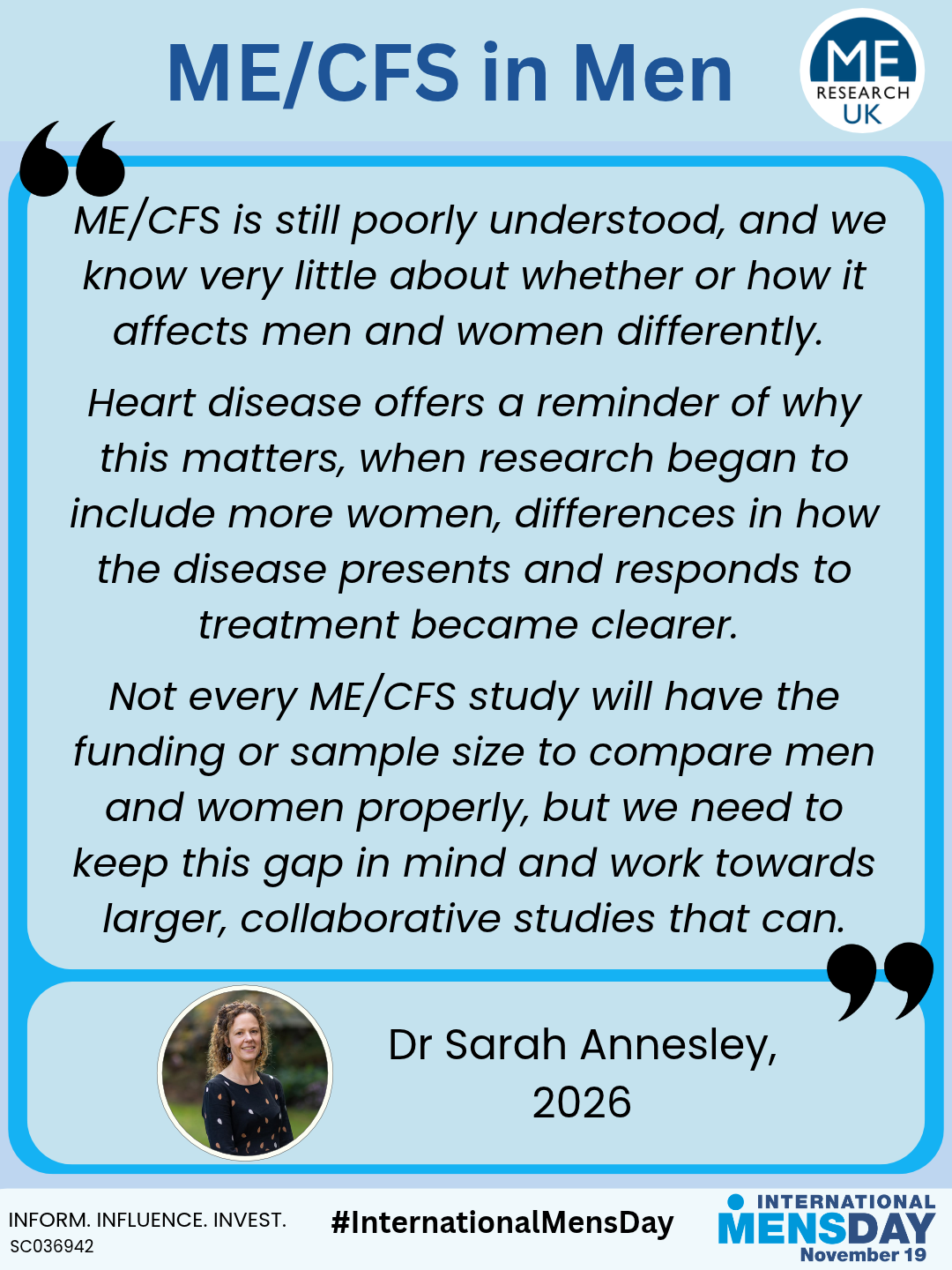
We still know little about differences in males and females with ME/CFS.
The evidence is not strong enough to draw firm conclusions, but studies suggest that males and females with ME/CFS may differ in the following ways:
The prevalence of ME/CFS: Reported ME/CFS rates are lower in men than in women.
When the illness begins: In males, ME/CFS appears to begin most often between the ages of about 10 and 19. In females, there appear to be two age ranges when it most often begins: 10–19 and 30–39.
Symptoms: Some studies have found less severe symptoms in men than in women. However, pressure on men to appear strong may lead some to downplay their symptoms, affecting these findings.
Response to exercise: Men reported slightly less fatigue overall than women. As with other symptom findings, this could reflect differences in the illness, in how symptoms are experienced, or in how they are reported.
Control of automatic body functions: Males had higher heart rate variability—a measure of how much the time between heartbeats changes—than females. This measure gives clues about how the body controls automatic functions, and higher values are generally seen as a sign of better health.
Fats in the blood: Studies have found differences in the types and amounts of blood fats in males and females with ME/CFS. These fats play a part in the body’s immune response and inflammation.
Much more research is needed to understand these differences and what they might mean for diagnosis and treatment.
Research update
Since November 2023, a small number of studies have been published that add to the evidence relating to sex differences in ME/CFS.
Differences identified relate to each of the following – click each heading to learn more
ME Research UK-funded research by Dr Gemma Samms and her supervisor, Prof. Chris Ponting, published in 2025, provided updated estimates of how common ME/CFS is in the UK.
Using hospital records from England, the researchers estimated that 0.25% of men and 0.92% of women in England have a diagnosis of the medical code G93.3 for ‘post-viral fatigue’. According to the researchers, this is the diagnosis with symptoms most closely matching those of ME/CFS.
When the study was published in 2025, the researchers considered what these rates would mean for the UK population of 68.3 million in 2023. They estimated that 83,626 males (0.25% of the 33.450 million UK males) and 320,296 females (0.92% of the 34.815 million UK females) would receive this diagnosis during their lifetime (recorded under G93.3). The estimated total was 403,922 people, or 0.6% of the population.
ME Research UK adds that applying the same rate to the more recent estimate of 34.0 million males in the UK in mid-2025 suggests that around 85,000 men in the UK may now be living with symptoms of the disease.
The study by Samms and Ponting also suggested that some groups are more likely to miss out on a diagnosis than others. The authors concluded:
“Other-than-white ethnic groups, older females (over 60 years), older males (over 80 years), and people living in areas of multiple deprivation are disproportionately undiagnosed with ME/CFS.”
In other words, diagnosis rates may underestimate how many people have the illness, including men from ethnic minority backgrounds and those living in disadvantaged areas. Evidence from studies looking at lived experiences of men with ME/CFS and a paper by Zoe Sirotiak and Emily Thomas also suggests that pressure on men to appear more masculine and strong may play a part:
“Social pressures may contribute to the lower rates of ME/CFS noted among men compared to women” – Sirotiak and Thomas, 2026.
Beyond diagnosis rates, researchers have also explored whether symptom patterns differ. Research by Habermann-Horstmeier and Horstmeier, published since 2023 has suggested that muscle problems may be linked to different symptoms in men and women with ME/CFS:
In men: muscle problems were linked to breathing difficulties and problems controlling body temperature.
In women: muscle problems were linked to all five groups of symptoms studied: breathing difficulties, problems controlling body temperature, flu-like symptoms, heart and circulation problems, and problems with vision.
However, too few people took part in the study to draw firm conclusions, and the authors emphasise that more research is needed.
A July 2026 study, also by Habermann-Horstmeier and Horstmeier, explored how immune-related and gut symptoms clustered in adults with a medical diagnosis of ME/CFS. In women, these symptoms formed two related but partly separate groups; in men, they formed one more closely connected group. Women classified as premenopausal also reported flu-like symptoms more often than those classified as postmenopausal, while gut symptoms and food intolerances were similar between these groups. Notably, the researchers assessed participants at one point in time, and cannot establish how an individual’s symptoms change over time, or link to hormonal events.
Alongside symptoms, studies have examined biological processes that might differ between males and females with ME/CFS. One area of interest is steroid hormones: chemical messengers that include cortisol, produced by the adrenal glands, and sex hormones such as oestrogen and progesterone. They help control many processes that may not work as expected in people with ME/CFS, including:
Small studies suggest that hormone differences between males and females with ME/CFS may go beyond those usually seen in healthy people. For example, research published in May 2024 on steroid hormone changes in ME/CFS found that:
Inmales: Those with mild or moderate ME/CFS had lower levels of cortisol (effects metabolism, blood pressure, inflammation, and sleep) and corticosterone (linked with stress and metabolism), but higher progesterone (in men impact spans multiple systems, including the central nervous, immune, cardiovascular, and renal systems) levels, than healthy males.
Infemales: Those with severe ME/CFS had higher levels of a steroid hormone called 11-deoxycortisol (a pre-curser to cortisol) than both healthy females and those with mild or moderate ME/CFS. They also had higher levels of another steroid hormone, 17α-hydroxyprogesterone (a marker of how active the adrenal glands are), than healthy females. Additionally, females with mild or moderate ME/CFS had higher progesterone (plays a key role in the female reproductive system) levels than healthy females.
An August 2025 paper by Dr Natalie Thomas, Prof. Chris Armstrong and colleagues also examined steroid hormones in ME/CFS. Here, the authors stressed that research needs to consider hormone differences between males and females, including how hormone levels change throughout life. These changes may help explain how ME/CFS develops or affects the body. The team has since proposed a framework to guide hormone research in ME/CFS and long COVID.
Studies have reported differences in metabolism, the set of chemical reactions that keep cells working, including those that release energy, between males and females with ME/CFS.
Our 2023 IMD article highlighted differences in how males and females with ME/CFS process fats. Further evidence has since emerged from research by Dr Natalie Thomas and Prof. Chris Armstrong’s team.
The researchers measured small molecules that cells produce and use, an approach called metabolomics. They found different patterns in energy-related chemicals and blood fats when comparing males and females with ME/CFS with healthy people of the same sex:
In males: The main findings involved lower amounts of cholesterol, a fat molecule that the body needs to function, in certain particles that carry fats through the blood. The findings suggest possible problems with how cholesterol is carried around the body and how some of these particles develop.
In females: Higher levels of alanine, a building block of proteins that is also involved in metabolism, and several fatty acids, together with lower levels of ketones, suggested changes in the fuels used for energy. The authors proposed that females may rely more on protein building blocks for energy, but the study did not directly show this.
Some findings overlapped: Blood sugar was higher in both sexes, and other complex findings indicated that problems with the particles that transport fat molecules around the body may occur in both sexes, but in different ways.
Again, these results need to be interpreted with caution because fewer males than females took part—312 compared with 882. This imbalance may have made any changes present harder to detect in males, even if they occurred in both sexes. In short, a finding that passes a statistical test in females but not in males does not, by itself, show that the sexes truly differ.
A 2025 study by Hofmann and colleagues examined the heart and circulation, along with a blood marker of oxidative stress—potentially harmful chemical changes in the body. It included 70 females and 25 males with ME/CFS, and 27 healthy females and 18 healthy males. The researchers reported different patterns in males and females, especially when standing:
In males: Those with ME/CFS had higher diastolic blood pressure than healthy males, both when sitting and standing. Their average pressure in the arteries was also higher when standing.
In females: Those with ME/CFS had faster heart rates than healthy females, both when sitting and standing. When standing, they also had a lower estimated amount of blood pumped with each heartbeat, including after allowing for body size. Another measure, based on the gap between the upper and lower blood pressure readings, was also lower when standing.
Oxidative stress: Males with ME/CFS had higher blood levels of advanced oxidation protein products, a sign of oxidative stress, than healthy males. The same increase was not found when comparing females with ME/CFS with healthy females.
These results suggest that changes in the heart and circulation may follow different patterns in males and females with ME/CFS. However, the male groups were small. The comparisons were also between people with ME/CFS and healthy people of the same sex, rather than direct tests of differences between the sexes.
Researchers have also looked at gene expression—how cells use the instructions stored in genes. A detailed US National Institutes of Health (NIH) study of ME/CFS, led by Dr Avindra Nath, reported:
Patterns of gene activity in muscle that differed by sex when comparing people with ME/CFS with healthy people.
Patterns that grouped together by sex, with some genes more active and others less active.
Differences linked to sex in genes involved in controlling the immune system, releasing energy from fats, and the work of mitochondria—the parts of cells involved in producing energy.
Both male and female participants with ME/CFS also showed increased oxidative stress. This involves reactive molecules that can damage cells and tissues. However, the affected biological processes differed between the two groups.
A 2026 study by Wallraven and colleagues examined handgrip strength, how quickly muscles tired, and how well strength recovered after a 60-minute rest. Handgrip strength has been described as ‘an irreplaceable indicator of muscle function’.
The study involved 102 people with ‘post-COVID syndrome’ (long COVID), including 25 males and 77 females. Of the 101 participants assessed for ME/CFS, 62 (61.4%) met the diagnostic criteria—the requirements used to identify the illness. However, the exact ME/CFS criteria used do not appear to have been specified.
The researchers looked at whether links between handgrip test results and substances measured in the blood differed between males and females.
They found:
In males: Higher blood levels of ferritin (a protein that stores iron in the blood) were linked to greater average handgrip strength. Higher platelet counts were linked to poorer recovery of strength after rest, although this link became weaker when the researchers took age and sex into account.
In females: Higher levels of anti-S1 IgG—antibodies against part of the virus that causes COVID-19—were linked to lower average handgrip strength. The researchers found no clear links between handgrip results and the blood markers they examined for inflammation or problems with the lining of blood vessels.
Did these links really differ between the sexes? When the researchers directly compared males and females and took age into account, only the link between ferritin and average handgrip strength showed evidence of a difference.
These findings describe links between blood test results and muscle function, and the comparisons included the wider long COVID group, not just people who also met ME/CFS criteria. The authors describe the work as an early investigation, and the small number of males makes the results less certain. As such, larger studies are needed to check and explain the findings.
There has also been research from Maureen Hanson’s team looking at responses to exercise in males and females with ME/CFS. Regrettably, these studies did not directly compare the sexes, rather two separate studies were conducted years apart, meaning that the results cannot be used as a direct comparison of males and females.
The studies discussed above explore symptoms and biological processes in people with ME/CFS. However, due to the lack of evidence, research on immune responses and post-acute infectious syndromes (PAIS)—illnesses that continue after an infection—is also relevant to consider. Here, it is essential to note that findings from this broader research do not necessarily apply directly to ME/CFS. Again, click each of the below headings to read more.
A paper published in April 2026 highlights differences between males and females in how the body responds to infections and vaccines. It also notes differences in the risk of developing a lasting illness after an infection. Like ME Research UK’s 2023 International Men’s Day articles, this paper highlights that the historical underrepresentation of females in research has limited what we know:
“The historical underrepresentation of female individuals in biomedical, clinical and public health research has limited our appreciation of how sex influences disease presentation, progression and treatment responses.”
In a viewpoint article, Julio Silva and Akiko Iwasaki discuss sex differences in illnesses that continue after infection, known PAIS. These include ME/CFS that follows an infection, even if the infection caused no noticeable symptoms. The article reviews existing research rather than reporting a new study.
In the article, the authors describe a contrast: males tend to have more severe illness during the initial viral infection, while lasting illnesses afterwards are more common and severe in females. Estimates support the finding that these lasting illnesses are more common in females. However, as previously noted, pressure to appear masculine may make some men less likely to seek a diagnosis or fully report symptoms.
Silva and Iwasaki go on to explore whether hormones, chromosomes and the immune system could help explain these patterns. Notably, their discussion covers several illnesses, not just ME/CFS. Key points include:
Immune responses: Studies in people with long COVID, and in those with ME/CFS, have found sex differences in immune cells which help defend the body.
Viral reactivation: Some viruses can stay inactive in the body and later become active again, and studies have found that females with ME/CFS had stronger antibody responses to some viral proteins and changes in B cells, another immune cell, linked to the virus becoming active again.
Testosterone: In both males and females with long COVID, lower testosterone was linked to a more active immune system and worse symptoms. Higher levels were linked to fewer symptoms, including less worsening after activity and fewer thinking problems. They were also linked to fewer signs of herpesviruses becoming active again. The authors suggest that hormone levels may matter alongside sex.
X chromosomes: Some genes that help control the immune system are on the X chromosome. In people with two X chromosomes, some of these genes can stay active on both copies, possibly strengthening immune responses. The authors explore whether this, and Xist—a molecule that helps switch off one X chromosome—could play a part in lasting illness after infection. This remains a possible explanation: much of the evidence comes from animal studies and illnesses where the immune system attacks the body, not directly from ME/CFS or long COVID. X chromosomes are something that ME Research UK -funded researcher Dr Alkisti Manousaki is investigating in her project “Investigating the genetic and cellular clues to understand why ME/CFS affects more women than men”.
Taken together, these studies offer useful clues, but several limitations run through the evidence:
Unclear use of terms: Some studies use ‘sex’ and ‘gender’ as though they mean the same thing, or do not clearly explain what they mean. This makes it harder to understand and compare the findings.
Too few participants: Many studies include only small numbers of people, especially males. This makes the findings less certain and means some differences may be missed.
Not the main question: Studies often look at differences between males and females as an extra question, rather than their main aim. The findings therefore need to be checked in studies designed specifically to explore these differences.
Indirect comparisons: Finding a link in one sex but not the other does not, by itself, prove a difference between them. Studies need to test those differences directly.
Although funding opportunities exist, including grants from ME Research UK, overall funding for ME/CFS research – especially that for large scale projects – remains low relative to the burden of the disease, in fact a 2020 study concluded that:
“We find the disease burden of ME/CFS is double that of HIV/AIDS and over half that of breast cancer. We also find that ME/CFS is more underfunded with respect to burden than any disease in NIH’s analysis of funding and disease burden, with ME/CFS receiving roughly 7% of that commensurate with disease burden.”
These limited budgets can restrict how many people a study is able to recruit, leaving too few males or females for reliable comparisons. Including both sexes is therefore not enough: studies need to be designed to test differences between them. Sustained funding and collaboration could help researchers build the larger, more representative studies needed.
Takeaway message
Research published since November 2023 adds to evidence that ME/CFS may affect males and females differently. Studies have reported differences in symptoms, hormones, energy use, the heart and circulation, and gene activity. Alongside these findings, studies on diagnosis and symptom reporting indicate that fewer males are diagnosed with ME/CFS, and pressure to appear masculine or strong may mean that some men are undiagnosed, experience delays in diagnosis, or downplay their symptoms.
Research on long COVID and other lasting illnesses after infection offers further clues about the interplay between hormones and the immune system, but, as not all those with long COVID meet ME/CFS diagnostic criteria, findings are not automatically applicable to those with ME/CFS, and more research is needed.
It is clear that more funding is required for ME/CFS research to enable larger studies to be conducted, designed specifically to compare males and females with ME/CFS. These studies should also consider the impact of intersectionality and ensure representation from underserved groups where possible.
This website uses cookies to improve your experience. Read More about how we use cookies. If you are not happy with us collecting cookies, you can opt out. AcceptReject
Privacy & Cookies policy
Privacy Overview
This website uses cookies to improve your experience while you navigate through the website. Out of these cookies, the cookies that are categorized as necessary are stored on your browser as they are essential for the working of basic functionalities of the website. We also use third-party cookies that help us analyze and understand how you use this website. These cookies will be stored in your browser only with your consent. You also have the option to opt-out of these cookies. But opting out of some of these cookies may have an effect on your browsing experience.
Necessary cookies are absolutely essential for the website to function properly. This category only includes cookies that ensures basic functionalities and security features of the website. These cookies do not store any personal information.
Any cookies that may not be particularly necessary for the website to function and is used specifically to collect user personal data via analytics, ads, other embedded contents are termed as non-necessary cookies. It is mandatory to procure user consent prior to running these cookies on your website.