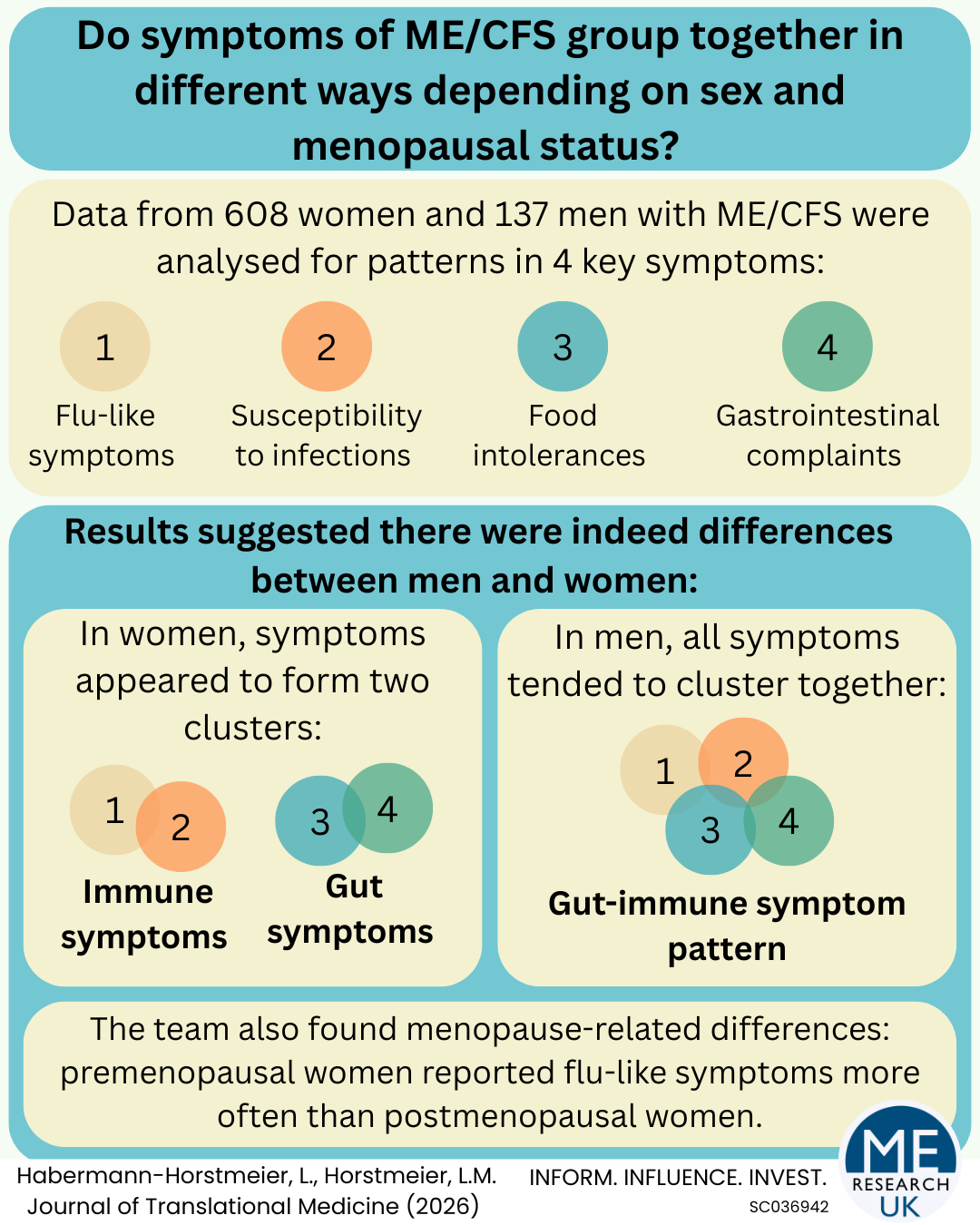
A study, published in the Journal of Translational Medicine, has looked at whether immune-related and gut-related symptoms in people with ME/CFS group together in different ways depending on sex and menopausal status using a dataset from Germany.
The researchers focused on four symptoms:
- Flu-like symptoms
- Susceptibility to infection
- Gastrointestinal complaints
- Food intolerances.
The analysis included information on 608 women and 137 men over the age of 20 years with a medical diagnosis of ME/CFS, although the exact criteria used to diagnose ME/CFS was not clear, the researchers state that
“it can be assumed that the diagnosis was primarily based on the Canadian Consensus Criteria or the International Consensus Criteria, given that these diagnostic methods are widely used in Germany.”
The researchers used complex statistical methods to see whether symptoms clustered together as separate immune and gut patterns, or as one combined immune–gut pattern, and to assess whether these patterns were different in women and men.
In women, immune symptoms and gut symptoms appeared to form two different but related groups. Flu-like symptoms and susceptibility to infections tended to sit together as an immune cluster, while gastrointestinal complaints and food intolerances formed a second gut cluster. This suggests that, for women with ME/CFS, immune and digestive problems may partly follow different underlying patterns.
In men, the same symptoms were more closely linked and appeared to form one combined gut-and-immune symptom pattern. This may mean that, in men with ME/CFS, immune and gastrointestinal symptoms are more tightly connected.
The study also found differences related to menopause. Among women, premenopausal participants reported flu-like symptoms more often than postmenopausal participants, while gut symptoms and food intolerances were more stable across those who were pre- and postmenopausal groups. This suggests that hormonal factors may influence immune-related symptoms more than gut-related symptoms in ME/CFS.
Overall, the findings suggest that ME/CFS symptoms may not be organised in the same way for everyone. Sex and menopausal status may shape how immune and gut symptoms appear and interact. Understanding these differences could help researchers design more targeted studies and may eventually support more personalised approaches to diagnosis, symptom tracking, and treatment.
The study provides useful evidence that immune and gut symptoms may be organised differently in women and men with ME/CFS, and may also vary by menopause status. However, the researchers emphasise that the findings should be interpreted with caution because:
- The number of men with ME/CFS in the study was relatively small.
- The exact ME/CFS diagnostic criteria used were not fully clear.
- Only a limited set of symptoms was analysed.
- The study relied on self-reported data collected at one point in time.
ME Research UK also notes that the analysis only included participants with complete records, excluding anyone missing key variables like age, sex, or diagnosis. While this complete case analysis is a standard approach, it introduces a risk of bias: if the excluded individuals differ systematically from those who remained in the study, the final results could be skewed.