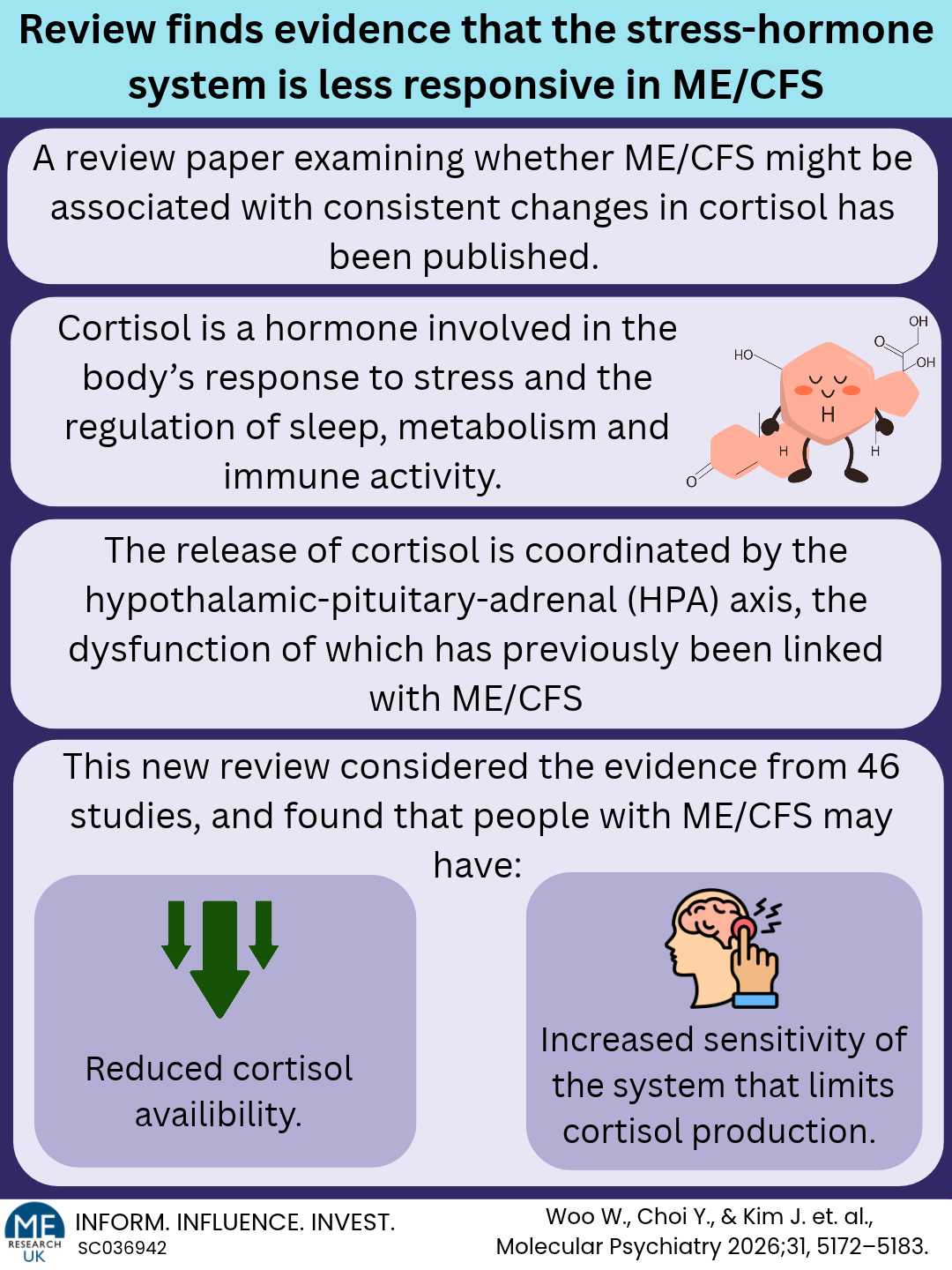
A review paper has been published examining whether ME/CFS might be associated with consistent changes in cortisol—a hormone involved in the body’s response to stress and the regulation of sleep, metabolism and immune activity, all of which have been found to be dysregulated in ME/CFS.
The release of cortisol is coordinated by the hypothalamic-pituitary-adrenal (HPA) axis, the dysfunction of which has previously been linked with ME/CFS. However, previous studies have produced mixed results, partly because cortisol can be measured in different ways and at different times. Therefore, in this review, the researchers aimed to combine evidence from many studies to look for an overall pattern, rather than looking at a measurement at just one point in time.
Notably, this review follows a paper, highlighted by ME Research UK last week, which emphasised not only the role of hormones in ME/CFS, but also proposed a framework for researchers working in this area, including the need to consider hormonal rhythms.
What did the researchers do?
The team carried out a systematic review, a type of study that use repeatable methods to search for, select, and combine all available evidence to answer a specific research question, and meta-analysis, a statistical method that combines the results of multiple independent studies on the same research question to produce a single estimate based on more evidence.
They included 46 case-control studies – a type of study that compares people with a disease or outcome (cases) to similar people without it (controls) to identify factors associated with the condition – covering 1,388 people with ME/CFS and 1,349 healthy comparison participants. Notably, 12 of the studies did ‘challenge tests’, where medicines or hormones were used to test how the body’s stress-response system reacted.
What did they find?
Compared with healthy participants, people with ME/CFS generally had lower cortisol in their saliva when waking and during the morning. Lower levels were also found in 24-hour urine samples and in hair, which can reflect cortisol exposure over a longer period.
Challenge tests the also suggested an altered stress response. Here, people with ME/CFS produced less cortisol after stimulation with ACTH, a hormone that normally tells the adrenal glands to release cortisol. Their cortisol was also suppressed more strongly after receiving a glucocorticoid, suggesting that the system controlling cortisol may be unusually sensitive to signals that turn it down.
What might this mean?
Taken together, these findings suggest that the stress-hormone system may be less responsive, or “hyporeactive,” in ME/CFS. In other words, the body’s hormonal response to, and ability to deal with or regulate, stress may be reduced.
The authors propose two possible features of this altered response: reduced availability of biologically active cortisol and stronger negative feedback—the body’s mechanism for limiting further cortisol production. Together, these changes could contribute to lower circulating cortisol levels in people with ME/CFS, as reported in the studies included in the review.
Such alterations in cortisol regulation could be relevant to symptoms including severe fatigue, unrefreshing sleep, post-exertional malaise (PEM), cognitive difficulties, and impaired recovery from physical or emotional stress. However, these findings do not establish that altered cortisol regulation causes these symptoms.
Notably, prolonged stress—often described as “chronic stress”—has also been associated with both the onset of ME/CFS and the worsening of symptoms. It is worth considering that while chronic stress is often perceived to be caused by life circumstances such as work, moving house, bereavement, or relationship breakdown. However, as Prof. Marshall-Gradisnik — who works on ME Research UK-funded research — explained at the 2025 IACFS/ME conference, ‘stress’ can also be caused when the body is exposed to a wide range of physical and chemical stimuli including (but not limited to) injury, temperature change, infection, chemicals, vibration, and allergens. In short, chronic stress is a prolonged, constant state of feeling overwhelmed and pressured that lasts for weeks or months – but what causes this ‘stress’, is extremely variable.
Overall, the review identifies a possible association between ME/CFS and altered regulation of cortisol and the HPA axis. The evidence should not be interpreted as showing cause and effect, and further research is needed to clarify the biological mechanisms and their clinical significance.
What are the limitations?
The results also varied considerably between the included studies—an issue known as heterogeneity, which is common in ME/CFS research. Potential sources of this variation include differences in the criteria used to diagnose ME/CFS, participant characteristics like age and sex, and illness duration or severity; the type of sample used to measure cortisol, such as saliva, urine or hair; the timing and frequency of sample collection; and differences in study design and laboratory methods. Factors such as sleep patterns, medication use, activity levels and co-existing health conditions may also have influenced cortisol measurements. This heterogeneity means that the pooled findings represent an average pattern across diverse groups and methods, rather than a result that necessarily applies to every person with ME/CFS.
Take-home message
The research included in this review of 46 studies suggests that ME/CFS is associated with a measurable pattern of reduced cortisol availability and increased sensitivity of the system that limits cortisol production. These results indicate that the stress-hormone system may be less responsive, or “hyporeactive,” in people with ME/CFS.
While the findings add to the established evidence base that ME/CFS is a biological disease, they do not yet provide evidence of a causal link, a diagnostic test or establish a treatment. More research is needed to understand biological mechanisms, and to disentangle where a less responsive stress-hormone system may fit into ME/CFS disease pathway(s).
As this review could not look at the results by characteristics such as age sex, ethnicity, length of disease and so on, future research should investigate the impact these characteristics may have on the link between cortisol, the HPA axis and ME/CFS.