
Sleep is essential for restoring and repairing the whole body, including the brain, and for processing memories. The vast majority of people with ME/CFS report having sleep difficulties, and research suggests that poor sleep quality is often associated with reduced quality of life. As sleep disturbances can exacerbate already challenging symptoms of ME/CFS – such as fatigue and cognitive dysfunction – addressing these issues would likely have a positive impact on the quality of life of those affected.
To help you navigate this comprehensive overview, you can jump directly to any of the key sections below:
Contents:
- What is sleep dysfunction?
- Lived experience
- What does the research say?
- Management
- Conclusion
- Sources
What is sleep dysfunction?
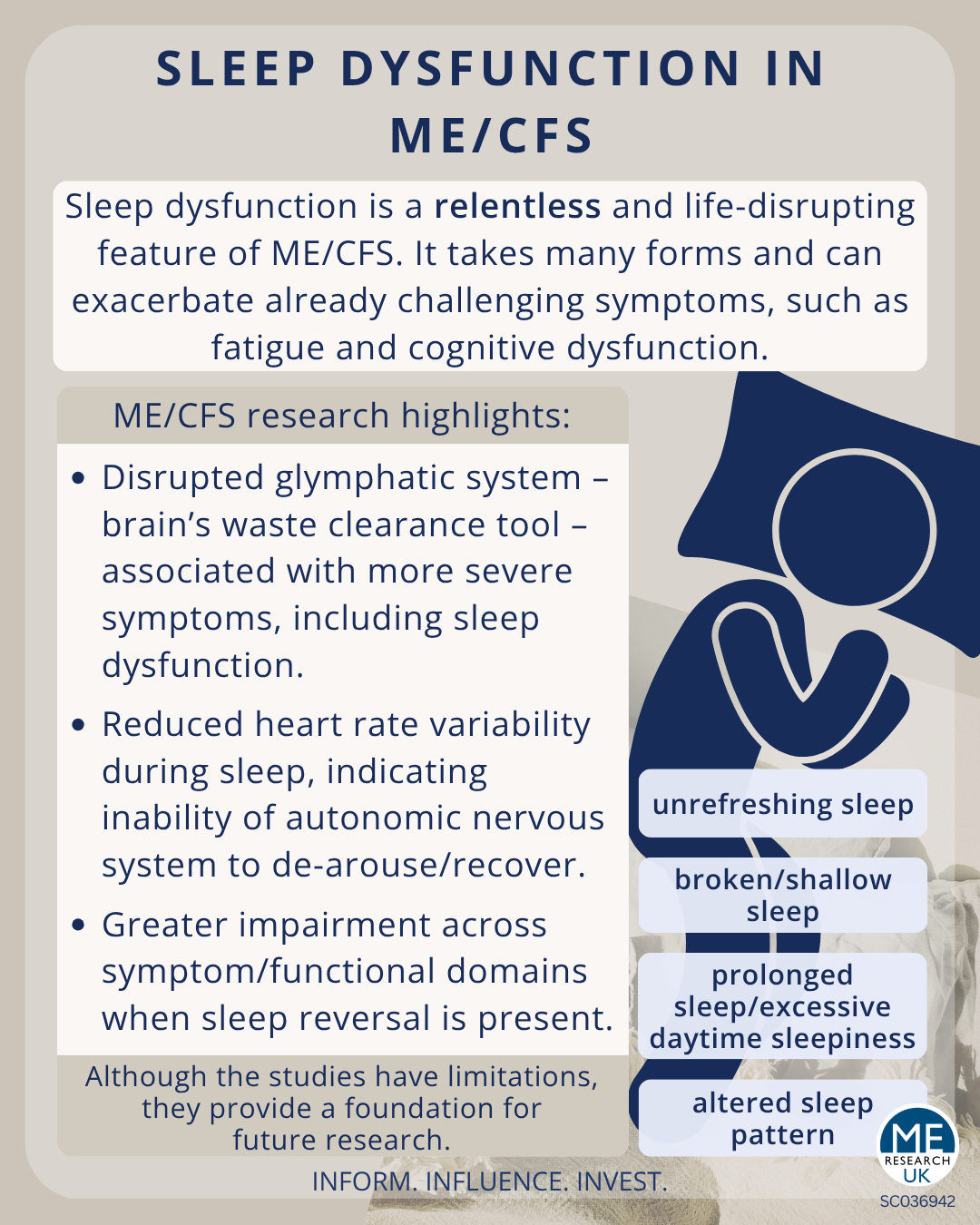
Sleep dysfunction takes many forms in ME/CFS, with each individual experiencing unique challenges. The National Institute for Health and Care Excellence (NICE) specifies within its ME/CFS criteria that unrefreshing sleep (not feeling refreshed or rested even after a full night of sleep) and/or sleep disturbance should be present alongside debilitating fatigue, post-exertional malaise (PEM) and cognitive dysfunction for an ME/CFS diagnosis to be made.
According to NICE, sleep disturbances may include:
- Feeling exhausted, flu-like, and stiff on waking (unrefreshing sleep)
- Broken or shallow sleep
- Altered sleep pattern
- Hypersomnia (prolonged sleeping or excessive daytime sleepiness)
Additionally, the Canadian Consensus Criteria (CCC) references reversed sleep rhythms, essentially where individuals find themselves sleeping more during the day than at night.
Lived experience
The many challenges of living with ME/CFS, including the profound impact of sleep issues, are highlighted in Dialogues for a Neglected Illness – a meticulously researched project supported by the Wellcome Public Engagement Fund (2018–21) and produced by Natalie Boulton with cameraman and editor Josh Biggs. Interviews from the series convey the raw reality of sleep dysfunction:
“… when I wake up in the morning I often feel really at my worst – I feel really ill very often … so it’s my normal symptoms but at their worst so I feel fluey and it does feel how I would imagine being poisoned and it really feels sleeping has done me some harm. It takes me the rest of the day to recover from that feeling” – Grace
“Having done years of night shifts, sleep for me never used to be a problem … I’m not as refreshed in the morning, even after long periods of sleep… and actually I need to rest and sleep during the day … certainly after periods of physical or even brief mental exertion, I have to sleep and rest to try to refresh myself, even though often sleep isn’t refreshing or reviving physically or mentally anymore…” – Ben
What does the research say?
Whilst many studies confirm the presence of sleep dysfunction in ME/CFS, there is comparatively less research into its underlying causes. Nevertheless, research suggests challenges across the brain and nervous system, as well as potential disruptions in the body’s internal clock.
Note: Some of the research on sleep dysfunction has utilised the older Fukuda criteria. Designed to classify chronic fatigue syndrome (CFS), the Fukuda criteria list PEM (the cardinal feature of ME/CFS) as an optional symptom rather than a mandatory requirement – unlike newer criteria, such as the Canadian Consensus Criteria (CCC). Consequently, the research findings summarised below encompass studies referring to both ME/CFS and CFS.
Key areas of research:
Brain differences
Using MRI to study the brains of participants, one study found differences in an area of the brain known as the medial pre-frontal cortex in individuals with CFS compared with controls. Furthermore, they found that the worse the sleep quality reported by people with CFS, the lower the intensity of certain signals. It should be noted that whilst this paper refers to CFS, they selected patients with CCC (a set of ME/CFS criteria requiring PEM). Several of the researchers involved in this study are also involved in ME Research UK-funded projects: Dr Zack Shan is investigating neuroinflammation (inflammation of brain) and lymphatic system in ME/CFS, and Associate Professor Leighton Barnden and Professor Sonya Marshall-Gradisnik – part of the Griffith University team – are investigating brainstem dysfunction in ME/CFS.
Dr Kiran Thapaliya, another researcher in the Griffith University team, led a preliminary ME Research UK-funded study using neuroimaging to explore the glymphatic system in people with ME/CFS. The glymphatic system is responsible for clearing waste products from the brain, similar to the role of the lymphatic system in the rest of the body. Glymphatic dysfunction was demonstrated in the ME/CFS cohort, with poorer glymphatic functioning associated with greater severity of symptoms, including sleep dysfunction and cognitive impairment. Researchers suggest contributing factors include sleep deprivation, reduced physical activity, elevated stress, low omega-3 fatty acid levels, and high blood pressure.
Sleep pattern and quality disruptions
The circadian rhythm is the body’s internal 24-hour cycle that regulates many physiological functions, such as sleep-wake cycle (daily rhythm alternating daytime alertness with nighttime sleep), as well as hormone production and body temperature fluctuations. Research into circadian rhythm disruptions in ME/CFS is limited and inconclusive, as such it is an area requiring further exploration.
- Core clock vs. secondary rhythms: A small exploratory study explored whether individuals with “CFS/ME” had disruptions in their circadian rhythm in rest and activity and distal skin temperature (DST). Using wrist monitors and temperature trackers in both summer and winter, the study did not show any major shifts in the timing of the main 24-hour internal clock, nor did it find differences in how long it took participants to fall asleep or how often they woke up at night. Nevertheless, patients showed differences in 12-hour second harmonic sleep (a secondary internal body clock), including not displaying a clear increase in the post-lunch temperature, unlike controls.
- Sleep efficiency: Contrasting findings from a separate study utilising wrist monitoring devices found that whilst individuals with ME/CFS spent more time in bed, total sleep time did not differ in comparison to matched controls i.e., poorer sleep efficiency. Furthermore, in ME/CFS, sleep efficiency was not only lower on average but highly unstable day-to-day, despite relatively regular sleep timing.
- Cellular signalling: A review paper proposed that in ME/CFS, disruptions in the function of cell signalling molecule, TGF-β, may disrupt physiological rhythms related to sleep, activity, and cognition, resulting in a myriad of issues such as insomnia, cognition problems, depression and autonomic dysfunction. Ultimately, the paper provides a theoretical framework tying in long COVID, stating that SARS-like coronavirus infections cause persistent changes in [TGF-β]. (Note: ME/CFS is a symptom-based clinical diagnosis not a mechanistic one. Importantly, many individuals with long COVID meet ME/CFS diagnostic criteria or have a dual diagnosis.)
- Sleep reversal: Another study investigated sleep reversal (sleep inversion) – where individuals are awake at night and sleep during the day – which affects an estimated 10% of ME/CFS patients reporting sleep difficulties. The study found that individuals with sleep reversal were “more impaired” across nearly all measured functional/symptom domains, identifying them as a particularly severely affected subgroup. Researchers also noted that younger age as one predictor of this pattern and suggested that underlying inflammation may be a major contributing cause.
- Deep sleep: Additionally, one study with 13 pairs of twins demonstrated reduced slow wave activity (reduced deep sleep) in patients with CFS compared with healthy controls following a sleep challenge, in which sleep was delayed by four hours.
Autonomic nervous system dysfunction
Independent research teams in Finland and Australia separately noted reduced nocturnal heart rate variability during sleep in patients with CFS compared with controls. Both groups theorised that an inability of the autonomic nervous system (part of the nervous system which controls heart rate) to de-arouse (calm down) during deeper sleep stages in people with CFS could potentially contribute towards unrefreshing sleep.
It should be noted that whilst the first paper refers to CFS, the team selected patients with the IOM 2015 Criteria (a set of ME/CFS criteria requiring PEM).
Co-occurring sleep disorders
Several studies have pointed to presence of sleep disorders in people with CFS – one such study analysed polysomnography (sleep study) results from 343 patients with CFS and found that 30% of individuals met the diagnostic criteria for sleep apnoea and periodic limb movement disorder.
Limitations of the studies
These findings represent summaries of complex literature, and individual papers should be reviewed in full to assess specific methodological strengths and limitations. Common constraints across the field include small sample sizes, limited sample diversity, a heavy reliance on self-reported data, and a lack of longitudinal follow-up. Collectively, these shortcomings underscore the ongoing necessity for rigorous, comprehensive research into ME/CFS.
Management
NICE guidance recommends that individuals with ME/CFS should be given personalised advice about rest and sleep management strategies. The guideline also mentions that if sleep management techniques do not improve symptoms, the possibility of an underlying sleep disorder or dysfunction should be considered, and also whether a referral to an appropriate specialist is warranted.
However, the guideline committee acknowledged certain limitations, noting that whilst sleep was an area of concern for patients with ME/CFS, “it was hard to be confident in recommending any advice when there was not any evidence and lack of consensus in the area”.
Conclusion
To gain a deeper understanding about sleep dysfunction in ME/CFS, more research is needed. Future studies should be conducted on a larger scale, utilising criteria that mandates the presence of PEM. Actively addressing sleep difficulties and investigating underlying causes is crucial in improving the quality of life of those living with ME/CFS.
This article is part of the Symptom Saturday series
Sources
ME Research UK articles on diagnostic criteria
Brain differences
- Medial prefrontal cortex deficits correlate with unrefreshing sleep in patients with chronic fatigue syndrome (Shan et al., 2017)
Aim: Examine brain structure variations associated with sleep quality in patients with CFS
Number participants in disease cohort: 38
Criteria: Canadian Consensus Criteria (CCC; for ME/CFS) - Disrupted glymphatic function and its relationship with sleep and cognitive impairment in ME/CFS assessed via DTI-ALPS (Thapaliya et al., 2026)
ME Research UK article
Aim: Explore the glymphatic system in people with ME/CFS.
Number participants in disease cohort: 31
Criteria: met either the CCC or the International Consensus Criteria (ICC)
Sleep pattern and quality disruptions
- Circadian rhythm abnormalities and autonomic dysfunction in patients with Chronic Fatigue Syndrome/Myalgic Encephalomyelitis (Cambras et al., 2018)
Aim: Explore circadian rhythm patterns in rest and activity and distal skin temperature (DST) in CFS/ME and their association with self-reported outcome measures patients at two different times of year.
Number participants in disease cohort: 10
Criteria: “met both the 1994 CDC/Fukuda definition and 2003 Canadian criteria” - Sleep in myalgic encephalomyelitis/chronic fatigue syndrome shows marked night‑to‑night fluctuation under free‑living conditions—results from a matched case‑control study (Saurel et al., 2026)
Aim: Characterise sleep, and the intraindividual variability (IIV) of sleep in people living with ME/CFS
Number participants in disease cohort: 38
Criteria: ICC
- Circadian rhythm disruption in Myalgic Encephalomyelitis/Chronic Fatigue Syndrome: Implications for the post-acute sequelae of COVID-19 (McCarthy, 2022)
Aim: Review ME/CFS from the perspective of circadian rhythms, covering both older and newer studies that make use of modern molecular methods. - The Implications and Predictability of Sleep Reversal for People with Myalgic Encephalomyelitis/Chronic Fatigue Syndrome: A Machine Learning Approach (Dietrich et al., 2025)
ME Research UK article
Aim: Explore the symptoms and functional impairment of those with and without sleep reversal by analysing the responses of a large international sample using the DePaul Symptom Questionnaire (DSQ) and Medical Outcomes Study 36-item Short-Form Health Survey (SF-36)
Number participants in disease cohort: “international aggregate dataset of 2313 participants with ME/CFS… composed of data from ten independent samples from six countries”
Criteria: Utilised a mix of physician-confirmed diagnoses, established criteria like the Canadian Consensus Criteria and Fukuda definitions, and social media recruitment, though specific criteria were not always specified - The impact of a 4-hour sleep delay on slow wave activity in twins discordant for chronic fatigue syndrome (Armitage et al., 2007)
Aim: Examine the response to a sleep regulatory challenge in CFS to evaluate the hypothesis that altered amounts of slow wave sleep in CFS could reflect reduced delta electroencephalograph (EEG) activity and impaired sleep regulation.
Number participants in disease cohort: 13
Criteria: “CFS was diagnosed according to the Centers of Disease Control and Prevention criteria” (Fukuda referenced)
Autonomic nervous system dysfunction
- Autonomic Nervous System Functioning Related to Nocturnal Sleep in Patients With Chronic Fatigue Syndrome Compared to Tired Controls (Orjatsalo et al., 2018)
Aim: Study the nocturnal cardiac autonomic nervous system (ANS) in CFS in different sleep stages.
Number participants in disease cohort: 8
Criteria: IOM 2015 criteria (criteria for ME/CFS that requires PEM)
- Parasympathetic activity is reduced during slow-wave sleep, but not resting wakefulness, in patients with chronic fatigue syndrome (Fatt et al., 2020)
Aim: Investigate differences in nocturnal autonomic activity across sleep stages and explored the association of parasympathetic activity with sleep quality and self-reported physical and psychological wellbeing in individuals with CFS.
Number participants in disease cohort: 24
Criteria: Fukuda referenced
Co-occurring sleep disorders
- Are there sleep-specific phenotypes in patients with chronic fatigue syndrome? A cross-sectional polysomnography analysis (Gotts et al., 2013)
Aims: Identify whether sleep-specific phenotypes exist in CFS and explore objective characteristics that could differentiate phenotypes, while also being relevant to routine clinical practice
Number participants in disease cohort: 343
Criteria: Fukuda

