

Post-exertional malaise (PEM), the cardinal feature of ME/CFS, is particularly debilitating as it involves the amplification of existing symptoms, alongside the potential appearance of new ones, following minimal exertion. However, the term “exertion” may be misconstrued, by those unfamiliar with ME/CFS, as activities typically considered high intensity by healthy individuals. Consequently, healthy individuals may inappropriately compare their own experiences – such as delayed onset muscle soreness (DOMS), a normal physiological response occurring a day or two after exercise – to PEM.
To help you navigate this comprehensive overview, you can jump directly to any of the key sections below:
Contents:
What is PEM?
The misconception that PEM is similar to everyday phenomena is addressed by the Bateman Horne Center in their educational video series:
“The word ‘exertion’ may undermine the fact that basic activities such as reading a book, using a computer, engaging in conversation, showering, or even sitting up to eat a meal can be sufficient to trigger an episode of PEM among particularly ill individuals.”
In relation to formal definitions, the authors of the International Consensus Criteria (ICC) for ME contend that the term “malaise” fails to reflect the low threshold for fatiguability and the complexity of post-exertion symptom flares. Hence, the ICC opts to use the term post-exertional neuroimmune exhaustion (PENE).
To fulfil an ME/CFS diagnosis according to the NICE 2021 guidance, PEM must be present alongside debilitating fatigue, cognitive dysfunction, and sleep difficulties (unrefreshing sleep and/or sleep disturbance) for at least three months.
NICE defines PEM as “the worsening of symptoms that can follow minimal cognitive, physical, emotional or social activity, or activity that could previously be tolerated. Symptoms can typically worsen 12 to 48 hours after activity and last for days or even weeks, sometimes leading to a relapse.”
The guideline elaborates that the symptoms of PEM are disproportionate to the activity that triggered them.
Lived experience
Whilst providing part of the framework for an ME/CFS diagnosis, formal definitions often fail to capture the true lived experience of PEM, its nuances and differences from person-to-person, and the devastating impact on daily life.
The many challenges of living with ME/CFS, including the realities of PEM, are highlighted in “Dialogues for a Neglected Illness” – a meticulously researched project supported by the Wellcome Public Engagement Fund (2018–21) and produced by Natalie Boulton alongside cameraman and editor Josh Biggs. Interviews from the series convey the raw reality of PEM through moving accounts:
- “The post-exertional malaise can be caused by me doing physical things like lifting or moving around a lot. And it also can be caused by stress or stimulation – so socialising for too long or being in a particularly stressful situation. Sometimes it can make me feel ill straight away and other times I can feel fine for maybe a day or two afterwards, and then it hits me. And that’s the particularly difficult thing to anticipate.” – Grace
- “Post-exertional malaise I think sounds quite benign as compared to the actual reality of experiencing that. It feels like there is actual poison flowing through my veins, I feel that ill. Terrible pain – for me it’s like a migraine, particularly in the head and neck. Terrible nausea – sometimes I can even vomit with it. Sometimes shaking in my body, and just this overwhelming feeling of illness. Desperate need to lie down to be in complete silence and darkness because any sensory stimulation is just agonising. And a total loss of function on every single level.” – Naomi Whittingham
What does the research say?
Research into post-exertional malaise (PEM) spans multiple physiological systems, aiming to map out its clinical presentation, timing, and underlying biological drivers.
Key areas of research:
Characterising the multi-dimensional nature of PEM
To understand how PEM manifests, researchers have examined its diverse symptom profile both qualitatively (gathering descriptive accounts) and quantitatively (measuring data and numerical patterns).
Qualitatively, a study of 43 people with ME/CFS captured rich personal descriptions of PEM, comparing day-to-day episodes (related to activities such as grocery shopping, conversations, and social interactions) to those triggered by cardiopulmonary exercise testing (CPET). Participants illustrated in stark detail the devastating reality of PEM – describing a profound exhaustion and other debilitating symptoms that completely disrupted everyday life. Whilst exhaustion, cognitive difficulties, and neuromuscular issues were consistently reported, participants also detailed a broad range of manifestations, including sensory sensitivity, feelings of despair, sleep disturbances, headaches, nausea, and sore throats. The study found that whilst PEM symptoms were highly individualised, CPET-induced episodes tended to be more immediate, intense, and longer in duration than daily PEM. These insights could help clinicians understand the daily impact of PEM whilst highlighting considerations for researchers when using exercise testing.
Quantitatively, one study used exploratory factor analysis – a statistical method – to explore whether PEM comprises of distinct components. The findings were that PEM consists of two separate experiences: a General factor and a Muscle factor.
The General factor encompassed 12 symptoms related to a generalised feeling of physical or mental fatigue following exertion, including prolonged worsening of symptoms after physical activity. The Muscle factor was composed of five symptoms related to pain, fatigue, or weakness in muscles following exertion.
Two researchers from this team had also found that individuals with a secondary diagnosis of fibromyalgia alongside “ME and CFS” displayed significantly worse PEM symptomatology and physical functioning compared to those without comorbid fibromyalgia.
Another study, involving 150 individuals with ME/CFS, reflected the multi-dimensional nature of PEM: 90% of participants “experienced PEM with both physical and cognitive exertion and emotional distress”. During PEM, fatigue was the most exacerbated symptom, but over 30% reported other symptoms such as cognitive difficulties, sleep disturbances, headaches, muscle pain, and flu-like feelings. Additionally, other symptoms were also reported including orthostatic (e.g. dizziness) and gastrointestinal issues. Duration of PEM varied, though 84% reported PEM lasting for 24 hours or more. (Note: Although researchers referred to ME/CFS throughout the paper, this specific study utilised the Fukuda criteria.)
Severity and risk factors
In relation to severity, a study found that higher PEM severity scores are more likely amongst individuals who were 32 years of age or older at the onset of ME/CFS, as well as those reporting increased susceptibility to viral infections. Additionally, suffering from a prior gastrointestinal infection was identified as a potential risk factor for worse PEM, though the authors note this involved a small subset of patients, making the association less certain.
Time-to-onset puzzle
In an aforementioned study, earliest time-to-onset of PEM yielded a wide range of responses with many participants reporting it to be possible for PEM symptoms to onset immediately or within a few hours of an inciting trigger.
The Bateman Horne video series on PEM posits an explanation of this study finding – “Despite this response data, clinicians who evaluate and treat those suffering with ME/CFS have almost universally recognized that the payback of PEM is often delayed by 24 to 48 hours from an initial triggering event. It is postulated that this discrepancy in data may arise from patients mistakenly interpreting the immediate worsening of symptoms of ME/CFS as a consequence of orthostatic intolerance, for an actual episode of post-exertional malaise.”
The series further postulates that “many of those suffering with ME/CFS who additionally experience particularly aggressive symptoms of orthostatic intolerance may discover, upon adequate treatment of their orthostatic intolerance, that they are finally able to exceed a threshold by which they exert themselves sufficiently to induce a true episode of post-exertional malaise. In these instances, onset of symptoms of PEM are indeed delayed up to 24 hours after an initial exertional trigger.”
Overlap with long COVID
One study conducted by the Bateman Horne Center exploring questionnaire responses about PEM from 80 participants with long COVID in comparison to 151 participants with ME/CFS, found that all but one long COVID respondent reported experiencing PEM. The onset and duration of PEM were found to be similar in both cohorts, but individuals with long COVID reported more diverse symptoms and triggers.
The authors propose, “PEM symptoms experienced by Long COVID respondents but not in ME/CFS patients may be because ME/CFS patients have been sick longer and are familiar with the activities that trigger PEM.” Additionally, individuals with long COVID employed significantly more PEM recovery strategies.
(Note: ME/CFS is a symptom-based clinical diagnosis not a mechanistic one. Importantly, many individuals with long COVID meet ME/CFS diagnostic criteria or have a dual diagnosis.)
Mitochondria, muscles, and biochemical changes
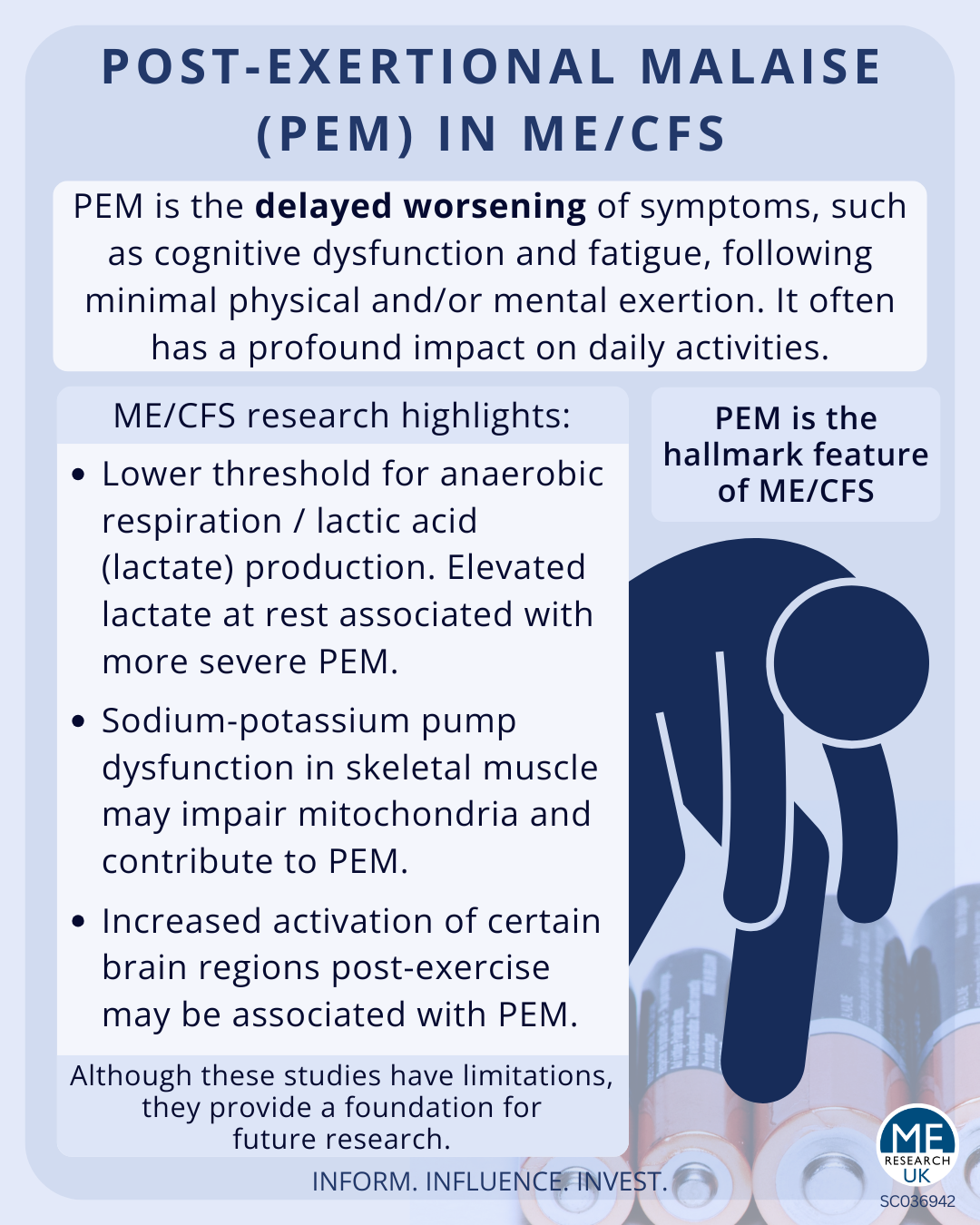
Mitochondria are involved in the normal production of energy by cells through aerobic respiration, a process requiring oxygen. When oxygen delivery is insufficient, cells produce energy outside the mitochondria with lactate (lactic acid) as a byproduct. A retrospective study in patients with ME/CFS, fulfilling the International Consensus Criteria (ICC), found that 44.7% had elevated lactate at rest, with the only significant difference between groups (with and without elevated lactate) being a higher prevalence of severe PEM in the elevated lactate cohort. The authors imply that these findings provide supplementary evidence for mitochondrial dysfunction in some individuals with ME/CFS, adding to the growing body of evidence that ME/CFS is heterogeneous and comprises distinct biological subtypes.
Another study assessed several biochemical changes associated with self-reported PEM in ME/CFS, identifying reduced levels of a substance called hypoxanthine during PEM (suggestive of an anomaly in cellular energy generation) and increased excretion of urine metabolites, suggesting an abnormally high metabolism. The study also highlighted increased muscle component breakdown and potential bacteraemia (bacteria in the bloodstream). Based on these findings, the researchers caution against the use of graded exercise therapy (GET).
A hypothesis and theory paper proposed that muscle weakness in severe ME/CFS may be driven by dysfunction of the sodium-potassium pump in skeletal muscle cells. Furthermore, the authors argue that this could disrupt cellular electrical signalling and cause sodium and calcium overload, which in turn impairs mitochondria, and contributes to the clinical threshold for post-exertional malaise (PEM).
Associate Professor Rob Wüst and his research team, who have an ongoing ME Research UK-funded project, have previously challenged deconditioning as the primary cause of PEM in ME/CFS and long COVID. In another paper, by comparing patients to healthy controls subjected to strict bed rest, they suggest that the physiological impairments associated with ME/CFS are distinct from changes from deconditioning (decline in function from inactivity).
Brain differences
By using MRI scans to visualise the brains of individuals with ME/CFS after exercise, researchers observed increased activity in the medial prefrontal cortex of the brain. Interestingly, the controls exhibited decreased activity in this region. Whilst the study suggests this altered brain activity could serve as a biomarker for PEM, the authors noted that several confounding variables must be controlled before drawing firm conclusions.
Similarly, another study found that individuals with ME/CFS exhibited a greater increase in brain activity (from pre- to post- exercise) compared to controls in regions of the brain known as the cingulate cortices. The researchers postulate that these changes were significantly associated with symptoms of PEM.
Blood vessel dysfunction
One study aimed to investigate whether onset of PEM may worsen arterial function in individuals with ME/CFS compared with controls. Participants undertook a maximal exercise cycle test, and measures of arterial stiffness were taken either 48 or 72 hours later. Unlike the control group, participants with ME/CFS did not exhibit the expected vasodilation (widening of blood vessels) after exercise. The researchers attributed this to low-grade inflammation in blood vessels and increased oxidative stress, which may be exacerbated by exercise and contribute to PEM onset. However, it is worth noting that in relation to PEM the researchers seem to be commenting on associations rather than establishing true cause-and-effect (admittedly this is challenging considering the nature of PEM).
Objective tools for assessing PEM
A meta-analysis explored the background of two-day cardiopulmonary exercise testing (CPET) and its effectiveness as a tool for measuring PEM in ME/CFS. Originally developed to assess how well the body functions during exercise for athletes and individuals with heart, lung, vascular, and metabolic issues, the two-day CPET has gained prominence in ME/CFS research since 2007.
The meta-analysis revealed that individuals with ME/CFS exhibited lower performance metrics and differences related to ventilation, especially on the second day of the two-day exercise test which “may indicate impaired recovery, reduced energy production, and likely PEM in ME/CFS patients”. This led authors to suggest that the two-day CPET could potentially be an objective assessment tool for PEM in ME/CFS.
A separate study tracking 80 ME/CFS participants and 64 controls post-CPET found that whilst recovery times varied widely (ranging from 1 to 64 days), ME/CFS participants took an average of two weeks to recover, compared to just two days for healthy controls.
A review suggested that due to mitochondrial dysfunction and impaired oxygen delivery, individuals with ME/CFS and long COVID rely on anaerobic (without oxygen) respiration – producing excess lactate – at significantly lower levels of activity than healthy controls. The authors discuss whether tracking lactate could help indicate the anaerobic contribution to everyday tasks, helping patients and clinicians fine-tune pacing strategies to prevent PEM. Portable blood lactate monitoring devices are already widely used in professional sports.
Limitations of the studies
It is important to recognise that the findings above represent summaries of complex literature, and individual papers should be reviewed in full to assess their specific strengths and weaknesses. A major hurdle across ME/CFS research is the reliance on retrospective recall, self-reported diagnoses without criteria-based confirmation, small sample sizes, and potential selection biases. Furthermore, there is the ethical challenge of using tests like CPET that deliberately induce PEM. These methodological challenges highlight the complexity of studying ME/CFS and underscore the critical need for larger, more diverse cohorts and rigorous standards in future research.
Management
Pacing
For ME/CFS, NICE recommends personalised energy management techniques (pacing) led by affected individuals with support from healthcare professionals within an ME/CFS specialist team. Pacing is a self-management technique where individuals strike a balance between rest and activity (physical, cognitive, emotional, and social). It is not considered to be curative.
According to NICE, the following factors should be considered as part of an energy management plan:
- Cognitive activity
- Mobility and other physical activity
- Ability to undertake activities of daily living
- Psychological, emotional and social demands, including family and sexual relationships
- Rest and relaxation (both quality and duration)
- Sleep quality and duration
- Effect of environmental factors, including sensory stimulation
The NICE committee states “No drug treatment has been found to be a safe and effective cure for ME/CFS. Pharmacological interventions are however commonly used for symptomatic relief in people with ME/CFS, for example for pain and sleep, even though evidence from clinical trials in ME/CFS may be lacking. Approaches can also be used for co-morbid conditions such as irritable bowel syndrome, migraine-type headaches, postural orthostatic tachycardia syndrome or vitamin D deficiency. Many people report self-medicating with vitamins and supplements.” The guideline does not allude to any specific pharmacological recommendations for PEM.
Orthostatic intolerance
Whilst direct management options for PEM are limited, the scope is broader for orthostatic intolerance (such as PoTS), which seemingly can mimic or overlap with PEM. PoTS management requires a tailored, multifaceted approach, which may include:
- General advice/lifestyle changes, such as avoiding triggers and increasing fluid intake
- Interventions such as wearing compression garments e.g. abdominal binders and stockings
- Medications such as beta-blockers to control heart rate
Note: Because NICE provides no separate clinical guideline for PoTS, the NHS website directs individuals to PoTS UK as a valuable resource based on patient experience and opinion.
Conclusion
PEM, the cardinal feature of ME/CFS, is debilitating and often unpredictable in nature. PEM is particularly devastating as it is an amplification of symptoms that may already be having a profound impact on an individual’s life. It is hard to avoid PEM due to the multitude of triggers that can occur on a daily basis, many of which are difficult to control.
More research is needed into PEM, yet methods of study can present an ethical challenge as CPET can induce PEM. This underscores why fully informed consent and actively listening to participant feedback throughout the research process are so critical.
This article is part of the Symptom Saturday series
Sources
ME Research UK articles on diagnostic criteria
Characterising the multi-dimensional nature of PEM
- Characterization of Post–exertional Malaise in Patients With Myalgic Encephalomyelitis/Chronic Fatigue Syndrome (Stussman et al., 2020)
ME Research UK article
Aim: Explore the impact of exertion on individuals with ME/CFS in their daily lives, in contrast to the impact following cardiopulmonary exercise testing (CPET).
Number participants in disease cohort: 43
Criteria: The study relied on self-reported diagnoses and physician referrals for CPET testing without verifying formal diagnostic criteria - Deconstructing post-exertional malaise: An exploratory factor analysis (McManimen et al., 2016)
Aim: Discern whether PEM is a unified construct or if it is composed of two smaller constructs, muscle fatigue and generalised fatigue.
Number participants in disease cohort: 704
Criteria: The study relied on self-reported diagnoses without verifying formal criteria, instead drawing symptom questions from established frameworks like Ramsay’s clinical description and the ME-ICC - Post-Exertional Malaise in Patients with ME and CFS with Comorbid Fibromyalgia (McManimen & Jason, 2017)
Aim: Determine if the PEM differences seen between patients with and without comorbid fibromyalgia exist for the Muscle or General PEM factors.
Number participants in disease cohort: 701
Criteria: The study relied on self-reported diagnoses without verifying formal criteria, instead drawing symptom questions from established frameworks like Ramsay’s clinical description and the ME-ICC - Deconstructing post-exertional malaise in myalgic encephalomyelitis/ chronic fatigue syndrome: A patient-centered, cross-sectional survey (Chu et al., 2018)
Aim: Describe symptoms associated with and the time course of PEM.
Number participants in disease cohort: 150
Criteria: Fukuda, although they “also inquired about onset and duration of PEM”
Severity and risk factors
- Epidemiological and clinical factors associated with post-exertional malaise severity in patients with myalgic encephalomyelitis/chronic fatigue syndrome (Ghali et al., 2020)
ME Research UK article
Aim: Define possible factors that could be associated with PEM severity.
Number participants in disease cohort: 197
Criteria: International consensus criteria (ICC)
Overlap with long COVID
- Post-exertional malaise among people with long COVID compared to myalgic encephalomyelitis/ chronic fatigue syndrome (ME/CFS) (Vernon et al., 2023)
Aim: Determine if people with long COVID experienced PEM, and if so, how it compared to PEM experienced by patients with ME/CFS.
Number participants in disease cohort: 80 long COVID, 151 ME/CFS
Criteria: “ME/CFS patients were clinically evaluated and met Fukuda research criteria for ME/CFS, the Canadian consensus criteria, and the IOM clinical diagnostic criteria for ME/CFS”
Mitochondria, muscles, and biochemical changes
- Elevated blood lactate in resting conditions correlate with post-exertional malaise severity in patients with Myalgic encephalomyelitis/Chronic fatigue syndrome (Ghali et al., 2019)
Aim: Investigate the frequency of elevated lactate at rest in ME/CFS patients, and comparing characteristics of ME/CFS patients with and without elevated lactate.
Number participants in disease cohort: 123
Criteria: ICC - Post-Exertional Malaise Is Associated with Hypermetabolism, Hypoacetylation and Purine Metabolism Deregulation in ME/CFS Cases (McGregor et al., 2019)
Aim: Assess the changes in biochemistry associated with the cases self-reported PEM scores over a 7-day period and the frequency of reporting over a 12-month period.
Number participants in disease cohort: 47
Criteria: Canadian consensus criteria (CCC) - The potential causes of myasthenia and fasciculations in severely ill ME/CFS patients: the role of disturbed electrophysiology (Wirth & Steinacker, 2026)
ME Research UK article
Aim: Hypothesis and Theory article – explore the causes of skeletal muscle (muscles connected to bone enabling movement) symptoms including, loss of force, fatigue, pain, fasciculations (twitches/tremor) in individuals with severe ME/CFS. - Skeletal muscle adaptations and post-exertional malaise in long COVID (Charlton et al., 2025)
Aim: Opinion article – Synthesise evidence and propose a pathophysiological framework for exercise-induced PEM and skeletal muscle symptoms in long COVID. - Skeletal muscle properties in long COVID and ME/CFS differ from those induced by bed rest (Charlton et al., 2026)
ME research UK article
Aim: Compare whole body exercise responses and skeletal muscle adaptations in patients with long COVID and ME/CFS to those observed following strict 60-day bed rest.
Number participants in disease cohort: 26 ME/CFS, 25 long COVID
Criteria: CCC
Brain differences
- Submaximal Exercise Provokes Increased Activation of the Anterior Default Mode Network During the Resting State as a Biomarker of Postexertional Malaise in Myalgic Encephalomyelitis/Chronic Fatigue Syndrome (Rayhan & Baraniuk, 2021)
Aim: Identify characteristics of PEM in the brain by using functional magnetic resonance imaging (fMRI) to compare brain activity (specifically the Default Mode Network) at rest before and after a two-day submaximal exercise.
Number participants in disease cohort: 34
Criteria: Fukuda and CCC - Neural consequences of post-exertion malaise in Myalgic Encephalomyelitis/Chronic Fatigue Syndrome (Cook et al., 2017)
Aim: Determine the neural consequences of acute exercise using functional brain imaging.
Number participants in disease cohort: 15
Criteria: Required to meet both Fukuda and CCC
Blood vessel dysfunction
- Effects of Post-Exertional Malaise on Markers of Arterial Stiffness in Individuals with Myalgic Encephalomyelitis/Chronic Fatigue Syndrome (Bond et al., 2021)
Aim: Investigate markers of arterial stiffness before a maximal exercise test and again after a 48 or 72 h recovery period to determine whether onset of PEM may worsen arterial function in ME/CFS in comparison to healthy controls.
Number participants in disease cohort: 11
Criteria: ICC
Objective tools for assessing PEM
- The Prospects of the Two-Day Cardiopulmonary Exercise Test (CPET) in ME/CFS Patients: A Meta-Analysis (Lim et al., 2020)
Aim: Evaluate the potential of the two-day cardiopulmonary exercise test (CPET) as an objective assessment tool for PEM in ME/CFS by conducting a systematic review and meta-analysis of existing literature comparing individuals with ME/CFS and healthy controls. - Recovery from Exercise in Persons with Myalgic Encephalomyelitis/Chronic Fatigue Syndrome (ME/CFS) (Moore et al., 2023)
Aim: Characterise the duration and severity of PEM symptoms following two cardiopulmonary exercise tests separated by 24 h (2-day CPET).
Number participants in disease cohort: 80
Criteria: CCC - Attenuating post-exertional malaise in Myalgic encephalomyelitis/chronic fatigue syndrome and long-COVID: Is blood lactate monitoring the answer? (Faghy et al., 2024)
ME Research UK article
Aim: Systematic review – Explore how monitoring lactate levels in the blood may provide a tool to support the management of post exertional malaise.

