The NICE guidelines for diagnosing and managing ME/CFS in England emphasise the importance of personalised care plans tailored to individual symptoms and needs, with key areas highlighted including:
- Early recognition and diagnosis for effective management.
- Implementing strategies to manage energy (pacing).
- Access to specialist support and care.
- Regular monitoring and review of care plans.
However, it is unclear whether the care currently offered, which centres around self-management of the disease, meets the needs of people with ME/CFS.
Therefore, a study, published in the journal BMC Health Services Research, has explored self-management support needs of individuals with ME/CFS in Norway. It is worth noting that although this study is conducted outside of England, the research team cite recommendations made in the NICE guidelines throughout.
What did the team do?
The study took place at a patient education and self-management department in a local hospital in Mid-Norway, which serves about 136,500 people. One-to-one interviews allowed participants to discuss their personal experiences in depth. Group interviews helped the researchers understand experiences shared by people with ME/CFS and their relatives, as well as differences in their views.
Overall, the study included 12 people with ME/CFS and four next of kin. All participants gave written consent, and interview times and locations were arranged around their preferences and needs.
What did they find?
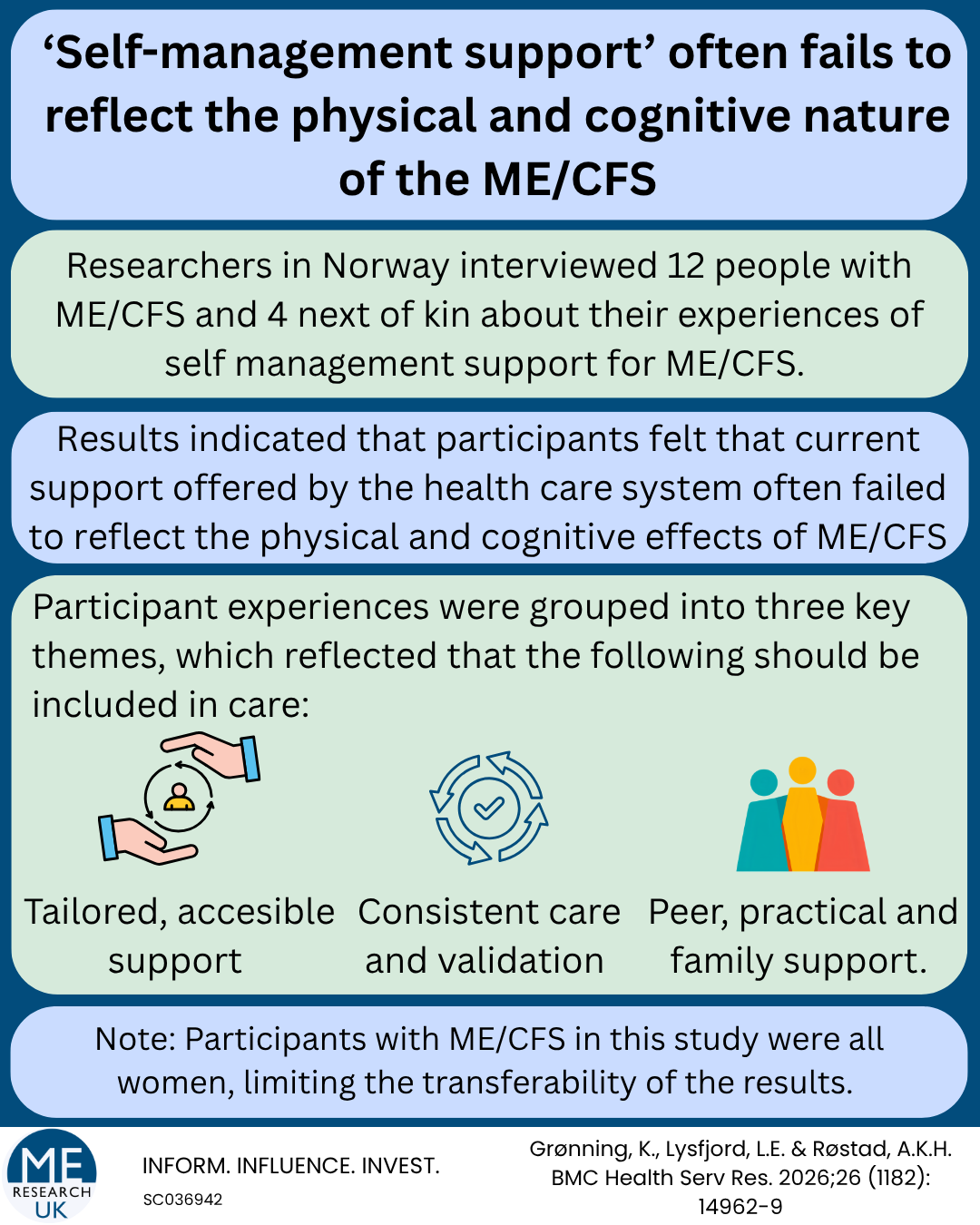
Results indicated that participants felt that current support offered by the health care system often failed to reflect the physical and cognitive effects of ME/CFS.
The researchers grouped participants experiences into three key themes:
Tailored, accessible support.
- Support should be individualised and reflect each person’s symptoms, circumstances, and readiness. For example, the needs of someone who has just received an ME/CFS diagnosis are likely to be very different to those of someone who has lived with the diagnosis for 15 years, equally someone with mild ME/CFS would need a different care plan to someone with very severe symptoms.
- Short modules and flexible digital, in-person or hybrid formats may help people with fluctuating energy and concentration.
Consistent care and validation.
- Participants reported gaps in follow-up, conflicting advice, and experiences of being doubted or dismissed.
- Some positive experiences were also recorded, with participants valuing health care professionals who understood ME/CFS, communicated sensitively and offered clear, continuing guidance.
Peer, practical and family support.
- Peer contact reduced isolation and enabled people to share strategies such as pacing, adapting activities and monitoring symptoms.
- Involving relatives could improve understanding and day-to-day support.
Limitations of the study
- Combining individual and group interviews was both a strength and a limitation of the study. It allowed individual insight to be gathered alongside shared and relational experiences. However, group interview settings influence the information participants are willing to share, doing both individual interview and a group interview increased the research burden on participants, and combining the different types of information was challenging for the researchers themselves.
- All participants with ME/CFS were women meaning that the results may not be generalisable to other gender groups.
- Interviewing those with ME/CFS and their next of kin together may influence the information both parties share with the interviewer.
- The researchers noted that those with severe ME/CFS were less likely to have been included as participants due to the recruitment process.
What is the takeaway message?
The findings suggest that self-management support for people with ME/CFS should be personalised, delivered in manageable stages, and embedded in a consistent care pathway with ongoing review and follow up. Better professional training, sensitive communication and clearer guidance may improve care. Because this small qualitative study was conducted in Norway, its findings provide insight but may not represent everyone with ME/CFS.
ME Research UK notes that more research is needed to assess what self-management support for ME/CFS looks like in other countries including England, and whether what is currently offered meets the needs of those living with the disease, using diverse groups of participants that include underserved populations. It would also be essential to look, as the study in Norway did, at how care could be improved with a view to using this information to develop care programmes that support people with ME/CFS in the best way possible.