

| NB: When considering information concerning groups of people with ME/CFS and those with long COVID, it is important to remember that ME/CFS is a symptom-based clinical diagnosis not a mechanistic one. It is clear there is a high degree of shared pathophysiology between ME/CFS and long COVID, and the two diagnostic labels are not mutually exclusive. Importantly, some individuals with long COVID meet ME/CFS diagnostic criteria or have a dual diagnosis. |
The ISLC-PAIS Conference 2026 – an international, interdisciplinary event on Post-Acute Infection Syndromes (PAIS) and Long COVID – took place in Amsterdam from 26–29 August 2026, and ME Research UK were in attendance in person.
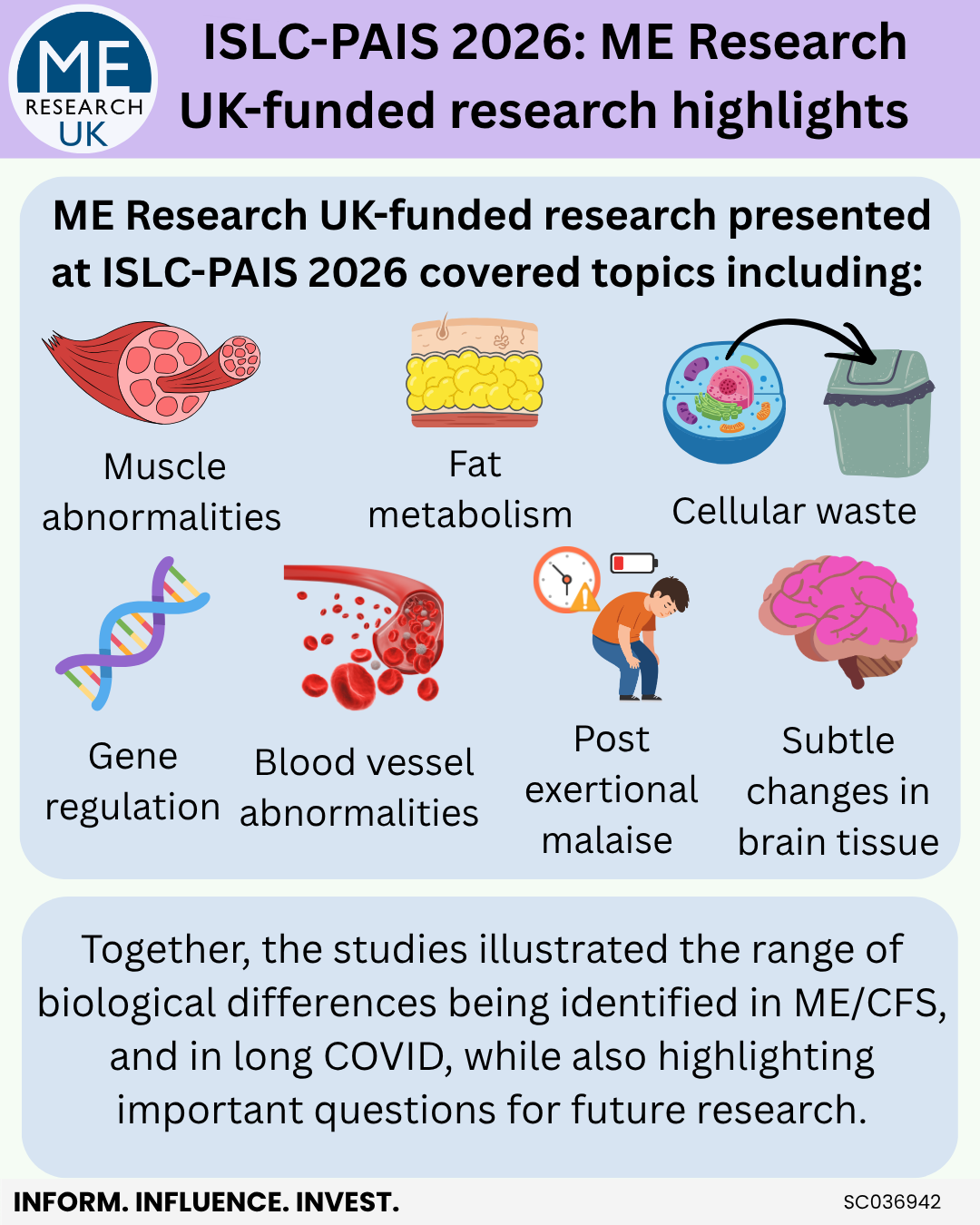
The following will discuss the ME Research UK-funded research projects presented at ISLC-PAIS 2026. Notably, these talks covered topics spanning muscle and blood-vessel abnormalities, post-exertional malaise (PEM), cellular waste, gene regulation, fat metabolism, and subtle changes in brain tissue.
Muscle abnormalities in people with ME/CFS and in those with long COVID
Research from Associate Professor Rob Wüst and his team at Vrije Universiteit Amsterdam highlighted a variety of muscle abnormalities in people with ME/CFS, and in those with LC.
Properties of skeletal muscle
Braeden Charlton presented a study – recently published in the journal ‘nature communications’ – in which the properties of skeletal muscle in people with ME/CFS, and in those with LC, were found to differ from those induced by bed rest.
Braedon explained that the research team compared how exercise affected the muscles of:
- People with long COVID
- People with ME/CFS
- Healthy people who underwent 60 days of complete bed rest.
The findings indicated that while 60 days of bed rest induced severe muscle wastage, known as ‘atrophy’, in healthy controls, this was not seen in people with long COVID or in those with ME/CFS.
Muscle atrophy seen in those who underwent bed rest did not alter muscle fibre type. However, abnormalities could be seen in both those with ME/CFS, and those with long COVID:
- Those with ME/CFS and those with LC had more of the muscle fibres – known as glycolytic fibres – which are for rapid, high-force contractions and rely primarily on a metabolic pathway – anaerobic respiration – that allows cells to produce energy without requiring oxygen.
- Participants with ME/CFS also displayed atrophy specifically in muscle fibres which are endurance oriented, resist fatigue, and rely on energy produced using oxygen (aerobic respiration).
These findings are particularly interesting given that research suggests that the bodies of people with ME/CFS “switch to anaerobic metabolism (less efficient energy production) earlier”, leading to a build-up of the waste product lactate in the blood.
Importantly, in their paper the research team concluded that their results “indicate that physical inactivity alone is insufficient to explain the skeletal muscle changes in patients.”
In this study, although participants were grouped into those with ME/CFS and those with LC, all these participants met diagnostic criteria for ME/CFS. As noted by both Rob Wüst and Braedon Charlton, one possible explanation for the differences observed between the two groups is length of disease – on average, those with LC had been unwell for a shorter duration compared with those in the ME/CFS group.
Muscle abnormalities and PEM
Associate Prof. Wüst then built on the research led by Charlton and presented research relating directly to post exertional malaise (PEM). Although these findings have not been published in full, they provided support for the muscle fibre type shift observed in Braedon Charlton’s work. Rob also reflected on how difficult it is for researchers to capture the full extent of PEM, stating that it is “super difficult to test and control”, in part due to the different ‘flavours’ of PEM trigger, such as emotional, physical, social, and cognitive exertion.
Capillary abnormalities
Another member of Rob’s team, PhD student Anouk Slaghekke, spoke about ME Research UK – funded research which had identified endothelial dysfunction specifically relating to the capillaries within muscle tissue of people with ME/CFS, and those with long COVID. Interestingly, Anouk’s findings suggest that it may not only mean that it is harder for oxygen to reach muscles in people with ME/CFS and in those with long COVID, but that it may be harder for waste products to leave muscle cells.
Accumulation of waste product in muscle cells
Interestingly, this last point was a central theme of Jelle Huijts’ presentation which indicated that there may be cellular waste build up in the skeletal muscle of people with ME/CFS. Jelle specifically spoke about a cellular waste product called lipofuscin, often known as the “wear-and-tear” or “age” pigment as it progressively accumulates inside the cells of living organisms as they age. A build-up of lipofuscin is linked to problems with how cells work. Previous research, although not specifically in people with ME/CFS, has linked it to the incomplete breakdown of damaged mitochondria. Mitochondrial damage has also been identified in people with ME/CFS. This includes the mitochondrial fragmentation found in a ME Research UK-funded project led by Prof. Prusty.
Symptom patterns found to map to DNA methylation in ME/CFS and in Fibromyalgia
Jolien Hendrix, PhD Fellow at Vrije Universiteit Brussel and KU Leuven, Belgium, presented the results from a study that looked at whether ME/CFS and fibromyalgia leave measurable patterns in DNA methylation—chemical “tags” that help regulate how genes are switched on and off. Although not directly funded by ME Research UK, this study used samples obtained during the team’s previous ME Research UK-funded project. The main finding of this new research was that although ME/CFS and fibromyalgia appear to share some biological features, they also have distinct methylation patterns associated with different symptom profiles. The most notable distinction was a methylation pattern associated with ME/CFS’s PEM and cognitive symptoms, alongside another pattern associated with pain and broader multisystem symptom burden in both ME/CFS and fibromyalgia.

Jolien Hendrix, PhD Fellow at Vrije Universiteit Brussel and KU Leuven, Belgium, presenting at ISLC-PAIS 2026
Increased use of fatty acids in people with ME/CFS?
At the conference, Dr Sarah Annesley of La Trobe University in Victoria, Australia, discussed her team’s research, which acknowledges funding from ME Research UK, on cells grown in the laboratory from blood samples donated by people with ME/CFS who met the Canadian Consensus Criteria. The researchers found a build-up of fats in these cells. Dr Annesley said the findings suggest that people with ME/CFS may produce and use more fatty acids than usual, which could mean that the way the body processes fats plays a part in ME/CFS disease mechanisms. The published paper relating to these findings also commented that problems involving immune function and lipid (fat) metabolism may be related.
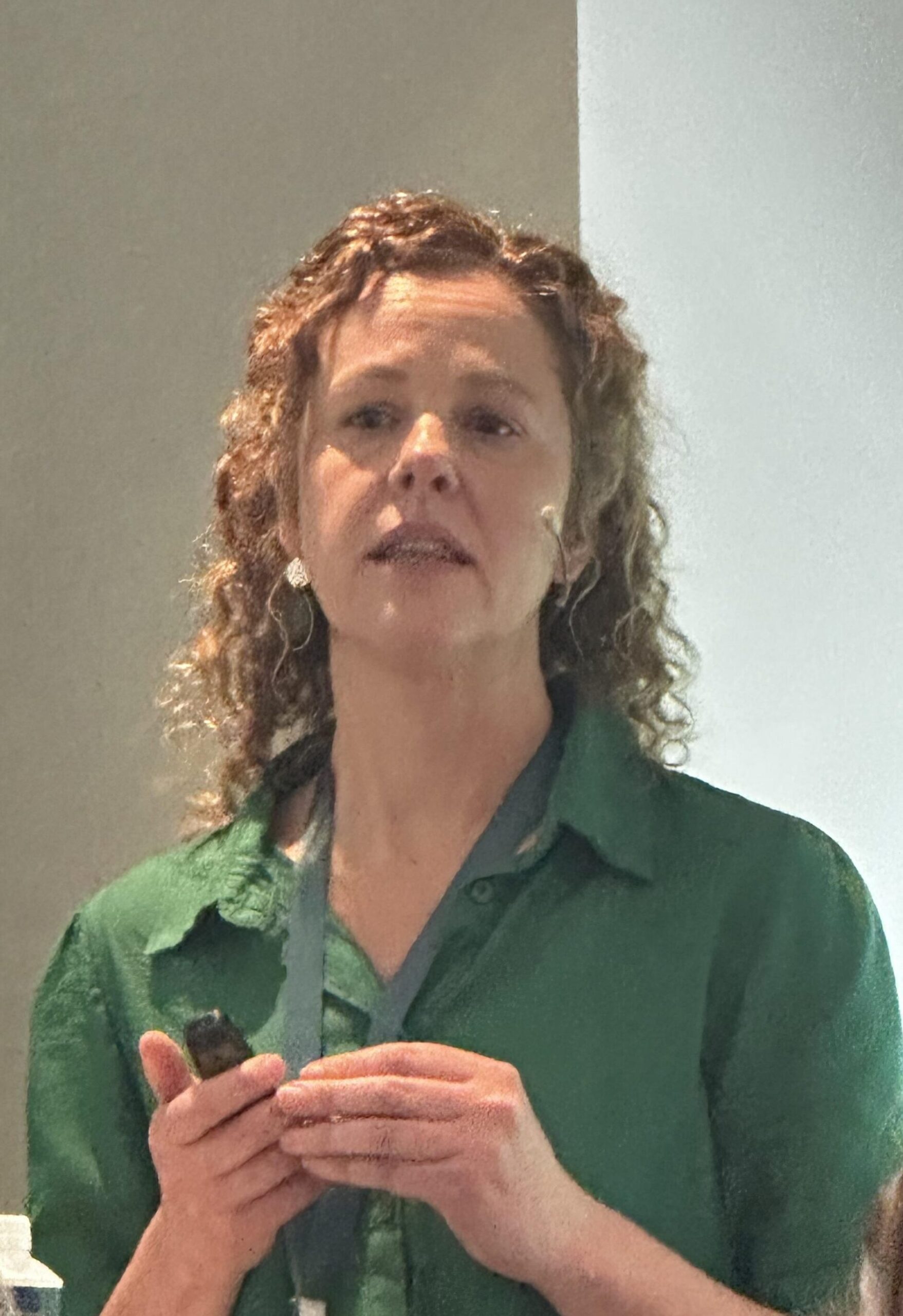
Dr Sarah Annesley, La Trobe University in Victoria, Australia, presenting at ISLC-PAIS 2026
ME/CFS and long COVID may involve subtle changes in the brain’s microstructure
Tanoj Bahadur Singh, PhD level researcher at Griffith University in Australia, presented the results of a study published in the journal “Frontiers in Medicine – Translational Medicine”. The aim of the research was to explore whether people with ME/CFS and those with long COVID have subtle differences in brain tissue. Findings suggest that ME/CFS and long COVID may involve subtle changes in the brain’s microstructure — very small-scale differences in the organisation of brain tissue. Although not able to establish cause and effect, these observations may help explain symptoms such as brain fog, fatigue, pain, sleep problems and post-exertional malaise, and support the idea that ME/CFS and long COVID may share some underlying neurological or biological features. Similarly to the work by Rob Wüst’s team, in this study the participants with ME/CFS had a significantly longer illness duration than those with long COVID, a factor that may limit the comparability of the two groups.
Takeaway message
ME Research UK-funded studies presented at the ISLC-PAIS 2026 conference identified a range of biological differences in ME/CFS, and in long COVID. These included changes in muscle fibres, blood vessels, cellular waste, gene regulation, fat metabolism and brain tissue. Together, the findings build upon existing evidence, and further illustrate that ME/CFS and long COVID are underpinned by complex biological disease mechanisms that cannot be explained by inactivity alone. The researchers also highlighted important questions for future research.
ISLC-PAIS 2026 Part 2: Systems thinking, terminology, and negative trials
ISLC-PAIS 2026 Part 3: What worked well and areas for further consideration

