
Whilst fatigue may be present in other conditions, this does not diminish the debilitating nature of this symptom in ME/CFS. Unfortunately, stigma, dismissive attitudes, and misconceptions around the disease – as acknowledged by the DHSC – mean that the profound impact of symptoms, such as fatigue, is often overlooked.
Compounding this is the fact that the word “fatigue” is often used colloquially by healthy individuals to describe everyday tiredness. As the Centers for Disease Control and Prevention (CDC) notes: “People with ME/CFS have fatigue that is very different from just being tired. The fatigue of ME/CFS can be severe; is not a result of unusually difficult activity; is not relieved by sleep or rest, [and] was not a problem before becoming ill.”
To help you navigate this comprehensive overview, you can jump directly to any of the key sections below:
Contents:
- What is fatigue?
- Lived experience
- What does the research say?
- Diagnostic delays
- Management
- Conclusion
- Sources
What is fatigue?
To fulfil an ME/CFS diagnosis according to NICE 2021 guidance, debilitating fatigue must be present alongside post-exertional malaise (PEM), sleep difficulties (unrefreshing sleep and/or sleep disturbance) and cognitive dysfunction for at least three months.
According to NICE, fatigue in ME/CFS typically has the following features:
- Feeling flu-like, especially in the early days of the illness
- Restlessness or feeling “wired but tired”
- Low energy or a lack of physical energy to start or finish activities of daily living and the sensation of being ‘physically drained’
- Cognitive fatigue that worsens existing difficulties
- Rapid loss of muscle strength or stamina after starting an activity, causing for example, sudden weakness, clumsiness, lack of coordination, and being unable to repeat physical effort consistently
The International Consensus Criteria (ICC) for ME notably excludes “fatigue” as a standalone category, likely to distance itself from the broad, colloquial use of the word “fatigue” and its potential to undermine a diagnosis. Nevertheless, fatigue is incorporated into the post-exertional neuroimmune exhaustion (PENE) category which refers to physical and mental fatiguability.
Ultimately, fatigue in ME/CFS impacts every aspect of life, resulting in significant reductions in previous levels of occupational, educational, social, and personal activity.
Lived experience
Clinical descriptions only capture part of the reality. The daily experience of fatigue is best understood through the words of those who live with it:
“The most severe symptom that I have experienced daily has been unrelenting exhaustion. I often describe it as having a battery that is at a maximum of 10% full, draining quickly. Once the battery is drained, I cannot charge it.” – Zoe Sirotiak
Journalist and author, Ed Yong mentions in a podcast episode: “I have experienced fatigue before—you know, I have done all-nighters, I’ve done long workouts, I’ve been jet-lagged. It’s really nothing like what the people I’ve interviewed have experienced. So, baseline, people with long COVID and ME/CFS experience a fatigue that is much more severe. They feel leaden, they feel weighed down, as if they’ve got weights on all of their joints.”
What does the research say?
Much of the existing research pertaining to fatigue in the condition relies on the previously prominent Fukuda criteria. Designed to classify chronic fatigue syndrome (CFS), these older criteria mention post-exertional malaise (PEM) but do not mandate its presence for diagnosis. Even though PEM is now understood as the defining feature of ME/CFS, reviewing this older research still holds value as long as this limitation is acknowledged.
Key areas of research:
Autonomic nervous system dysfunction
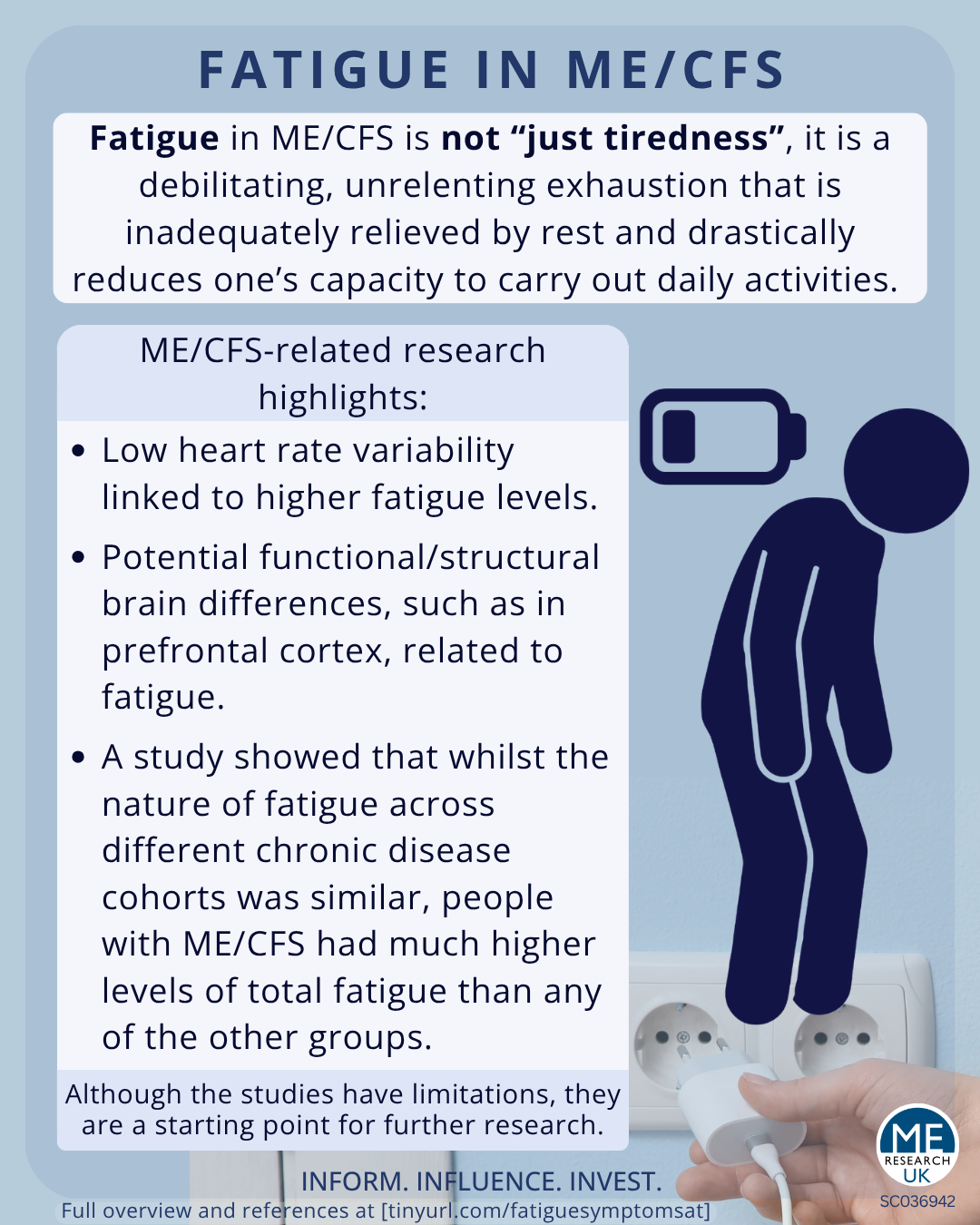
One study found that problems with the autonomic nervous system – the part of the nervous system which controls heart rate – may contribute to the severity of fatigue in individuals with CFS. Specifically, low heart rate variability (HRV) was generally linked to higher fatigue levels, implying that HRV analysis could be a clinically useful tool for predicting fatigue severity.
Brain differences
Using magnetic resonance imaging (MRI), researchers found that individuals with CFS displayed reduced activity in an area of the brain known as the basal ganglia during reward-related tasks, a reduction associated with their fatigue symptoms. Another study suggested a link between a reduced volume of an area of the frontal lobe of the brain (dorsolateral prefrontal cortex) and greater fatigue severity.
Genetic variations
A systematic analysis of 50 research papers found that specific genetic variations related to immune and brain pathways are linked to higher levels of CFS-related fatigue, cancer-related fatigue, and other disease-related fatigue.
Gut microbiome differences
The microbiome refers to the collection of roughly 100 trillion microorganisms – including bacteria, fungi, and viruses – that live on and inside the human body. Many of these bacteria are beneficial and essential to survival, making the balance of bacteria in the gut crucial.
A study revealed several differences in the gut microbiome between individuals with ME/CFS and healthy controls, a finding that corroborates other research. Most relevant to this topic, the abundance of the bacterium F. prausnitzii appeared to be inversely associated with the severity of fatigue experienced by individuals with ME/CFS.
Furthermore, a review, acknowledging that fatigue is a multifactorial symptom, examined the role of the gut microbiome in fatigue across a range of physiological and pathological conditions, including ME/CFS and long COVID. The authors proposed that fatigue may be linked to alterations in the gut microbiome, including reduced abundance of butyrate-producing bacteria, impaired gut barrier function, chronic low-grade inflammation, and metabolic disturbances although causal relationships remain unproven. The review also highlighted the potential of dietary interventions, such as dietary fibre, fermented foods, and prebiotics, to support gut microbiome, whilst emphasising that these approaches should be presented as supportive strategies rather than disease treatments.
Supplementation
A systematic review assessed 14 studies exploring dietary supplementation in ME/CFS. The researchers found that whilst some interventions, such as oxaloacetate, NADH and CoQ10 combinations, demonstrated significant reductions in fatigue, methodological limitations like small sample sizes and missing data, prevented firm conclusions. Furthermore, results for secondary outcomes, such as cognitive function and inflammatory markers, were mixed, and six studies noted adverse effects including nausea and insomnia.
Distinguishing ME/CFS from other diagnoses
Proper diagnostic differentiation is critical. One paper highlights the importance of the presence of PEM in ME/CFS to distinguish it from conditions with overlapping symptoms and where fatigue is common such as thyroid disorders, autoimmune diseases, psychological conditions, neurodegenerative diseases, and infections. Although, it is important to note that ME/CFS is currently a diagnosis of exclusion and tests may be available for other conditions, and furthermore it is possible for individuals with ME/CFS to have addition fatiguing conditions as comorbidities.
Interestingly, an ME Research UK-funded study compared fatigue across five chronic disease groups, including ME/CFS. Whilst the intrinsic nature of fatigue was similar across all groups – suggesting that symptoms like fatigue arises from generic disease processes shared by chronic illnesses – people with ME/CFS experienced significantly higher levels of total fatigue than any other group.
A paper comparing case definitions for ME/CFS, states that “given the absence of biomarkers for diagnosis, ME/CFS is defined by a combination of symptoms, most of which are non-specific and common to a number of diseases and conditions.” These findings highlight why it is important to identify the cardinal feature – PEM – in addition to fatigue and other symptoms, to distinguish ME/CFS from other diseases/conditions.
Limitations of the studies
Many studies have small sample sizes, which could lead to skewed results that do not accurately represent a larger population. Hence, more research needs to be done about the underlying causes of fatigue in ME/CFS going forward. Furthermore, fatigue is not a one-size-fits-all experience; it is deeply subjective and shaped by a complex interplay of physical, psychological, and environmental factors.
Diagnostic delays
Within its 2021 guidance, NICE notes that “People with the condition report delays in diagnosis, and many healthcare professionals lack the confidence and knowledge to recognise, diagnose and manage it. Fatigue associated with another chronic disease may be confused with ME/CFS and some practitioners are reluctant to positively diagnose ME/CFS when no other causes are found.” This makes it all the more imperative that healthcare practitioners are adequately educated about the accurate diagnosis and management of ME/CFS, as alluded to in the DHSC delivery plan.
Management
Related to fatigue and PEM, NICE recommends personalised energy management techniques – commonly known as pacing – led by the affected individual with support from an ME/CFS specialist team. Pacing is a self-management technique where individuals strike a balance between rest and activity (physical, cognitive, emotional and social). It is not considered to be curative.
Currently, NICE has not approved any medications specifically for treating ME/CFS-related fatigue. However, it is important to treat any comorbidities that could be contributing towards the overall burden of disease.
Conclusion
Fatigue is a devastating yet highly stigmatised symptom of ME/CFS. As fatigue is a prominent feature of many other conditions and a commonly used word, the impact of this symptom on individuals with ME/CFS is frequently downplayed. Fatigue is not simply tiredness, it is a debilitating symptom that is not relieved by rest and drastically reduces one’s capacity to carry out daily activities.
This article is part of the Symptom Saturday series
Sources
ME Research UK articles on diagnostic criteria
Autonomic nervous system dysfunction
- Reduced heart rate variability predicts fatigue severity in individuals with chronic fatigue syndrome/myalgic encephalomyelitis (Escorihuela et al., 2020)
Aims: Assess Heart rate variability (HRV) parameters as potential biomarker in CFS/ME and the relationship between HRV indices and self-reported symptoms in individuals with CFS/ME.
Number participants in disease cohort: 45
Criteria: 1994 CDC/Fukuda definition
Brain differences
- Decreased Basal Ganglia Activation in Subjects with Chronic Fatigue Syndrome: Association with Symptoms of Fatigue (Miller et al., 2014)
Aim: Explore basal ganglia function in patients with CFS and its relationship with CFS-related symptoms – fMRI study
Number participants in disease cohort: 18
Criteria: 1994 CDC criteria (Fukuda criteria)
- Mechanisms underlying fatigue: a voxel-based morphometric study of chronic fatigue syndrome (Okada et al., 2004)
Aim: Explore with MRI whether there are anatomical abnormalities that correlate with the severity of fatigue.
Number participants in disease cohort: 16
Criteria: Likely Fukuda
Genetic variations
- A systematic review of the association between fatigue and genetic polymorphisms (Wang et al., 2017)
Aim: association of SNPs with fatigue in various patient populations
Number of papers included in review: 50
Gut microbiome differences
- Deficient butyrate-producing capacity in the gut microbiome is associated with bacterial network disturbances and fatigue symptoms in ME/CFS (Guo et al., 2023)
ME Research UK summary article
Aim: Multi-omic analysis of a geographically diverse cohort to assess gut dysbiosis.
Number participants in disease cohort: 106
Criteria: 1994 CDC (Fukuda) and the 2003 Canadian Consensus criteria
- Gut microbiome-immune-metabolic axis in fatigue: mechanistic insights and food science approaches (Kim et al., 2026)
Aim: Summarise clinical and mechanistic evidence connecting gut microbiome alterations with fatigue-related phenotypes, focusing on myalgic encephalomyelitis/chronic fatigue syndrome, post-acute COVID-19 syndrome, general adult fatigue, and exercise-induced fatigue.
Supplementation
- Dietary Supplementation for Fatigue Symptoms in Myalgic Encephalomyelitis/Chronic Fatigue Syndrome (ME/CFS)—A Systematic Review (Dorczok et al., 2025)
Aim: Provide an updated synthesis of the efficacy of dietary supplementation interventions in ME/CFS and explore possible mechanisms underlying their therapeutic effects.
Number of studies in review: 15
Criteria: “All studies used the 1994 CDC Fukuda criteria”
Distinguishing ME/CFS from other diagnoses
- European Network on Myalgic Encephalomyelitis/Chronic Fatigue Syndrome (EUROMENE): Expert Consensus on the Diagnosis, Service Provision, and Care of People with ME/CFS in Europe (Nacul et al., 2021)
Aim: Assess the existing knowledge and experience on health care delivery for people with ME/CFS in European countries, and to enhance coordinated research and health care provision in this field.
- Perceived fatigue is comparable between different disease groups (Jones et al., 2009)
ME Research UK summary article
Aim: examine descriptions of fatigue by patients with a range of chronic diseases and determine the relationship between symptom domains.
- Differing case definitions point to the need for an accurate diagnosis of myalgic encephalomyelitis/chronic fatigue syndrome (Nacul et al., 2017)
Aim: Compare case definitions for ME/CFS