

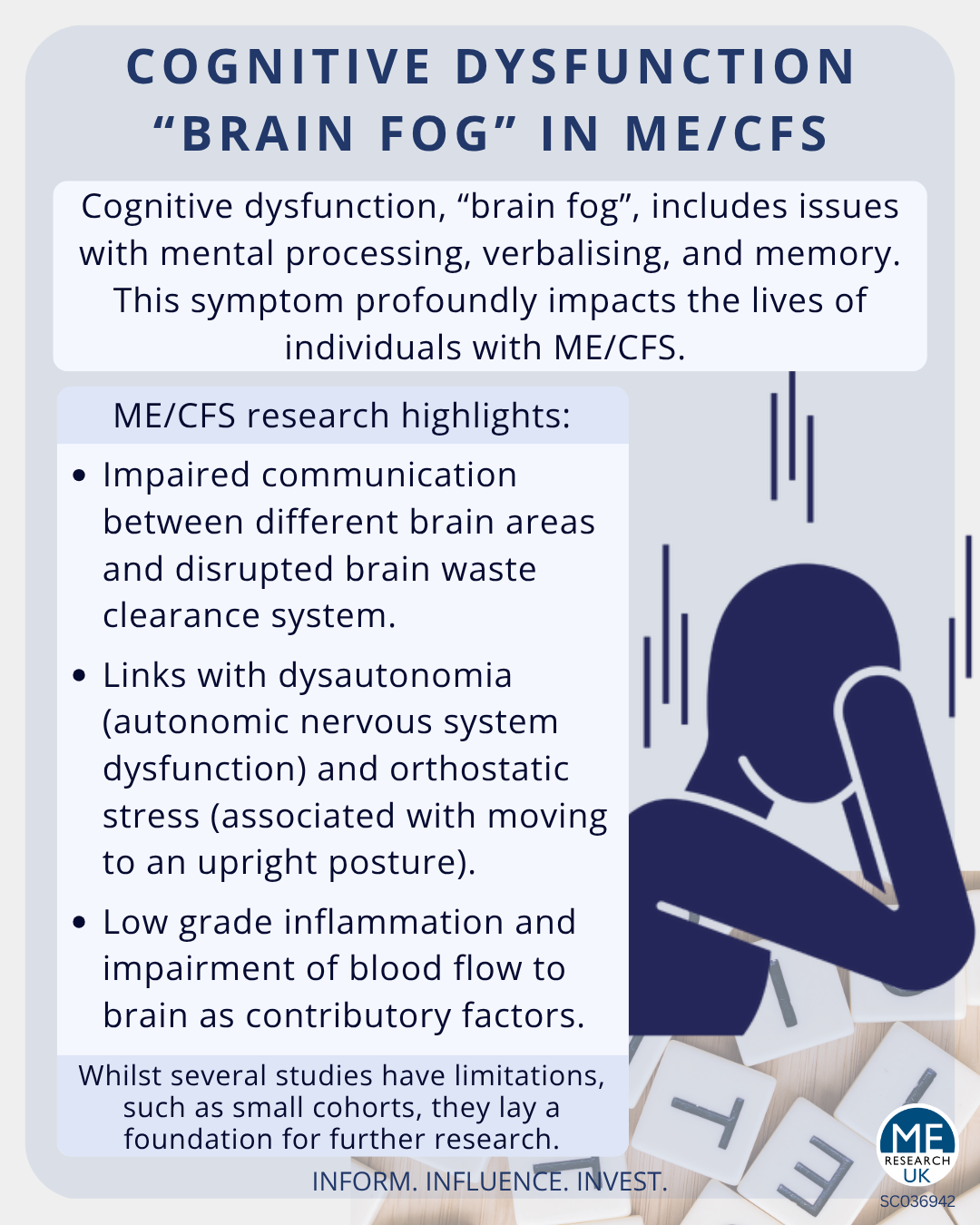
Cognitive dysfunction, often referred to as “brain fog”, is a complex and distressing core symptom of ME/CFS that encompasses issues with mentally processing, verbalising, and remembering information. The experience of cognitive dysfunction cannot be equated to the occasional forgetfulness and lapses in concentration experienced by healthy individuals. Rather, cognitive impairments in ME/CFS can fluctuate between being a source of incredible frustration to profoundly impacting activities of daily living.
To help you navigate this comprehensive overview, you can jump directly to any of the key sections below:
Contents:
- What is cognitive dysfunction?
- Lived experience
- What does the research say?
- Management
- Conclusion
- Sources
What is cognitive dysfunction?
To fulfil an ME/CFS diagnosis according to NICE 2021 guidance, cognitive dysfunction must be present alongside debilitating fatigue, post-exertional malaise (PEM), and sleep difficulties, for at least three months.
According to NICE, cognitive difficulties may include:
- Problems with finding words or numbers
- Difficulty in speaking
- Slowed responsiveness
- Short-term memory problems
- Difficulty concentrating or multitasking
NICE also acknowledges that people with ME/CFS are rarely seen at their worst for two key reasons. First, debilitating symptoms or the risk of worsening condition often prevent individuals from leaving their homes. Second, cognitive difficulties often mean “people wait until they feel they can speak and explain clearly before contacting services.”
Lived experience
The many challenges of living with ME/CFS, including the profound impact of cognitive impairment, are highlighted in “‘Dialogues for a Neglected Illness” – a meticulously researched project supported by the Wellcome Public Engagement Fund (2018–21) and produced by Natalie Boulton with cameraman and editor Josh Biggs.
Accounts from the video series capture the heavy toll of these symptoms, such as:
“I couldn’t do anything at all cognitively, just thinking even basic sentences with a yes or no answer is too difficult. Once it was a bit better, I would spend an awful lot of time where I just didn’t really think; I could just stare into space for hours because…I got very easily overloaded by things.
…It’s the spectrum. Everyone forgets some words. Everybody sometimes goes into a room, can’t remember what they went in for. It’s when you are doing it constantly and you do it over and over again in the same instance.” – Anna
What does the research say?
Research into the cognitive dysfunction related to the condition spans multiple domains – highlighting how challenges such as autonomic dysfunction, impaired cerebral blood flow, and brain inflammation potentially contribute to this devastating symptom.
Note: Some of the research on cognitive dysfunction has utilised the older Fukuda criteria. Designed to classify chronic fatigue syndrome (CFS), the Fukuda criteria list PEM (the cardinal feature of ME/CFS) as an optional symptom rather than a mandatory requirement – unlike newer criteria, such as the Canadian Consensus Criteria. Consequently, the research findings summarised below encompass studies referring to both ME/CFS and CFS.
Key areas of research:
Brain structure and function
In an ME Research UK-funded study, detailed magnetic resonance imaging (MRI) scans were used to investigate communication between different areas of the brain – or functional connectivity – in people with ME/CFS. Functional connectivity was impaired between areas of the brain involved in cognitive function, as well as movement, sensory processing, the sleep-wake cycle, self-awareness and autonomic responses.
The same research group used MRI to assess the functioning of the glymphatic system, which is responsible for clearing waste from the brain, much like the lymphatic system does for the rest of the body. Glymphatic dysfunction was demonstrated in the ME/CFS cohort, with poorer glymphatic functioning associated with greater severity of symptoms, including sleep dysfunction and cognitive impairment. Researchers believe multiple factors could contribute to this reduced function, including sleep deprivation, reduced physical activity, elevated stress, low omega-3 fatty acid levels, and high blood pressure.
Autonomic dysfunction and orthostatic stress
A significant body of research points to the connection between cognitive difficulties and dysregulation of the autonomic nervous system (part of the nervous system responsible for managing automatic functions such as heart rate, breathing, and blood pressure). This dysregulation is commonly referred to as autonomic dysfunction or dysautonomia.
In comparison to healthy controls, one study found that people with CFS had slower cognitive performance, whilst maintaining accuracy (the precision with which participants complete cognitive tasks such as pairing numbers with symbols). The researchers also identified reduced cardiac vagal tone (reduced ability of the body to control heart rate) in people with CFS and linked this with the observed cognitive impairment.
This is closely tied to orthostatic stress – physiological challenges experienced when transitioning to an upright posture. The body’s inability to handle this orthostatic stress is referred to as orthostatic intolerance. Through a head-up tilt test, researchers induced orthostatic stress in individuals with ME/CFS. They found that working memory was worsened shortly after the stress test, indicating deterioration in cognitive function. Another study similarly found that simple tests of orthostatic stress and cognition in a doctor’s office setting can elicit worsened symptoms, including impaired cognition in people with long COVID and ME/CFS. Nevertheless, the authors do mention the importance of formal testing.
Furthermore, researchers have examined the overlap between cognitive dysfunction and orthostatic intolerance. Whilst the Institute of Medicine (IOM) 2015 criteria treats neurocognitive impairment (i.e. cognitive dysfunction) and orthostatic intolerance as interchangeable additional manifestations for diagnosis, a study found that 93.4% of ME/CFS participants experienced both. Only 1.7% to 4.5% reported orthostatic intolerance without concurrent neurocognitive impairment, leading researchers to argue against treating these symptoms as interchangeable.
Inflammation and blood flow
A research team including Professor Simon Carding – who is currently working on a project funded by ME Research UK, published a review exploring evidence on the relationship between infection, inflammation, and cognitive dysfunction, in people with ME/CFS. The researchers state that in ME/CFS, cognitive dysfunction may be a result of ongoing low-grade inflammation associated with raised levels of pro-inflammatory cytokines (proteins that promote inflammation). They propose that these cytokines may contribute to problems such as impaired blood flow to brain, and furthermore suggest a role of immune dysfunction in cognitive issues.
The connection to vascular (blood vessel) health is reinforced by the role of the endothelium, a thin layer of cells lining every blood vessel that plays a pivotal role in regulating blood flow, blood clotting, and inflammatory responses. A review suggested that persistent herpesvirus infections, such as Epstein-Barr virus (EBV) and HHV-6, could contribute to endothelial dysfunction and symptoms of ME/CFS, including cognitive dysfunction. The authors propose that herpesviruses may cause endothelial damage through complex processes involved in latency (becoming inactive), rather than through active infection.
Broadening this perspective, one review suggests that neurological symptoms in ME/CFS, such as impaired cognition, could be linked to impaired blood flow, increased intracranial pressure and overactivity of the central nervous system.
Neurochemical differences
A multi-omics analysis (research method combining different biological data types) looked at how the body processes tryptophan – an essential amino acid we get from food. Normally, tryptophan is used to make serotonin, a chemical in the brain that helps regulate mood and brain function. The authors suggest that in people with ME/CFS, exercise triggers a shift: instead of making serotonin, the body begins breaking tryptophan down along a different chemical pathway (called the kynurenine pathway). Because more tryptophan is diverted down this alternative route, the body produces less serotonin – a change that may contribute to cognitive issues.
Additionally, a review suggested that chronic stress could contribute to the dysregulation of the hypothalamic-pituitary-adrenal (HPA) axis – a system that controls the body’s response to stress. This dysregulation may be associated with cognitive dysfunction in ME/CFS through mechanisms involving neuroinflammatory responses, oxidative stress, and disturbances in neurotransmitter balance.
Cognitive performance and clinical presentation
A systematic review and analysis of 40 studies suggested that ME/CFS affects cognitive function in a heterogenous manner, with varying impacts on different domains such as visuo-spatial short-term memory, working memory, and attention. It should be noted that whilst the review mentions ME/CFS, the authors restricted themselves to analysing articles which fulfilled the Fukuda criteria which is utilised for diagnosing CFS.
Additionally, a study indicated that afternoon napping was associated with poorer cognitive functioning and increased daytime sleepiness in patients with CFS.
Limitations of the studies
It is important to recognise that the findings above represent summaries of complex literature, and individual papers should be reviewed in full to assess their specific strengths and weaknesses. Common limitations across the papers include small sample sizes, limited sample diversity, a reliance on self-report data, and the absence of comparisons with healthy control groups. Collectively, these shortcomings highlight the ongoing need for rigorous, comprehensive research into ME/CFS.
Management
Whilst NICE guidelines do not have specific recommendations addressing cognitive dysfunction in ME/CFS, the general principles highlighted for managing ME/CFS are relevant for management of this symptom.
It is worth noting that whilst a randomised control trial found that supplementation with the antioxidant, ubiquinol, led to improvement in cognitive performance and fatigue (in CFS patients), NICE does not currently endorse specific medications or supplements for ME/CFS. Any potential treatment must undergo rigorous clinical trials before it can be formally recommended.
Pacing
Post-exertional malaise (PEM) – the worsening of symptoms (including cognitive issues) following even minor physical or mental exertion – means effective energy management, or pacing, essential. According to NICE, this involves working with individuals to create a personalised energy management plan that accounts for current energy limits, and establishes realistic expectations and meaningful goals.
Accessible resources
To support people with ME/CFS, NICE encourages that information provided be made available in a variety of accessible formats, such as written materials, electronic options, and audio, according to individual needs. Whilst severe cognitive issues may often mean it is not possible to effectively process information in any format, having flexible, accessible communication options available when required remains crucial.
Orthostatic intolerance
Relevant to the potential association between orthostatic intolerance and cognitive dysfunction, NICE recognises that people with ME/CFS may experience orthostatic intolerance, including postural orthostatic tachycardia syndrome (PoTS), and that medications may form part of the management strategy. PoTS management requires a tailored, multifaceted approach, which may include:
- General advice/lifestyle changes, such as avoiding triggers and increasing fluid intake
- Interventions such as wearing compression garments e.g. abdominal binders and stockings
- Medications such as beta-blockers to control heart rate
Note: Because NICE provides no separate clinical guideline for PoTS, the NHS website directs individuals to PoTS UK as a valuable resource based on patient experience and opinion.
Conclusion
Cognitive dysfunction is a debilitating symptom of ME/CFS that profoundly impacts daily life. Whilst existing research highlights a complex mix of contributory factors – ranging from autonomic and vascular dysfunction to shifts in brain chemicals – it is evident that more research is required to understand and address this core aspect of the disease.
This article is part of the Symptom Saturday series
Sources
ME Research UK articles on diagnostic criteria
Brain structure and function
- Subcortical and default mode network connectivity is impaired in myalgic encephalomyelitis/chronic fatigue syndrome (Inderyas et al., 2024)
ME Research UK article
Aim: Dr Barnden and his team aimed to build on their previous research by using a stronger 7-Tesla MRI scanner, which provides increased sensitivity and resolution, with the goal of uncovering more information about brain abnormalities in people with ME/CFS.
Number participants in disease cohort: 31
Criteria: Canadian Consensus Criteria (CCC) and/or International Consensus Criteria (ICC) - Disrupted glymphatic function and its relationship with sleep and cognitive impairment in ME/CFS assessed via DTI-ALPS (Thapaliya et al., 2026)
ME Research UK article
Aim: Dr Kiran Thapaliya and colleagues at Griffith University in Australia conducted a preliminary study using neuroimaging to explore the glymphatic system in people with ME/CFS.
Number participants in disease cohort: 32
Criteria: CCC or ICC
Autonomic dysfunction and orthostatic stress
- Reduced Cardiac Vagal Modulation Impacts on Cognitive Performance in Chronic Fatigue Syndrome (Beaumont et al., 2012)
Aim: Examine the relationship between heart rate variability (HRV) and cognitive performance in patients with CFS.
Number participants in disease cohort: 30
Criteria: likely Fukuda - Cognitive Function Declines Following Orthostatic Stress in Adults With Myalgic Encephalomyelitis/Chronic Fatigue Syndrome (ME/CFS) (van Campen et al., 2020)
Aim: Determine whether cognitive impairment persists after completion of head-up tilt testing (HUT).
Number participants in disease cohort: 128
Criteria: met both Fukuda and ICC - Orthostatic Challenge Causes Distinctive Symptomatic, Hemodynamic and Cognitive Responses in Long COVID and Myalgic Encephalomyelitis/Chronic Fatigue Syndrome (Vernon et al., 2022)
Aim: Evaluate whether a simple, standardised, office-based test of orthostatic intolerance (OI), the 10-min NASA Lean Test (NLT), would aggravate symptoms and produce objective hemodynamic and cognitive abnormalities.
Number participants in disease cohort: 42 long COVID, 26 ME/CFS
Criteria: Institute of Medicine (IOM) criteria - Orthostatic intolerance and neurocognitive impairment in Myalgic Encephalomyelitis/Chronic Fatigue Syndrome (ME/CFS) (Gaglio et al., 2022)
Aim: Evaluate whether the IOM diagnostic criteria are justified in treating neurocognitive impairment and orthostatic intolerance as interchangeable, “either/or” symptoms.
Number participants in disease cohort: 242
Criteria: IOM criteria
Inflammation and blood flow
- Cognitive Dysfunction in Myalgic Encephalomyelitis/Chronic Fatigue Syndrome—Aetiology and Potential Treatments (Bansal et al., 2025)
ME Research UK article
Aim: A research team including Professor Simon Carding – who is currently working on a project funded by ME Research UK, review evidence on relationship between infection, inflammation, and cognitive dysfunction – brain fog, in people with ME/CFS. - Herpesvirus Infection of Endothelial Cells as a Systemic Pathological Axis in Myalgic Encephalomyelitis/Chronic Fatigue Syndrome (Nunes et al., 2024)
ME Research UK article
Aim: Review evidence linking herpesviruses to persistent endothelial cell infection and the implications for endothelial dysfunction, encompassing blood flow regulation, coagulation, and cognitive impairment—symptoms consistent with ME/CFS and long COVID.
Neurochemical differences
- Heightened innate immunity may trigger chronic inflammation, fatigue and post-exertional malaise in ME/CFS (Che et al., 2025)
Aim: Conduct a multi-omics analysis based on plasma metabolomic and proteomic profiling, and immune responses to microbial
stimulation, before and after exercise, in ME/CFS.
Number participants in disease cohort: 56
Criteria: Fukuda and CCC - Chronic stress and cognitive dysfunction in myalgic encephalomyelitis/chronic fatigue syndrome: HPA axis dysregulation and hippocampal plasticity (Kang et al., 2026)
ME Research UK article
Aim: Integrate current evidence on the potential role of hypothalamic-pituitary-adrenal (HPA) axis dysregulation and related neurobiological alterations in chronic stress-associated cognitive dysfunction in ME/CFS.
Cognitive performance and clinical presentation
- Systematic review and meta-analysis of cognitive impairment in myalgic encephalomyelitis/chronic fatigue syndrome (ME/CFS) (Aoun Sebaiti et al., 2022)
Aim: Delineate the cognitive profile of ME/CFS through a systematic review and meta-analysis approach.
Number of studies in analysis: 33 - The Association between Daytime Napping and Cognitive Functioning in Chronic Fatigue Syndrome (Gotts et al., 2015)
ME Research UK article
Aim: Examine self-reported sleep in patients with CFS and explore whether sleep quality and daytime napping, specific patient characteristics (gender, illness length) and levels of anxiety and depression, predicted daytime fatigue severity, levels of daytime sleepiness and cognitive functioning
Number participants in disease cohort: 118
Criteria: Fukuda
