Last week, in a posting on X, the Simmaron Research Centre, USA (whose institute works to advance translational science in treating neuroimmune diseases) have highlighted that “one of the biggest challenges in ME/CFS research has been patient heterogeneity“.
This research group is behind a Rapamycin Pilot Treatment Trial for ME/CFS, and in 2022 published a paper entitled:
Challenges in ME/CFS research relating to heterogeneity is not a new topic of discussion. In fact, it was also highlighted at the 1st International Conference on Clinical and Scientific Advances in ME/CFS and Long COVID in 2024, by former ME Research UK grant award-holder Dr Nuno Sepúlveda who stated that disease heterogeneity – how a disease can present differently from person to person – is one of the biggest challenges in ME/CFS research.
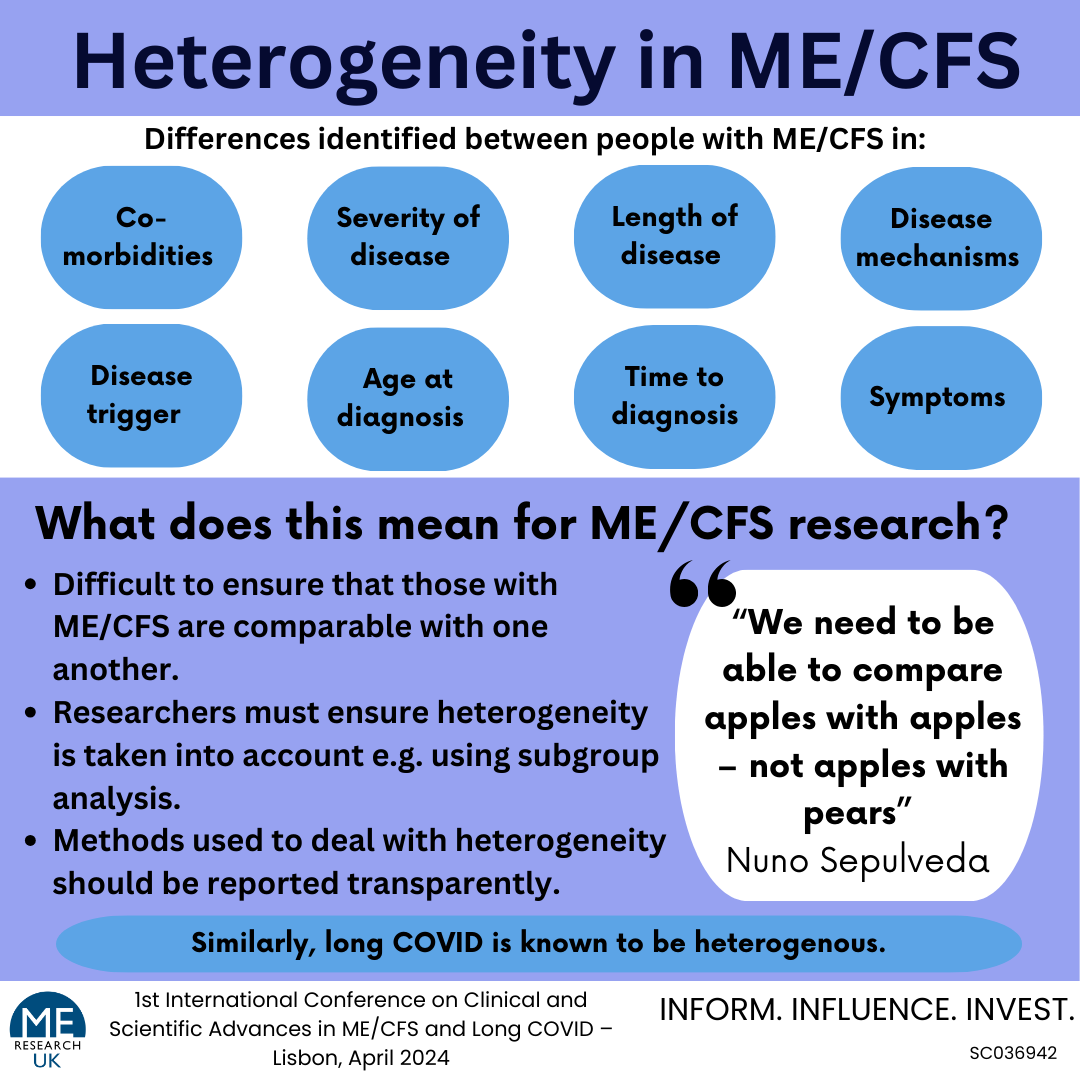
So, what is heterogeneity?
Heterogeneity simply means “variation within a group”. In ME/CFS research, it means that a group of people recruited into the same study may differ in important ways such as (but not limited to) factors:
- Relating to their illness
- How long they have been ill
- How long it took them to get a diagnosis
- How severe their symptoms are
- What other conditions they have (known as comorbidities)
- Which diagnostic criteria were used
- How their symptoms change after physical, cognitive or emotional effort
- How ME/CFS is defined by the study (especially where not all methods require PEM for a diagnosis of the disease to be made)
- What triggered the illness
2. Relating to general characteristics:
- Age
- Sex
- Ethnicity
- Body mass index
- Level of activity before ME/CFS (e.g., if they were a professional athlete or led a sedentary lifestyle)
- Socioeconomic status (level of education, income, employment type, area of residence – or a combination of all of these).
Why does heterogeneity make research harder?
Imagine trying to test a treatment for “headache” without separating migraine, sinus infection, concussion and medication side effects. The average result could look confusing, not because the treatment has no effect, but because it helps one subgroup and not another. ME/CFS research can face a similar problem. If a study combines people whose illness biology differs, a real signal may be diluted until it disappears in the results for the overall group. This can affect many types of research, for example:
- Biomarker studies may struggle to find a consistent blood, immune or metabolic pattern.
- Treatment studies may miss benefits that apply only to a subset of patients.
- Studies of symptoms may produce results that seem inconsistent from one paper to the next.
Notably, even when researchers use careful methods, groups of mixed participants can make interpretation of results and study replication difficult.
Why results presented for the whole ME/CFS participant group can be misleading
Many scientific papers report results for all those with ME/CFS, for example the average fatigue score, the average level of an immune marker, or the average response to a treatment. While averages are useful, they can hide important patterns, for example effect modification, where the association of interest, such as the link between a specific hormone and ME/CFS severity level, differs by a third factor like sex. Here, if half a males in the study have high levels of a marker and females have low levels, the average may look ‘normal’, and without looking at the spread of the results by sex, researchers may miss the fact that two distinct subgroups exist.
This is why some researchers argue that ME/CFS studies should not only compare those with the disease with healthy controls, but also examine variation within the ME/CFS group itself. Scatter plots, histograms and subgroup analyses can sometimes reveal patterns that a simple average conceals.
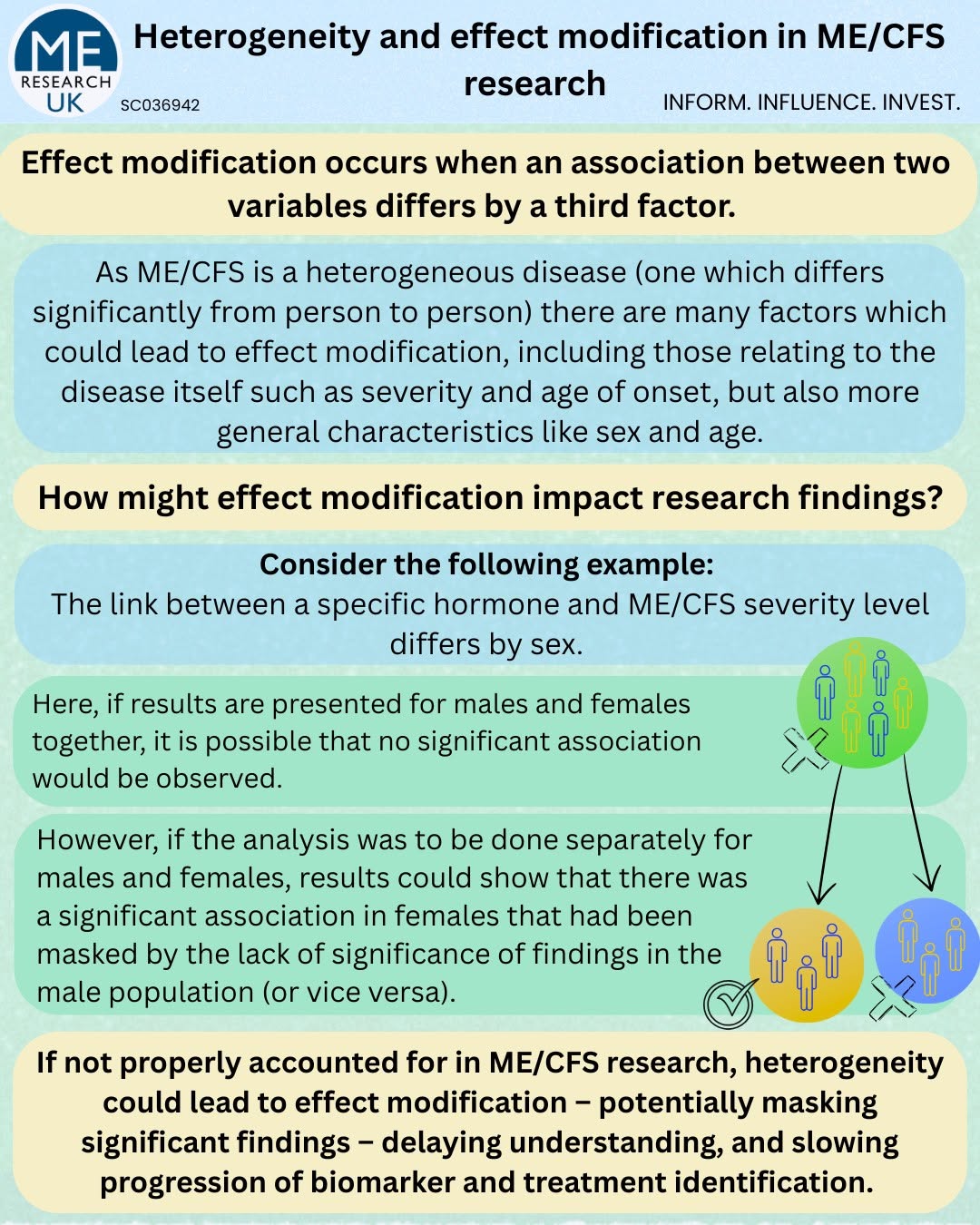
The challenge for researchers is to design studies that take heterogeneity seriously from the start. That means ensuring as standard the use of clear diagnostic criteria which require PEM for a diagnosis of the disease to be made, defining and measuring PEM carefully, disentangling PEM from orthostatic intolerance, recording co-existing conditions, describing disease severity, and making participation possible for people who cannot travel or tolerate lengthy assessments. It also means, where sample size allows, investigating the potential for effect modification.
It also means appropriately involving people with lived experience in study design. Those who have experience of the disease – both those who live with it and those who care for them – can help researchers identify procedures that are too burdensome, missing symptoms that matter, and ways to include those who are severely affected. This is not only good ethics; it can improve the science by reducing selection bias and making study groups more representative.
Conclusion
ME/CFS research is complicated because the diagnosis brings together people who share core features but may differ in factors such as disease severity, symptom patterns, triggers, co-existing conditions and underlying biology. Combining all those with the disease together and assuming they are identical can blur research findings. Treating heterogeneity with curiosity may help researchers identify subgroups, discover more reliable biomarkers, and eventually develop treatments that are better matched to individuals with ME/CFS.