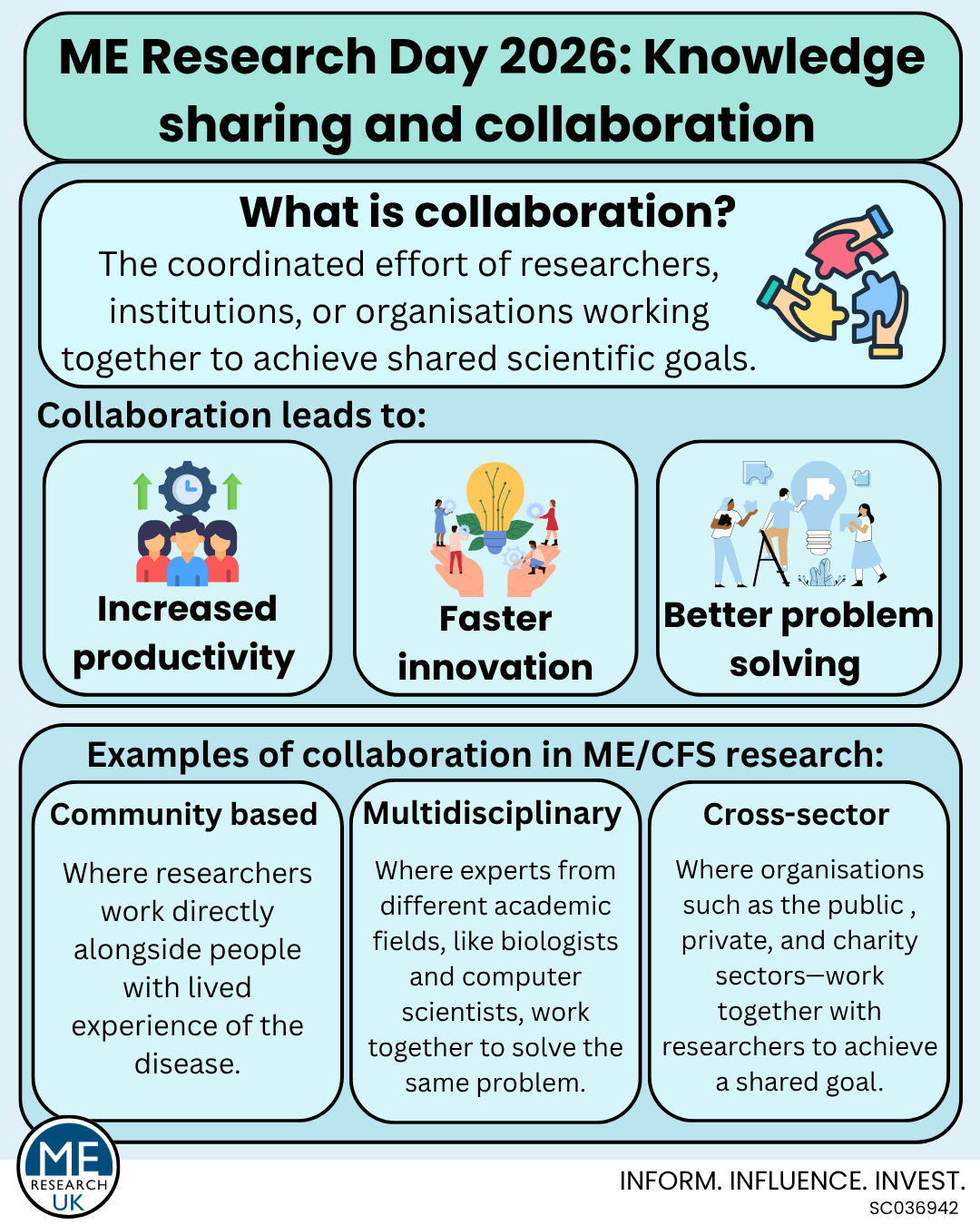
What is collaboration?
Collaboration is widely recognised for boosting productivity, accelerating innovation, and improving problem-solving — but what exactly is it?
Collaboration is the coordinated effort of groups with different expertise and experiences, such as researchers, institutions, organisations, and the public, all working toward shared a shared goal or objective(s). By combining expertise and resources, collaborative groups can address complex challenges and generate innovative ideas, whether through novel approaches, original methods, or groundbreaking concepts.
The following will discuss types of collaboration often used in ME/CFS research, benefits of collaboration, and the potential challenges faced.
Types of collaboration
There are several different types of collaboration in research:
- Person-to-person collaboration: Where researchers combine expertise, resources, or perspectives to achieve a common scientific goal.
- Multi-institution collaboration: Where researchers from different academic institutions combine expertise, resources, or perspectives to answer the same research question.
- Multidisciplinary collaboration: Often highlighted as important in ME/CFS research, ‘multidisciplinary collaboration’ is where experts from different academic fields, like biologists and computer scientists, or geneticists and machine learning specialists, work in parallel towards a common goal.
- Interdisciplinary collaboration: Here, scientists from different disciplines work together, integrating knowledge and expertise, combining knowledge, methods, and perspectives into a cohesive approach to solve complex problems.
- Community based collaboration: Another essential form of collaboration in ME/CFS research is ‘community based collaboration’ where researchers work directly alongside people with lived experience of the disease.
- Cross-sector collaboration: This is where organisations from at least two different domains—such as the public (government), private (business), and non-profit (charity) sectors—work together with researchers to achieve a shared goal.
When asked about experience of collaboration within ME Research UK-funded research and related activities, Prof. Dr. Lode Godderis stated:
“Close collaboration between research teams and specialised laboratories proved crucial. When initial analytical approaches did not deliver as expected, collaboration enabled us to pivot methodologically and continue generating meaningful results.”
Dr Sarah Annesley said:
“I have had the privilege of collaborating with leading researchers across multiple disciplines, bringing together complementary expertise to address complex questions in ME/CFS. These collaborations have been essential for strengthening our research, increasing its impact, and positioning us to be able to translate our findings into meaningful outcomes. Advancing ME/CFS research requires a multidisciplinary approach and a growing network of researchers, and collaboration is key to achieving both.”
Dr Annesley also spoke directly about community based collaboration:
“Working with people who are severely affected by ME/CFS has changed the way we approach research. By adapting our studies to make sure they can take part and have a voice in shaping the research, we’re helping ensure that the people most in need of answers are not left behind.“
Professor Chris Ponting, also provided an example of collaboration:
“Our ongoing ME Research UK project is one between the Universities of Edinburgh and Sheffield Hallam, and is interdisciplinary between experts in machine learning/artificial intelligence (Ava Khamseh), mathematics (Sjoerd Beentjes), and ME/CFS (Audrey Ryback, Caroline Dalton, Chris Ponting)“.
Another great example of all three types of collaboration is the DecodeME study, led by Professor Chris Ponting, .
DecodeME was a a collaboration of researchers, people with ME/CFS, and advocates for the disease, on the study website it states:
“DecodeME was led by a dedicated team of researchers, charity partners, and people with lived experience of ME/CFS. The study brought together scientific expertise and the voices of the ME community to ensure the research was relevant, inclusive and held to the highest standards throughout.”
What are the benefits of collaboration?
The key benefits of collaboration include:
- Increased innovation and better problem solving: When scientists from different disciplines work together this helps to create an environment where out-of-the-box thinking can occur, increasing the development of novel solutions.
- Better access to resources and skills: When different teams work together, they pool resources, knowledge, and experience, meaning that they can share specialised equipment, unique datasets, and technical skills.
- Increased research impact: When articles are published, those written by researchers from multiple institutions or countries tend to be referenced more and have greater academic impact compared with those from researchers at a single academic institution.
- Better chances of securing funding: Collaborative projects—especially international, multidisciplinary, community-based or cross-sector partnerships —are often more attractive to major grant agencies and private investors. In fact, at the 2026 NIHR/MRC Post-Infection Conditions Research Showcase, one of the three core questions was “How can we enable new collaborations across specialties and disciplines to stimulate further vital research?”, highlighting the importance of collaboration to NIHR and MRC.
- More efficient translation of knowledge from research to the ‘real world’: This benefit is especially relevant to community-based and cross-sector collaboration, and ensures that research is more quickly grounded in real-world challenges, speeding up the practical application of the findings.
- Potential to reduce bias: Working with a team that brings together different areas of expertise can help reduce the impact of potential personal bias. Each researcher is likely to approach the project with distinct strategies, methods and perspectives, some of which may not have been considered by a single researcher working alone.
Jolien Hendrix, PhD Candidate at Vrije Universiteit in Brussel, Belgium, who is working on research supported by ME Research UK shared a quote on her experience of collaborative working in ME/CFS reserach:
“The value of collaboration lies not only in combining knowledge, but in seeing the same problem through different eyes….Having this collaboration, we can have a strong methodological approach for lab analysis but still make it as relevant and feasible for people with ME/CFS”
Are there any challenges when working collaboratively?
It is worth noting that collaborative working is not always plain sailing, and researchers may encounter hurdles such as:
- Misaligned goals, priorities, and expectations: Collaborators often bring different expectations and priorities to a shared project, particularly in cross-sector collaborations. For example, academic researchers may prioritise novel findings and the development of new methods, whereas industry partners may place greater emphasis on rapid, ‘marketable’ outputs. Similarly, research timelines may differ: academic studies often require slower, more methodical long-term approaches, while external partners may need projects to deliver results more quickly.
- Conflicts over authorship: Deciding who is first author on a paper and determining the order of authors can create tension between research groups.
- Intellectual property and data sharing: Keeping university or business data safe, managing patent rights, and sharing data ethically can involve complicated legal discussions.
- Institutional and systemic barriers: Different institutions can have different admin and ethics review processes, which can cause problems such as delays to the start of a project.
- Difficulties with communication and time-zone barriers: International or multi-organisation teams can face practical challenges, such as arranging meetings across time zones, dealing with language differences, and using different technology systems. Communication can also be harder when researchers from different fields use technical terms, or when non-specialist partners are not familiar with scientific language. To avoid confusion and work well together, teams should agree on clear, shared language that everyone can understand.
- Potential for power imbalance: There may be unequal input into the the project between researchers, for example between senior academics may spend less time on a project but have more influence over decisions compared with early career researchers. There can also be power differences between researchers and other collaborative partners, especially community partners, and this can lead to challenges. It is also possible that disagreements may arise over the fair distribution of research funding, lab space, and technical support.
As NIHR recommends, in order to mitigate the risk of these challenges, a collaboration agreement, such as (but not limited to) those developed by the Intellectual Property Office, can be used.