
Whilst there is often a focus on four key symptoms in ME/CFS (fatigue, post-exertional malaise, cognitive dysfunction, and sleep disturbances), it is important to recognise that a significant proportion of individuals with ME/CFS, especially those with severe and very severe ME/CFS, experience sensory hypersensitivity. This often-overlooked symptom comes in many forms and can be profoundly disabling, affecting how individuals interact with others and with their environment. Understanding the nature of sensory hypersensitivity is crucial for fostering empathy and providing appropriate support for those affected.
To help you navigate this comprehensive overview, you can jump directly to any of the key sections below:
Contents:
- What is sensory hypersensitivity?
- Lived experience
- What does the research say?
- Management
- Conclusion
- Sources
What is sensory hypersensitivity?
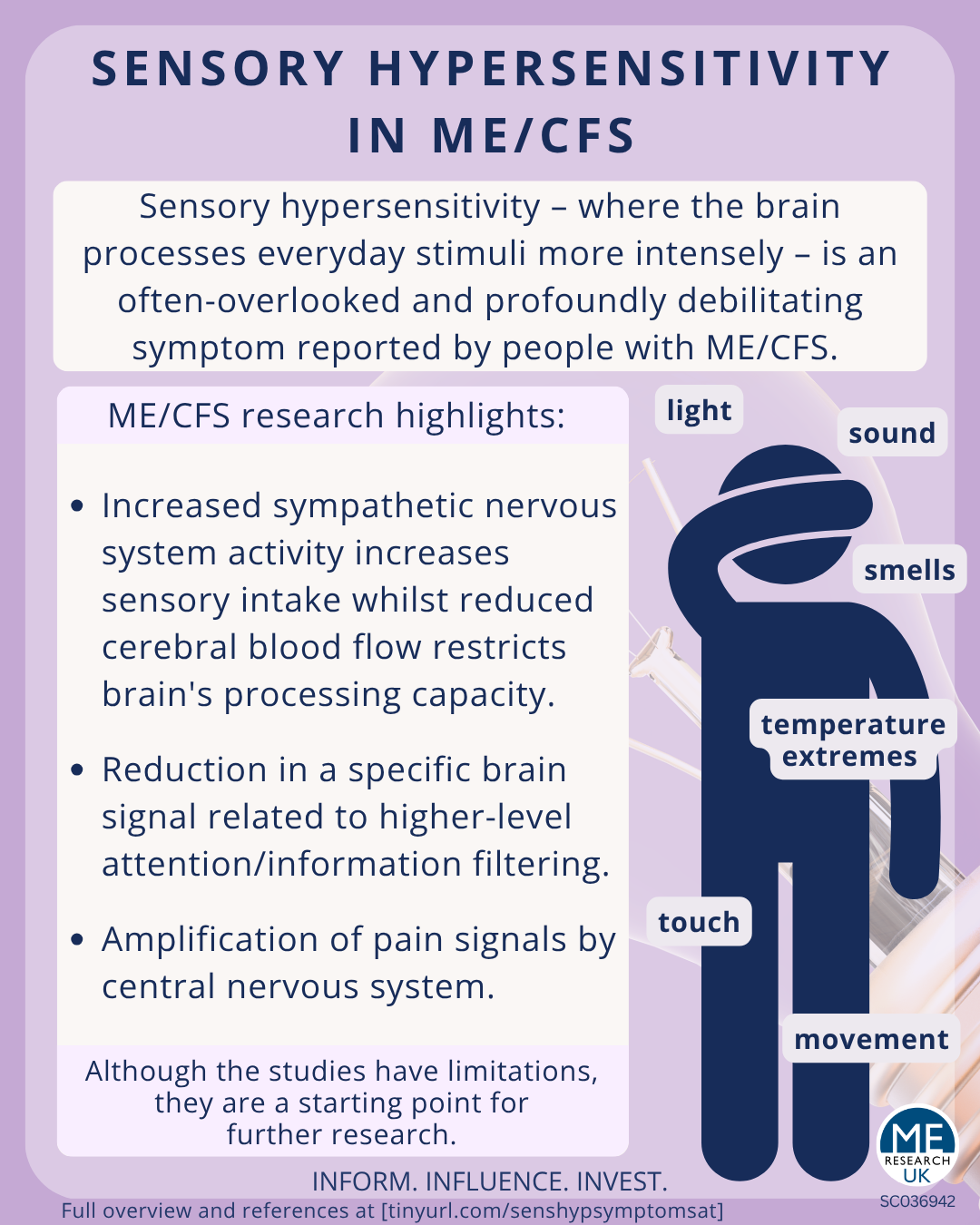
Sensory hypersensitivity – where the brain processes everyday stimuli more intensely – is reported in ME/CFS, particularly for those living with severe or very severe ME/CFS. This often-overlooked symptom manifests in various forms and can be profoundly disabling, fundamentally altering how individuals interact with their surroundings and loved ones.
The NICE 2021 guidance for ME/CFS explicitly highlights hypersensitivity to light, sound, touch, movement, temperature extremes, and smells. The International Consensus Criteria (ICC), within their “Neurosensory and perceptual” symptom category, further give examples of “inability to focus vision, sensitivity to light, noise, vibration, odour, taste and touch.”
Lived experience
The many challenges of living with ME/CFS, including the profound impact of sensory hypersensitivity, are highlighted in “‘Dialogues for a Neglected Illness” – a meticulously researched project supported by the Wellcome Public Engagement Fund (2018–21) and produced by Natalie Boulton with cameraman and editor Josh Biggs.
Accounts from the video series capture the heavy toll of these symptoms, such as:
“One of the major symptoms for me has been, and continues to be, sensory sensitivities – and I find them, in many ways, among the most disabling of my symptoms. For me it’s been all senses – light, sound, even taste and smell, touch, movement. All of these place a considerable strain on my brain and body, and too much of them can cause an immediate worsening of symptoms.” – Naomi Whittingham
“Any sort of pressure, whether it be clothing or a watch strap was painful. Even having someone walking around in the room, the rustling would be too much noise for me…So the problem with being out and about, for example, traveling in a car or being in a coffee shop or restaurant, is that there’s just far too much noise, lights around, sound, motion and it makes me feel sick” – Anna
What does the research say?
Despite sensory hypersensitivity being a symptom known to be associated with ME/CFS, especially amongst those with severe and very severe ME/CFS, the research is limited.
Key areas of research:
Greater functional impairment
One study examined the prevalence and health impacts of sensory hypersensitivities, specifically to noise and light, in individuals with ME/CFS compared to those with multiple sclerosis (MS). Analysing data from over 2000 participants, the researchers found that people with ME/CFS were significantly more likely to experience these hypersensitivities, particularly both simultaneously, than those with MS. ME/CFS participants reporting both sensitivities exhibited more severe symptoms and greater functional impairments across all health measures. The researchers suggest that such hypersensitivities may stem from underlying neurological dysfunction, especially involving the brain’s salience network. It is important to note that the dataset combined multiple sources, which employed varying diagnostic criteria.
Hypervigilance and reduced blood flow to brain
A review suggested hypersensitivity to stimuli like light, noise, and smells may be caused by a combination of physiological stress (including increased activity of the sympathetic nervous system) and reduced blood flow to the brain. The body enters a state of heightened autonomic alertness (known as hypervigilance), which increases the intake of normal sensory stimuli. At the same time, reduced cerebral blood flow limits the brain’s ability to process these signals properly. This mismatch (where an increased sensory load meets reduced processing capacity) can overwhelm the system, resulting in severe hypersensitivity symptoms.
Higher order issues with brain processing
A study examined why people with ME/CFS experience sensory problems by measuring brain activity during auditory tasks. Whilst the ME/CFS group reported far greater everyday sensory difficulties, EEG brain scans showed no difference in comparison to healthy controls in sensory gating – the brain’s automatic ability to filter out redundant or repetitive sensory information. Instead, researchers discovered a significant reduction in a specific brain signal (the P300 wave) that reflects higher-level attention and information filtering.
Vision-related symptoms
To explore vision-related problems in the condition, a research programme at the University of Leicester was initiated with co-funding from ME Research UK and the Irish ME Trust. The work yielded three studies demonstrating that individuals with ME/CFS perform worse than matched controls across three distinct aspects of vision, that eye movement dysfunction is a prominent feature of the illness, and that vision-related symptoms – such as bright light sensitivity, eye pain, and difficulty focusing – are a significant clinical feature.
Amplified pain signals
An observational study compared experimental pain processing in 48 individuals with CFS, 19 individuals with multiple sclerosis (MS), and 30 healthy controls to uncover the distinct mechanisms driving chronic pain in each condition. Using techniques such as cuff pressure, the researchers found that individuals with ME/CFS had significantly lower pain thresholds and higher pain amplification (temporal summation) than those with MS, whilst both groups showed similar levels of pain inhibition. The findings demonstrated an overactive pain facilitation system (where the central nervous system amplifies incoming pain signals) is a prominent feature of CFS rather than MS, “suggesting a greater role for central sensitization in CFS”.
Limitations of the studies
It is important to recognise that the key points of the studies above have been summarised, and a more in depth look at each paper is necessary to ascertain strengths and weaknesses of the research. Some limitations include sample variability and reliance on self-report. These challenges highlight the complexity of studying ME/CFS and underscore the need for rigorous methodologies in future research.
Management
The NICE 2021 guideline for ME/CFS does not offer specific management strategies for sensory hypersensitivity, but it does recommend that health and social care organisations adapt services to accommodate sensitivities. Additionally, under the energy management section, the guideline advises discussing the effect of environmental factors, including sensory stimulation, when planning care.
The 25% ME group, which supports people with severe ME, made some suggestions to help support individuals with sensory hypersensitivity who have been admitted into hospital (but the suggestions could be applied generally) –
- Noise hypersensitivity: Use of earplugs or ear defenders; placement of patient “away from phones, television sets etc.” They also note – “Conversation and general busyness may tire the patient further.”
- Light: Use of dark glasses or night blinders (similar to those worn by airplane passengers); placement of patient “away from excessive bright lights.”
Comorbidities
Some individuals may also have comorbidities that contribute to sensory sensitivities, such as mast cell activation syndrome (MCAS). For example, Anna (a contributor to the Dialogues for a Neglected Illness video series) shared:
“…I’ve had problems with what I thought were allergies from the beginning, and only recently have I been diagnosed with mast cell stuff, which explains perfumes, toiletries…household cleaners…”
Similarly, conditions like postural orthostatic tachycardia syndrome (PoTS) can co-occur with ME/CFS and contribute to symptom burden. Assessing for and managing co-existing conditions may help alleviate some sensory issues.
Conclusion
Sensory hypersensitivity is a debilitating and underrecognised symptom associated with ME/CFS. Although research remains limited, existing evidence and personal accounts highlight its profound impact. Improved awareness, accommodations, and continued research are essential to improve quality of life for individuals living with this symptom.
This article is part of the Symptom Saturday series
Sources
ME Research UK articles on diagnostic criteria
- Health outcomes of sensory hypersensitivities in myalgic encephalomyelitis/chronic fatigue syndrome and multiple sclerosis (Maeda et al., 2023)
ME Research UK article
Aims: Understand the prevalence rates and characteristics of hypersensitivities to noise and lights amongst people with ME/CFS and to compare them to people with another chronic illness, multiple sclerosis (MS).
Number participants in disease cohort: 2402 individuals with ME/CFS; 270 individuals with multiple sclerosis (MS)
Criteria: a range - An attempt to explain the neurological symptoms of Myalgic Encephalomyelitis/Chronic Fatigue Syndrome (Maeda et al., 2021)
Aims: Understand the prevalence rates and characteristics of hypersensitivities to noise and lights amongst people with ME/CFS and to compare them to people with another chronic illness, multiple sclerosis (MS).
Number participants in disease cohort: 2402 individuals with ME/CFS; 270 individuals with multiple sclerosis (MS)
Criteria: a range - Higher-order brain processes, rather than early processing, underlie sensory problems in ME/CFS: evidence from ERPs (Wirth et al., 2026)
Aims: Deduce the pathomechanisms resulting in central nervous pathology and the myriad of neurocognitive symptoms in ME/CFS - Increased Vulnerability to Pattern-Related Visual Stress in Myalgic Encephalomyelitis (Wilson et al., 2015)
ME Research UK article
Aim: Determine vulnerability to pattern-related visual stress in ME/CFS
Number participants in disease cohort: 20
Criteria: TBC - Endogenous Pain Facilitation Rather Than Inhibition Differs Between People with Chronic Fatigue Syndrome, Multiple Sclerosis, and Controls: An Observational Study (Collin et al., 2017)
Aim: Compare experimental pain measurements in patients with CFS or MS and healthy controls.
Number participants in disease cohort: 48
Criteria: Fukuda criteria “a CFS diagnosis as defined by the United States Centers for Disease Control and Prevention (CDC) 1994 criteria for CFS was required from each participant’s physician”