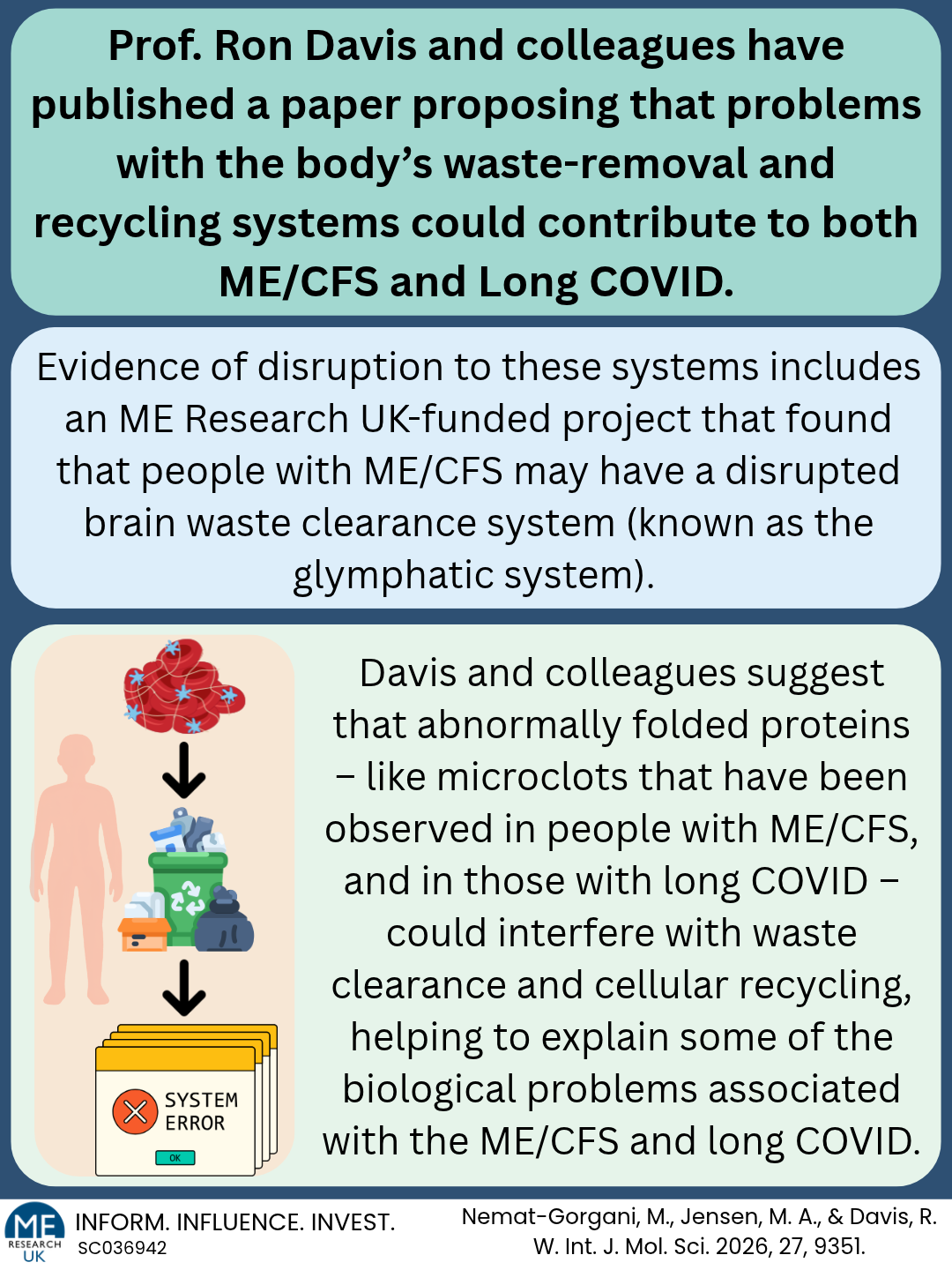
Prof. Ron Davis and colleagues at Stanford University have published a paper proposing that problems with the body’s waste-removal and recycling systems could contribute to both ME/CFS and Long COVID.
This comes shortly after ME Research UK-funded research by Kiran Thapaliya’s group in Australia identified evidence of a disrupted brain waste clearance system (the glymphatic system) in people with ME/CFS. Notably in this study, poorer glymphatic functioning was associated with greater severity of symptoms, including sleep dysfunction and cognitive impairment.
The article from Prof. Davis’ team discusses two “clean-up” systems in particular:
- The glymphatic–meningeal lymphatic system: The system which helps move waste out of the brain (citing the research from Thapaliya’s group).
- Autophagy: The recycling process inside cells that breaks down worn-out or damaged material.
Although complex, the team’s central suggestion is that disruption to either of these systems could make it harder to dispose of potentially harmful material.
In theory, this could make it harder for the body to stay in balance—maintain homeostasis—particularly within the brain and spinal cord, together known as the central nervous system (CNS).
Notably, the researchers suggest that dysfunction in the CNS may be linked with symptoms such as brain fog, disturbed sleep, dysautonomia, fatigue, and post-exertional malaise (PEM).
How could these systems become disrupted?
Much of the discussion centres on proteins and protein folding. Often described as the ‘workhorses of the cell’, proteins perform many essential tasks in the body—but they must fold into the correct shape to work properly.
In fact, when proteins fold incorrectly, not only may they not work as they should, but they can also clump together forming structures that can harm cells.
Notably, a build-up of misshapen proteins has been linked with diseases such as Alzheimer’s, Parkinsons, and rare prion diseases, like Creutzfeldt‑Jakob disease, which are caused by misfolded prion proteins that damage brain tissues.
Misshapen proteins have also been identified in people with ME/CFS, and in those with long COVID. For example:
- An increased tendency for proteins to clump together has been observed in ME/CFS blood samples.
- Microclots – small clots, made of a misfolded protein called fibrin, have been found to be floating around in the liquid part of blood (plasma) in both people with ME/CFS, and in those with long COVID. Notably, although these clots are too small to show up in regular blood tests, it is thought that they could impair blood flow and oxygen transportation.
Prof. Davis and colleagues hypothesise that these abnormal protein structures could interfere with waste clearance and cellular recycling, helping to explain some of the biological problems associated with the ME/CFS and long COVID.
Although not directly linked to in the paper by Ron Davis and colleagues, of note here is research, presented at the 2026 ISLC-PAIS conference, from Jelle Huijts which indicated that there may be cellular waste build up in the skeletal muscle of people with ME/CFS.
Takeaway message
The paper presents a hypothesis to test, rather than an established explanation for either ME/CFS or long COVID. Findings from MRI-based studies support further research into the brain’s waste-clearance system, and the proposed links between protein misfolding and autophagy also warrant investigation.