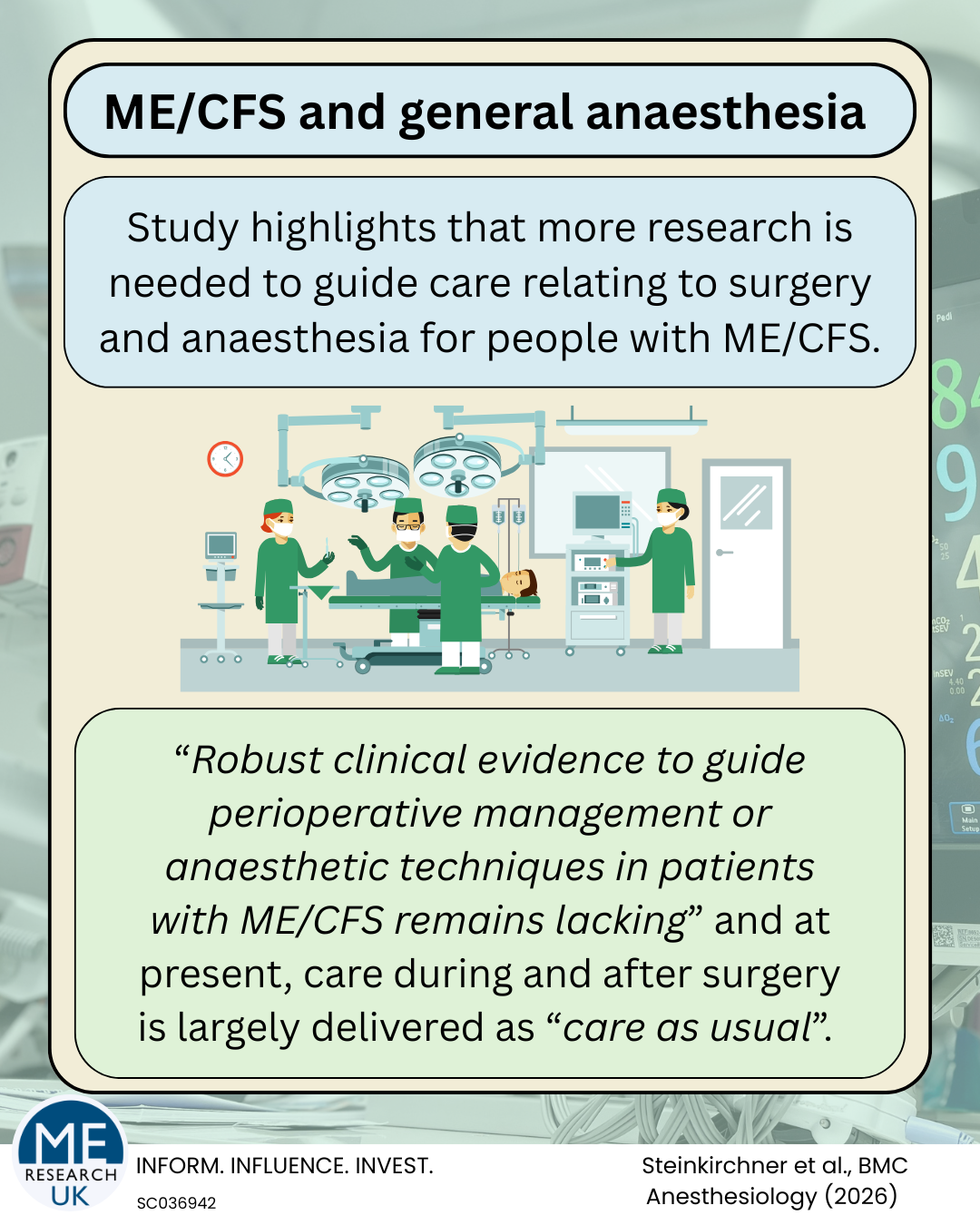
A team or researchers in Regensburg, Bavaria have highlighted the lack of research around general anaesthesia in people with ME/CFS.
Stating that “robust clinical evidence to guide perioperative management or anaesthetic techniques in patients with ME/CFS remains lacking” and at present, care during and after surgery is largely delivered as “care as usual”, the researchers conducted a ‘hypothesis-generating’ study aimed to producing relevant research questions to drive this area of inquiry forward.
What did the study do?
The researchers reviewed the medical records of 15 people with ME/CFS and compared them with the records of 15 similar people who did not have the disease. The team specifically examined what happened during and shortly after surgery, including looking at blood pressure, heart rate, pain, sickness, use of pain relief, and time spent in recovery.
In the study, ME/CFS was defined as a physician-documented diagnosis of ME/CFS at the time of anaesthesia. This diagnosis was identified in one of two ways:
- It was formally coded as G93.3 — the ICD code most closely matching ME/CFS — in the participant’s medical records.
- It was identified through a review of medical records for participants who had a record of the ICD code U09.9 for long COVID.
As the research team acknowledged, “formal diagnostic criteria such as the Canadian Consensus Criteria were not applied”.
What did the results show?
Overall, the study did not identify major safety problems linked to general anaesthesia in the people with ME/CFS included in the study. Their blood pressure and heart rate were sometimes slightly lower during surgery, but this did not appear to cause serious problems.
However, people with ME/CFS reported more pain after surgery and were more likely to need stronger pain relief, such as opioids.
The study was small, so the findings should be treated as early evidence rather than firm conclusions. Importantly, the researchers did not measure whether people developed a delayed worsening of symptoms after surgery, known as post-exertional malaise (PEM), which is often referred to as the cardinal feature of ME/CFS.
Key limitations
- Small sample size of only 15 people with ME/CFS and 15 healthy controls.
- No formal diagnostic criteria were used to identify ME/CFS. Instead, the study used the code G93.3 for “post viral fatigue” or a diagnosis of ME/CFS recorded in medical records alongside the code U09.9 for long COVID. Notably, these methods of identifying ME/CFS may not be directly comparable with stricter diagnostic criteria for the disease.
- The study was retrospective, meaning it looked back at existing records rather than following participants over time from the start.
- PEM, and its potential impact on recovery, was not assessed as a key outcome.
- The study did not consider ME/CFS severity, disease duration, or other factors that may affect outcomes during or after surgery.
Conclusions
This study suggests that, in this small sample of participants, general anaesthesia appeared to be broadly safe for people with ME/CFS in the immediate period around surgery. However, larger studies that follow participants throughout the surgical journey are needed, especially studies investigating pain control and the role that PEM may play on recovery. ME Research UK notes that would also be essential to consider how other factors relating to heterogeneity, such as ME/CFS disease severity, duration of disease, sex, ethnicity etc., play a role.