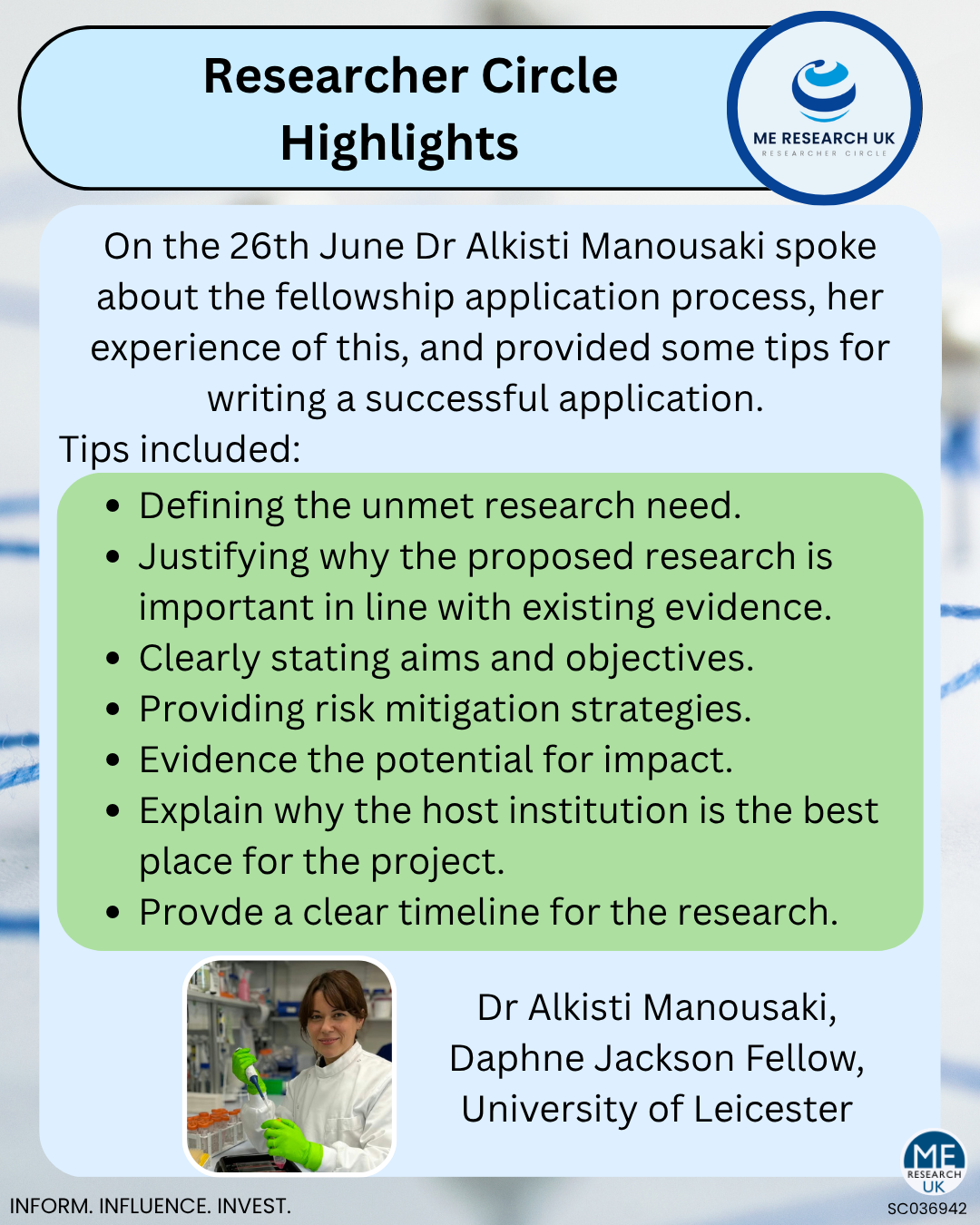
On the 26th June 2026, the fifth meeting of ME Research UK’s Researcher Circle took place. In this session, Dr Alkisti Manousaki – Daphne Jackson Fellow at Leicester University, co-funded by ME Research UK and the Medical Research Council – spoke to the group about fellowship applications.
Within the talk, Alkisti:
- Explained that research fellowships are “competitive positions designed for reseacrhers who have completed their PhD and wish to pursue independent research projects. Unlike standard postdoctoral positions, fellowships often provide longer-term funding, and opportunities to establish leadership in a research area”
- Considered different types of fellowships: career transition which often support transition of a researcher to independence, capacity building and discipline/sector transition, and specialised fellowships which may be career re-entry, like the Daphne Jackson Fellowship, be university specific, or skill retraining.
- Discussed what you need to start a fellowship application – this included identification of suitable fellowship and check that you meet the eligibility criteria, have a concrete research idea to build on, secure a host institution and supervisor.
- Reflected on the timeline and process of her application to the Daphne Jackson fellowship, emphasisng that it took just over a year from initial application to fellowship award. Notably, Alkisti highlighted that the application process often happens alongside fulltime work or study, and knowing about the timeline – and requirements for each stage – can be useful to help you plan
- Described a draft plan for writing an application, which recommended choosing a dedicated time and place(s) to write, working by section rather than all in one go, assign time for editing the application, and reflect on the approach you have taken.
- Provided tips for writing the project proposal itself such as clearly defining the unmet need alongside critical appraisal of the existing literature, stating the aims and objectives of the proposed project, outline strategies to mitigate risk in the project, and clearly show the potential impact of the project. In this section, Alkisti also spoke about the need to justify the chosen research institute and project time line using a Gantt chart.
- Gave some general tips including: attendance at grant writing workshops; the need to discuss your ideas and get feedback from peers, colleagues, supervisors, collaborators and advisors; importance of ‘selling your story’; stay motivated (something previously discussed in detail at a Researcher Circle session); ask for advice; and have mock interviews – as many as you can!
Following the talk, the members had a discussion around the tips provided, especially mentioning how useful it can be to dedicate time for editing work rather than trying to do everything as you go along.
The Researcher Circle will meet every other month, and will alternate between more structured sessions with a speaker followed by time for questions and discussion, and informal ‘catch-ups’ which aim to provide a friendly forum to discuss progress and challenges faced, and to practice presentations.
As such, ME Research UK looks forward to welcoming the students for an online ‘catch-up’ in August!
The Circle is aimed (initially) at PhD-level students working on projects funded by ME Research UK charity, and will:
- Fulfil ME Research UK’s aim to create an environment to encourage, support, and to facilitate the entrance and retention of early-career researchers in the field of ME/CFS research.
- Create an online space for students to network and learn about each other’s work.
- Provide an opportunity for skill development through talks given by members of ME Research UK staff, from established researchers in the field, and from other relevant experts.
- Provide a friendly forum to discuss challenges faced, to practice presentations, and to lay the foundations for future careers.