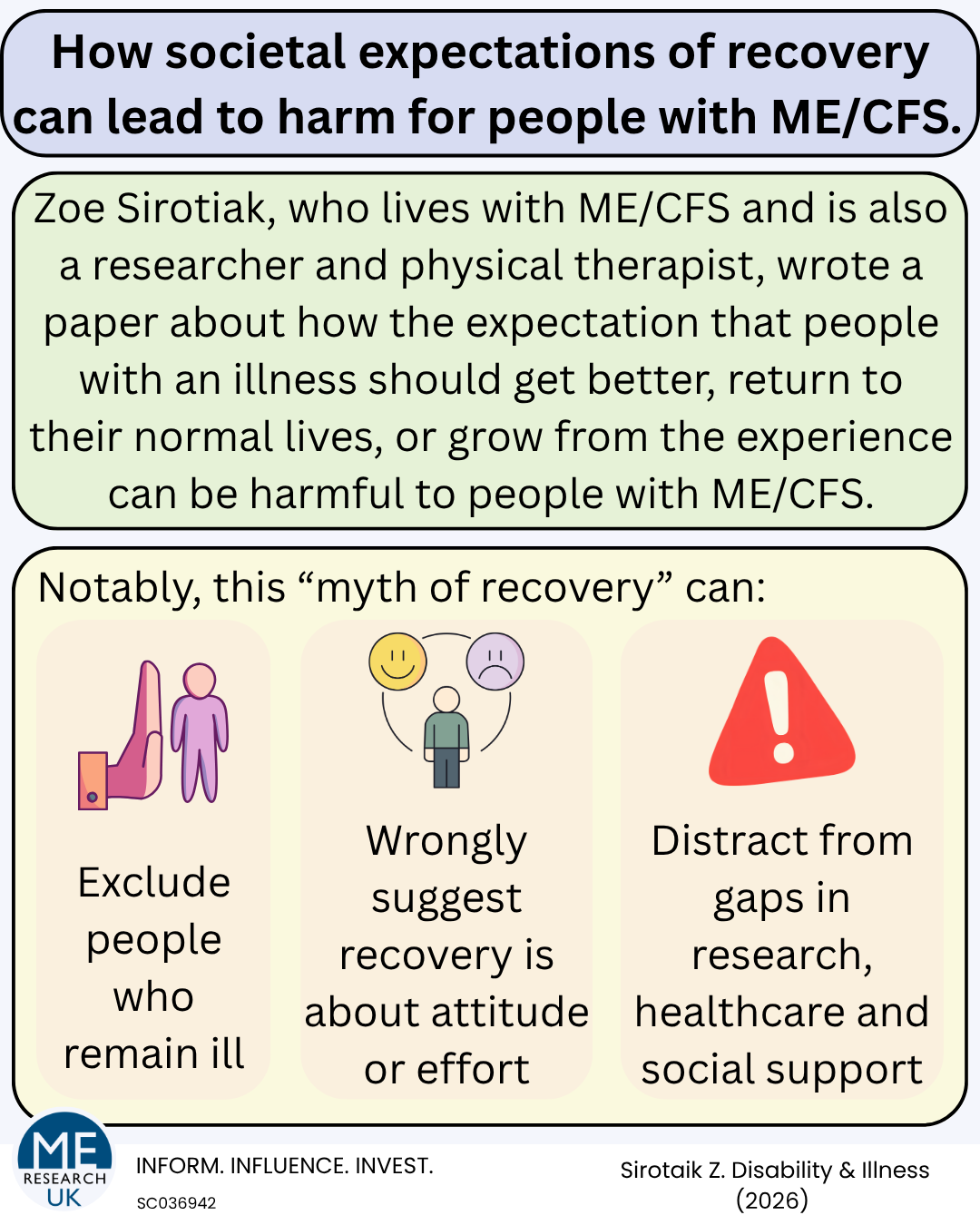
In an article, published in the journal ‘Disability & Society’, Zoe Sirotiak – a person with ME/CFS, researcher, and physical therapist – reflects on “the myth of recovery”, and how the societal expectation for people who are unwell to “get better” can create harm for people with chronic diseases, like ME/CFS.
The author uses a methodology, called ‘critical autoethnography’, which allows her to connect personal experiences to wider cultural, political, and social meanings and understandings.
Results of the analysis identified five ‘interrelated experiences’, which were:
- ‘No language for this loss’
Here, Sirotaik explains that people with chronic illnesses that have no clear medical explanation, can experience an uncertain, ongoing sense of loss. Their health, daily life, identity and hopes for the future may change permanently, even if they look well to others, but because there is no obvious single event or recognised ending, their grief is often overlooked or dismissed.
Within this section, the author reflects on her own personal experience and explains how she is expected to move on, be grateful and present work as proof of resilience.
“I hear repeatedly. I have multiple graduate degrees, a clinical license, and a growing publication record. By conventional metrics, I am on an upward trajectory. In reality, I am destroyed. My productivity is not a measure of wellness; it is simply the residual trace of a life that no longer exists.”
However, as those with ME/CFS will know all too well, continuing to exist and achieve things does not replace the life, abilities and future she has lost.
Additionally, it is recognised that not recovering is more than a medical outcome; it also affects how a person is viewed and treated by society. In fact, their understandable grief may be wrongly seen as a personal or emotional failure, and they may even feel pressured to turn their experience into a hopeful, grateful or inspiring story that is easier for other people to accept.
2. ‘The limits of the medical process’
In the article, Sirotak makes clear that medicine tends to focus on illnesses it can explain and treat, and that when tests do not show a clear cause, people with illnesses, such as ME/CFS, may erroneously be told that stress or a lack of effort is responsible for their symptoms. Furthermore, if patients do not improve, they can be blamed rather than the treatment or healthcare system being questioned.
“The underlying message is the same: You have control over how you feel. You must. However, when your symptoms plateau or worsen, and your body refuses to cooperate, the blame is returned to you. You did not try hard enough. You did not try long enough. You did not think the right thoughts. I once believed it. I held myself responsible for failing to improve until I realized the problem was not with me. The treatments fail because they do not account for what these conditions truly are; instead, they are designed for what the system already knows how to manage.”
In this section, Sirotaik also emphasises inequality in health care, detailing that “women and people from non-white backgrounds” are more likely to have symptoms dismissed or face barriers to effective care
3. ‘Working from the cage’
The author explains that society often judges people by how much they can work and produce, and uses her own experience to show that productivity is not the same as health, happiness or recovery. Sirotaik explains that although her qualifications and publications make her look successful, they hide severe illness, grief and the loss of the life she once had. Not only this, but she feels pressure to present her work as hopeful and meaningful because this is more acceptable to others and helps her retain credibility. In reality, continuing to work is a way to cope and to make her suffering visible. The paper argues that praising this as resilience can hide the true cost of illness and reinforce the unfair idea that a person’s worth depends on what they can achieve.
“I can speak from firsthand experience: Productivity is not equivalent to wellbeing. ‘But you are so productive! You must be feeling better,’ I hear repeatedly. I have multiple graduate degrees, a clinical license, and a growing publication record. By conventional metrics, I am on an upward trajectory. In reality, I am destroyed. My productivity is not a measure of wellness; it is simply the residual trace of a life that no longer exists.”
In this section, Sirotiak also considers that people with illnesses that are poorly understood may only be taken seriously when they can no longer function at all, while those who remain active can wrongly be assumed to have recovered. Additionally, it is explained that getting disability support can be especially difficult because symptoms may be invisible and applicants must repeatedly prove how ill they are. This leaves many people trapped: working may be necessary for income, credibility or survival, but their ability to produce can then incorrectly be used as evidence that they are not really unwell at all.
4. ‘Smiling through the collapse’
The author explains that when she honestly reported depression and anxiety after becoming seriously ill with ME/CFS, doctors began to wrongly treat her physical symptoms as mental-health problems, so much so that exhaustion was labelled depression, a racing heart was called anxiety, and further medical investigation was stopped. Building on this, Sirotiak reflects on how she has learned that people with ‘poorly understood illnesses’ can be trapped: showing distress may make health care professionals think the illness is “all in the mind”, while appearing calm may make it seem less serious. To remain believed and receive care, patients may feel forced to hide their true feelings, appear hopeful and make their ‘suffering’ easier for others to accept.
In this section, the author also argues that healthcare systems often expect patients to be either recovered or clearly improving. Treatment, insurance support and professional respect may depend on showing progress, even when staying stable or preventing further decline is the best realistic outcome. People who do not improve can even be discharged, blamed for lacking effort or treated as difficult and unstable.
“Those who deviate from the script risk being labelled noncompliant, unstable, or difficult, which further disqualifies their suffering from medical investigation. Emotional regulation thus becomes a form of institutional control, shaping not only how patients are perceived but whether they remain eligible for medical care at all.”
5. ‘Hope is a muzzle’
Here, it is argued that hope and positivity can become a form of pressure for people with illness and disease that may not improve. People may be expected to stay cheerful, keep trying treatments, and describe themselves as ‘fighters’ so that others do not have to face the reality of their disease, and if they do lose hope, they may be seen as difficult or less deserving of care. Regrettably, this shifts attention away from failures in healthcare, research and support, and instead makes the attitude of the person with the disease seem like the problem.
“Hope demands compliance and protects observers from the discomfort of medically unexplained or non-recovering conditions. The focus shifts from institutional failure to individual attitude, framing resilience as a virtue and despair as a personal weakness, so that continued suffering becomes evidence of poor coping rather than unmet structural need. Those who do not engage in hope are labelled difficult, pessimistic, or resistant to care, further justifying their marginalization”
Key takeaways
The paper explains that the “myth of recovery” refers to the strong social expectation that illness stories should end with improvement, a return to normal life, or a lesson about personal growth. Within the text, Sirotiak argues that this societal expectation not only excludes people who remain unwell, but can also suggest (wrongly) that recovery depends mainly on having the right attitude or trying hard enough, while drawing attention away from gaps in research, healthcare and social support.
Notably, Sirotaik expresses that anger and refusal are understandable responses to repeated mistreatment, and that a person with a chronic disease, like ME/CFS, who challenges a doctor, rejects an unsuitable explanation, or refuses to present an uplifting recovery story is not necessarily being difficult or giving up. Rather, such responses are likely to be ways of protecting themselves and demanding fair treatment.
Importantly, Sirotiak calls for healthcare and research that listen carefully to ‘patients’, take uncertainty seriously, tackle unequal treatment, invest in better evidence, and support people with chronic illness whether or not they recover.
Comment from ME Research UK
Although not directly related, many concepts in Sirotaik’s paper echo themes discussed in an article ME Research UK highlighted earlier this week, which discussed epistemic and affective injustice in ME/CFS.
Respectively, these two concepts relate to:
- Lived experience of those with the disease not being believed or being dismissed by others, for example when a person’s symptoms are wrongly dismissed as psychological, or it is assumed that they are just not trying hard enough.
- Being treated unfairly in relation to one’s emotions. Here, people with ME/CFS can be harmed not only when their symptoms are doubted, but also when their emotional responses to that doubt are judged or controlled by others, including by societal expectations.