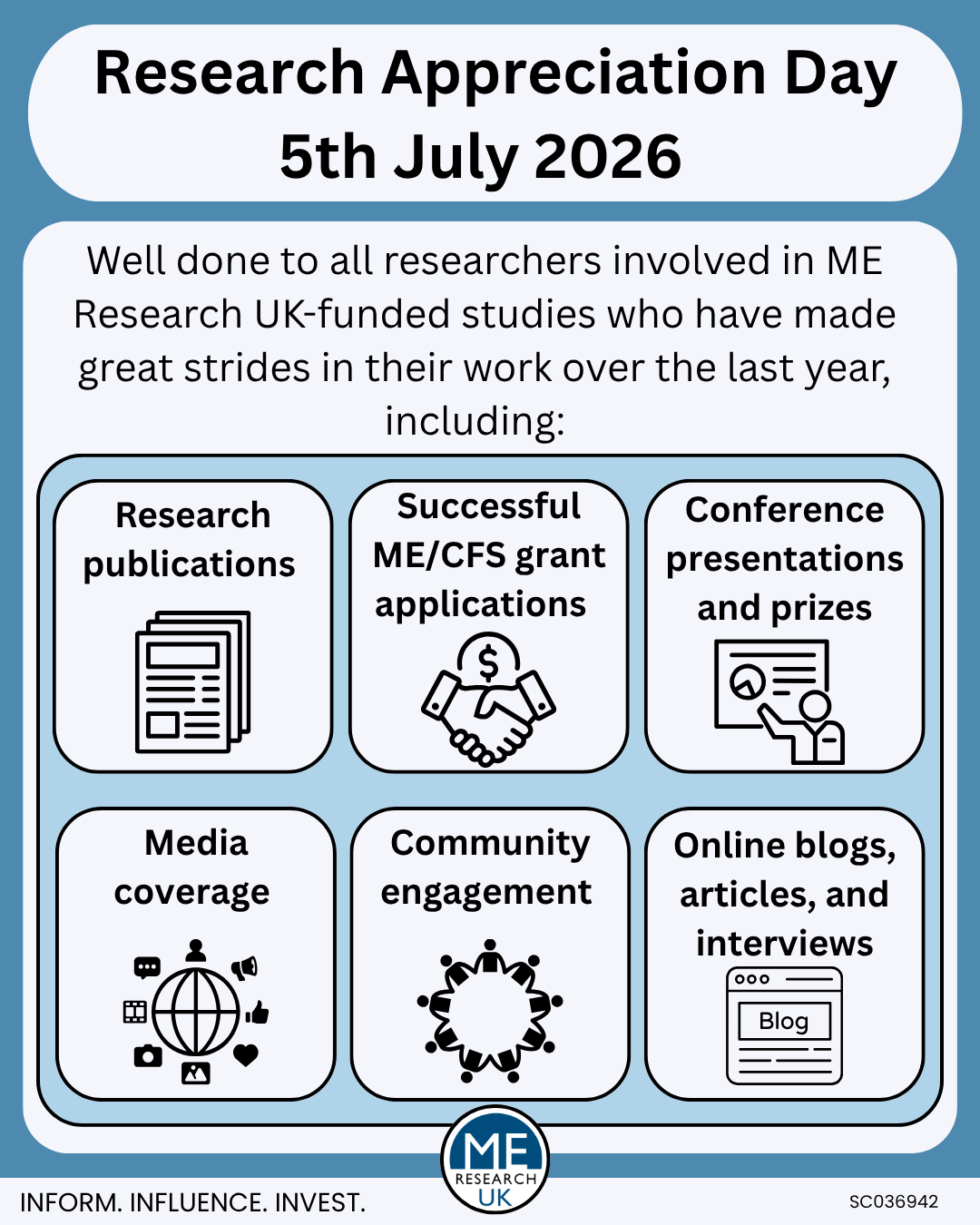
Since the last Research Appreciation Day on the 5th of July 2025, researchers involved in ME Research UK-funded studies have made great strides in their work, including:
- Gemma Samms, whose ME Research UK-funded research investigates genetic risk factors for ME/CFS using data from the DecodeME project, has submitted her thesis, the central requirement for earning a Doctor of Philosophy (PhD) degree, and is awaiting the oral examination, known as a viva, in which the student defends their work and demonstrates their knowledge of the field, allowing examiners to come to a definite conclusion about the outcome of the examination.
- Gemma Samms has also been included in Edinburgh University’s 300 Faces of Edinburgh Medical School for her work in ME/CFS.
- Funded by ME Research UK alongside the Open Medicine Foundation and the Amar Foundation, researchers including Dr Bo Bertilson, have identified that protein signatures in cerebrospinal fluid differ between groups of people with ME/CFS providing further evidence of disease heterogeneity.
- Tina Katsaros, a PhD student at La Trobe University, Australia, working on ME Research UK-funded doctoral research has successfully completed the laboratory phase of her project, and is now focused on writing her thesis, which investigates the role of mTORC1 in ME/CFS.
- ME Research UK-funded researchers Prof. Elisa Oltra and Prof. Simon Carding contributed to a review article on the role of human endogenous retroviruses (HERVs) in ME/CFS. Published in the International Journal of Molecular Sciences, the article discusses the evidence linking this family of viruses to immune and neurocognitive dysfunction in the disease, the potential of HERV signatures as biomarkers, and the promise of HERV-targeted antibodies as treatments for ME/CFS.
- An article by Hollie Byrne, Sarah Knight and the team at Murdoch Children’s Research Institute in Melbourne, Australia, was recognised as a top viewed article for 2025 in the Journal of Neuroscience Research. The article reports on their ME Research UK-funded study looking at brain structure and functional connectivity in adolescents with ME/CFS.
- Dr Amy Proal, co-founder and president of the PolyBio Research Foundation, whose ME Research UK funded project is focused on identifying viruses in tissue and nerve samples from people with ME/CFS, opened, and presented at, the PolyBio 2026 Spring Symposium.
- Current and fomer ME Research UK-funded researchers Prof. Chris Ponting and Prof. Dr. Carmen Scheibenbogen spoke at the International ME/CFS Conference 2026.
- On International ME Awareness Day (12th May) the UK government announced via a Press Release £4.75m in funding for the University of Edinburgh to coordinate a world-first genomics study which will enable the SequenceME programme, led by Prof. Chris Ponting who has received research funding from ME Research UK, to sequence the genomes of up to 6,000 ME/CFS patients, generating a world-first high-resolution genetic map of the disease.
- Former ME Research UK-funded researcher, Prof. Dr. Carmen Scheibenbogen, spoke on a SolveME YouTube interview about GLP-1 receptor agonists and whether they could have potential in the future management of ME/CFS.
- Dr Andrea Polli, Prof. Lode Godderis, and PhD student Yanthe Buntinx at Vrije Universiteit Brussel and Katholieke Universiteit Leuven in Belgium successfully secured funding from ME Research UK for a project investigating immune exhaustion in ME/CFS.
- Prof. Bhupesh Prusty and his team published results from their ME Research UK-funded study investigating how viral infections may influence the development of ME/CFS. Their findings indicated that immunoglobulins from the blood of people with post-infectious ME/CFS caused disruption to the mitochondria of healthy cells.
- Tina Katsaros, spoke to the host of the Let’s Talk SciComm podcast about her ME Research UK-funded PhD project on cellular energy abnormalities in ME/CFS, as well as the importance of communicating the results of scientific research.
- A team of researchers including Prof. Jo Nijs, Associate Prof. Andrea Polli, Jente Van Campenhout, and Jolien Hendrix – all of whom have all received research funding from ME Research UK – published a paper considering whether changes in gene activity that do not alter the DNA sequence itself (epigenetic modifications) could lead to dysregulation of a system central to pain regulation in people with ME/CFS and fibromyalgia. While the study was not directly funded by ME Research UK, the group used samples obtained during their previous ME Research UK-funded project.
- Professor Sonya Marshall-Gradisnik – part of the team working on ME Research UK-funded research investigating changes in the structure and function of the brain in ME/CFS – appeared on Australian radio show “Nightlife”, to discuss a publication from another ongoing project.
- Prof. Chris Ponting at the University of Edinburgh successfully secured funding from ME Research UK for a new study investigating the use of blood-based markers to help in the diagnosis of ME/CFS. The highly interdisciplinary team of researchers includes Audrey Ryback, Ava Khamseh and Sjoerd Beentjes from the University of Edinburgh, and Caroline Dalton from Sheffield Hallam University.
- A team of researchers, including Associate Prof Rob Wüst, who is currently working on a project funded by ME Research UK, published a paper considering whether biological aging of endothelial cells may act as a potential disease mechanism of ME/CFS, and of long COVID.
- PhD student Yanthe Buntinx wrote an article for ME Research UK on “Chronic pain in ME/CFS: the immune system and lifestyle factors”. The article is the first in a series of pieces from members of the ME Research UK Researcher Circle, which aims to create an environment to encourage, support, and to facilitate the entrance and retention of early-career researchers in the field of ME/CFS research. Yanthe also created an infographic to summarise the key points in her article.
- Speakers at the 2025 IACFS/ME Virtual Research and Clinical Conference, which took place online between the 22-25th October 2025, included Dr Leonard Jason, Prof. Sonya Marshall-Gradisnik, Dr Carmen Scheibenbogen, Caroline Kindon, and Dr Luis Nacul – all of whom have previously received research funding from ME Research UK.
- Leighton Barnden and colleagues at Griffith University, Australia published more findings from their ME Research UK-funded brain imaging study in ME/CFS and long COVID, reporting alterations in brain microstructure and neurochemical profiles in people with long COVID.
- ME/CFS Science published an article entitled “2025: looking back on a year of ME/CFS research”. According to the article, the “most interesting ME/CFS research studies of the year” included work from the DecodeME team, Assistant Professor Rob Wüst, Dr Bupesh Prusty, Dr Nuno Sepúlveda, and Professor Carmen Schiebenbogen, all of whom have received funding from ME Research UK.
- To mark the 25th anniversary of the charity ME Research UK sponsored the 2025 IACFS/ME virtual poster competition, which was won by both Jolien Hendrix, a PhD Candidate involved in ME Research UK-funded research at Vrije Universiteit in Brussel, Belgium, and Anne Gardella, a PhD Candidate and researcher at the Cornell Center for Enervating Neuroimmune Disease at Cornell University in Ithaca, New York (USA).
- Prof. Dr Carmen Scheibenbogen, former ME Research UK-funded researcher, gave a talk providing evidence for autoimmunity in ME/CFS and long COVID during the 2nd International Conference on Clinical and Scientific Advances in ME/CFS and Long COVID.
- Caroline Kingdon, who has worked on ME Research UK-funded projects, spoke about her experiences visiting people with severe ME at the 2nd International Conference on Clinical and Scientific Advances in ME/CFS and Long COVID (November 12th-13th, 2025).
- Prof. Bhupesh Prusty at Riga Stradins University in Latvia, successfully secured funding from ME Research UK for a project investigating the role of autoimmunity in ME/CFS.
- Jente Van Campenhout at Vrije Universiteit Brussel, who is currently working on a PhD-level research project investigating the links between mitochondrial function and the autonomic nervous system in ME/CFS, received an award for best oral presentation at the 3rd Belgian Pain Society Young Researchers Day earlier this year.
- A commentary from a group of researchers, including Carmen Scheibenbogen who has received funding from ME Research UK, challenged conclusions drawn in a paper published in February 2024, by Brian Walitt and colleagues.
- Jelle Huijts was awarded the Best Poster Award at the International Union of Physiological Sciences (IUPS) conference for a presentation on his work on skeletal muscle alterations in patients with ME/CFS and long COVID, which is part of an ME Research UK-funded project led by Dr Rob Wüst at Vrije University Amsterdam.
- Dr Fatima Labeed and Dr Jackie Cliff secured funding from ME Research UK and the ME Association for a project developing a diagnostic test for ME/CFS, expanding on their initial study showing electrical differences in blood cells from people with ME/CFS.
- Prof. Brett Lidbury and colleagues at The Australian National University and other institutions published findings of their ME Research UK-funded study in June 2025, analysing the whole-exome sequences of people with ME/CFS.
- La Trobe University recognised ME Research UK’s latest investment in Dr Sarah Annesley’s research.
- Dr Alkisti Manousaki at the University of Leicester was awarded a Daphne Jackson Trust Fellowship for a project investigating the genetic and cellular clues that may explain why ME/CFS affects more women than men. The fellowship is jointly funded by ME Research UK and the Medical Research Council.
- Initial results from DecodeME, a project lead by Professor Chris Ponting who has secured funding from ME Research UK, were released as a pre-print paper and gained much attention in the media including a Daily Telegraph headline reading ‘ME is a real illness, genetic study shows’.
- Research by Professor Jason and colleagues found that the way questions are asked in ME/CFS research can influence the responses given by participants. The team concluded that these altered responses to study questions may unintentionally reinforce erroneous assumptions that the ME/CFS is psychological in nature (psychosomatic).
- Assistant Professor Rob Wüst, who is working on an ME Research UK-funded project investigating muscle microclots and microvascular pathology in ME/CFS, took part in a video in which he answered questions from ‘patients’ as part of a joint project by NMCB, who are funded by the ZonMw ME/CFS research programme, and ME Central.
- Dr Sarah Annesley at La Trobe University in Australia was awarded funding from ME Research UK for a new study looking at microRNA profiles and their impact on platelet function and energy production in women with ME/CFS.