

Whilst there is often a focus on four key symptoms in ME/CFS (fatigue, post-exertional malaise, cognitive dysfunction, sleep disturbances), it is important to recognise that a significant proportion of individuals with ME/CFS experience pain. Pain comes in many forms in ME/CFS, is often difficult to manage and can greatly impact quality of life. Understanding the nature of pain in ME/CFS is crucial for effective management and support for those living with this condition.
To help you navigate this comprehensive overview, you can jump directly to any of the key sections below:
Contents:
What is pain in ME/CFS?
The National Institute for Health and Care Excellence (NICE) within their criteria recognise that pain is commonly associated with ME/CFS, and that it can come in many different forms, specifying: “pain on touch, myalgia [muscle pain], headaches, eye pain, abdominal pain or joint pain without acute redness, swelling or effusion.” The Centers for Disease Control and Prevention (CDC), further mention that “some people with ME/CFS” may also have tender lymph nodes in the neck or armpits and “a sore throat that happens often.”
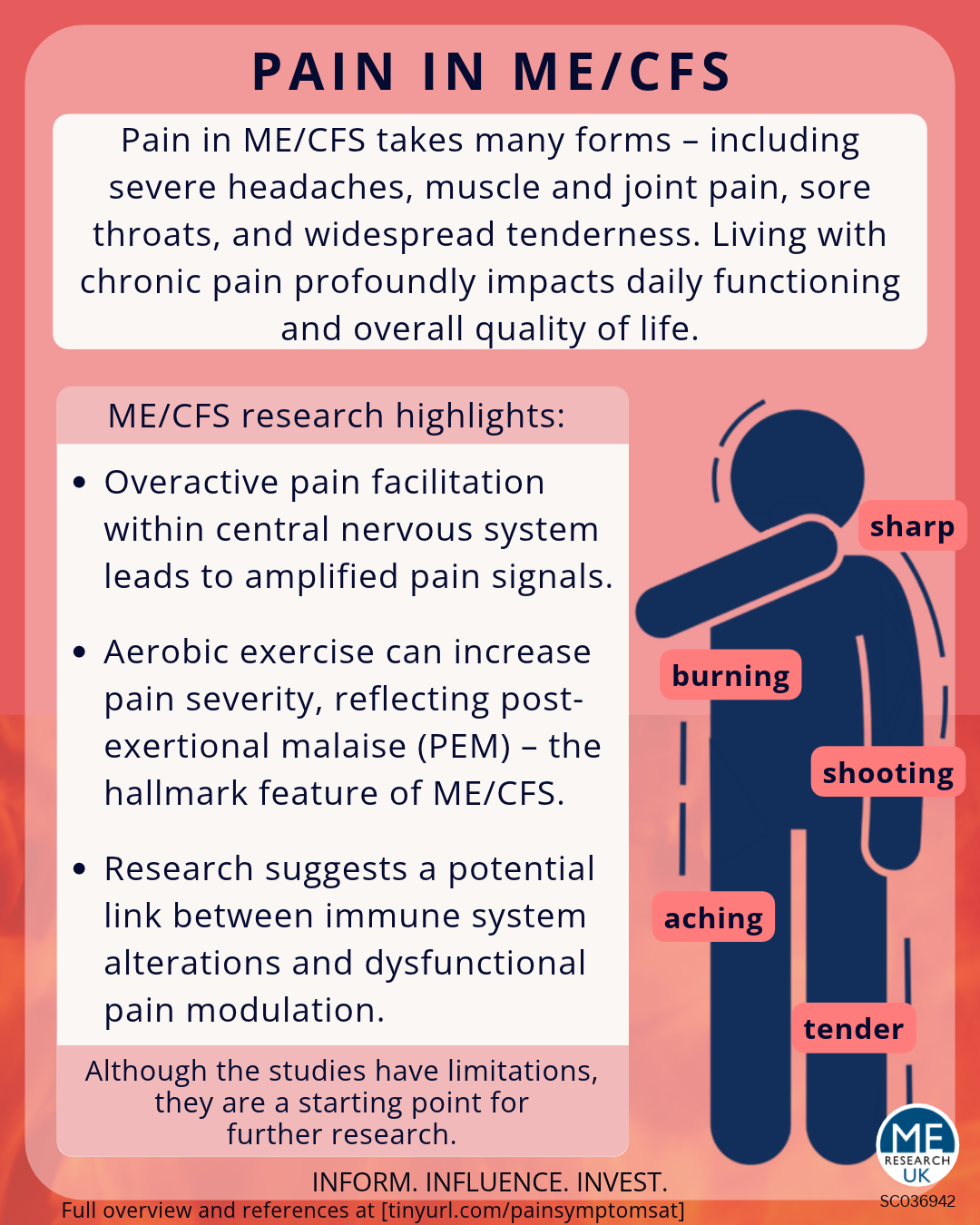
The Canadian Consensus Criteria, describes the often non-specific nature of pain in ME/CFS – “Pain is often generalized and ‘nonanatomical,’ i.e., not confined to any expected structural or nerve root distribution. The pain occurs in unexpected places at unexpected times. There are pains of many qualities: sharp, shooting, burning and aching. Many patients have significant new onset headaches of many types, including tension and pressure headaches and migraines. There is often generalized myalgia and excessive widespread tenderness or pain that is usually perceived to originate in the muscles but is not limited to the classical [fibromyalgia syndrome] FMS tender points.”
Lived experience
The many challenges of living with ME/CFS, including the impact of pain, are highlighted in “‘Dialogues for a Neglected Illness” – a meticulously researched project supported by the Wellcome Public Engagement Fund (2018–21) and produced by Natalie Boulton with cameraman and editor Josh Biggs.
Accounts from the video series capture the heavy toll of these symptoms, such as:
“I now do get headaches that I never used to. So they may be constant and dull, or an overall ache… I was not someone who got headaches before. I also get pains in my hands… [which] started after the initial viral trigger event… I can also get pains in my legs as well…” – ‘R’
“The main pain that I have is my sore throat and … I get a pain in my joint of my elbow on and off. When I’ve done too much the first thing that I get is my sore throat, which is generally there, gets worse and then I get the flu-like feeling really intensely.” – Grace
“Nowadays my pain is under much better control but that’s dependant on me very carefully pacing myself. Also, living in an environment that’s controlled in terms of light and sound. Anytime that I overdo it too much the pain generally returns…” – Naomi Whittingham
What does the research say?
Exploring how pain is triggered, amplified, and experienced is vital for understanding ME/CFS.
Note: Many of the research on pain has utilised the older Fukuda criteria. Designed to classify chronic fatigue syndrome (CFS), the Fukuda criteria list PEM (the cardinal feature of ME/CFS) as an optional symptom rather than a mandatory requirement – unlike newer criteria, such as the Canadian Consensus Criteria (CCC). Consequently, the research findings summarised below encompass studies referring to both ME/CFS and CFS.
Key areas of research:
Prevalence and impact of chronic pain
A study demonstrated that a “prominent proportion” of individuals with CFS/ME experience chronic pain and this associated with diminished quality-of-life, despite it being an understudied symptom. They state that “Most patients with CFS/ME report experiencing chronic, widespread pain, highlighting the importance of pain management in the treatment of CFS/ME”.
Aerobic exercise increases pain
In comparison to healthy controls, one systematic review and meta-analysis found that engaging in aerobic exercise led to a small to moderate increase in pain levels amongst individuals with ME/CFS and those with fibromyalgia. Comparing 15 studies, the authors found this increase in pain was more pronounced when assessed 8 to 72 hours post-exercise compared to within the first two hours. Interestingly, no significant differences in pain responses were found between the ME/CFS and fibromyalgia cohort. The authors state that the findings confirm pain as a component of PEM.
Interplay between pain and fatigue
Whilst primarily investigating “fatigue pathways”, one study provided insights into the interplay between pain and fatigue in CFS. Compared to healthy controls, there were increased pain and fatigue ratings in individuals with CFS during forearm occlusion (inflation of blood pressure cuff to block blood flow to forearm). The researchers suggest this means activation of “pain pathways” may have contributed to fatigue intensity. However, when similar experimental pain was induced without forearm occlusion, significant reductions in fatigue ratings were noted in the CFS cohort. Hence, they further suggest the involvement of sensitised deep tissue-receptors.
Immune system changes leading to dysfunctional pain modulation
An ME Research UK-funded study found moderate associations between exercise-induced changes in pain thresholds and immune system activity, particularly in relation to C4a (a protein that is an immune system byproduct), in individuals with ME/CFS. The findings suggest a potential link between immune system alterations and dysfunctional pain modulation, although the researchers do mention that further research is warranted.
MicroRNA expression correlates with pain intensity
Researchers explored microRNAs as potential biomarkers for pain intensity in adolescents with CFS. They noted that participants with CFS had higher pain thresholds (can tolerate/withstand more painful stimuli) than healthy controls. The expression of certain microRNAs “was significantly downregulated and notably interfered with pain intensity and frequency in patients with CFS” and correlated with levels of immune inflammatory markers shown to mediate pain intensity in individuals with CFS
Amplified pain signals
An observational study compared experimental pain processing in 48 individuals with CFS, 19 individuals with multiple sclerosis (MS), and 30 healthy controls to uncover the distinct mechanisms driving chronic pain in each condition. Using techniques such as cuff pressure, the researchers found that individuals with ME/CFS had significantly lower pain thresholds and higher pain amplification (temporal summation) than those with MS, whilst both groups showed similar levels of pain inhibition. The findings demonstrated an overactive pain facilitation system (where the central nervous system amplifies incoming pain signals) is a prominent feature of CFS rather than MS, “suggesting a greater role for central sensitization in CFS”.
Experiences of pain amongst children
A qualitative study exploring experiences of children with CFS/ME identified three main themes: diverse experiences of pain, negative impact of pain, and the lack of effective treatments. Participants described varying levels of pain, affecting different parts of their bodies, with triggers ranging from physical activity to sensory stimuli. Pain significantly restricted their daily activities, including education and social interactions, and often had mental health implications. The study highlighted that understanding experiences of pain in children with the condition is important in developing targeted interventions.
Limitations of the studies
It is important to recognise that the key points of the studies above have been summarised, and a more in depth look at each paper is necessary to ascertain strengths and weaknesses of the research. Some limitations include sample variability and reliance on self-report. These challenges highlight the complexity of studying ME/CFS and underscore the need for rigorous methodologies in future research.
Management
The committee, responsible for the production of the NICE 2021 guideline for ME/CFS, identified pain as a common symptom in ME/CFS that is “particularly intense in people with severe or very severe ME/CFS.” However, they state that a “lack of evidence meant they could not recommend any interventions”. As a result, NICE does not have a specific guidance for managing pain in ME/CFS, rather a person’s pain should be investigated and managed according to best practice, “referring to specialist pain services if appropriate”. The NICE 2021 guideline for ME/CFS refers to other NICE guidelines for the management of neuropathic pain and headaches.
Conclusion
Pain is a significant and often debilitating symptom for many people living with ME/CFS, driven by complex underlying mechanisms that are not yet fully understood. Managing it effectively often requires a multidisciplinary, patient-centred approach tailored to individual needs. Continued research into these biological pathways is essential for developing more targeted and effective treatments in the future.
This article is part of the Symptom Saturday series
Sources
ME Research UK articles on diagnostic criteria
- Chronic Pain Prevalence, Characteristics, and Impact in United States Adults With Chronic Fatigue Syndrome/Myalgic Encephalomyelitis (Adamowicz et al., 2026)
Aims: Determine what proportion of individuals with CFS/ME live with or without chronic pain. Describe the pain characteristics (including pain intensity, locations, and limitations) among individuals with CFS/ME experiencing chronic pain. Examine whether those with comorbid CFS/ME and chronic pain differ on pain and pain-related quality-of-life indices, relative to individuals with chronic pain without CFS/ME and relative to CFS/ME individuals without chronic pain. “… a secondary analysis of publicly available data from the 2023 NHIS Sample Adult Survey”. - Pain-Related Post-Exertional Malaise in Myalgic Encephalomyelitis / Chronic Fatigue Syndrome (ME/CFS) and Fibromyalgia: A Systematic Review and Three-Level Meta-Analysis (Barhorst et al., 2021)
Aims: Meta-analysis to examine acute effects of aerobic exercise on clinical pain in people with ME/CFS and fibromyalgia
Number of studies included: 15 - Evidence for Sensitized Fatigue Pathways in Patients with Chronic Fatigue Syndrome (Staud et al., 2016)
Aims: Investigate whether metabolites trapped in muscle tissue after exercise (such as hydrogen ions, lactic acid, and ATP) activate peripheral fatigue-signalling pathways and contribute to post-exertional fatigue in ME/CFS. Additionally investigate the impact of experimental pain on fatigue using mechanical and heat stimuli suited for characterising mechanical and heat pain sensitivity of study subjects.
Number participants in disease cohort: 39
Criteria: Fukuda - Exercise-induce hyperalgesia, complement system and elastase activation in Myalgic Encephalomyelitis/Chronic Fatigue Syndrome – a secondary analysis of experimental comparative studies (Polli et al., 2018)
ME Research UK article
Aim: Examine whether two different types of exercise results in changes in health status, circulating elastase activity, interleukin (IL)-1b and complement C4a levels.Number participants in disease cohort: 22
Criteria: Fukuda - MicroRNAs as Biomarkers of Pain Intensity in Patients With Chronic Fatigue Syndrome (Al‐Rawaf et al., 2019)
Aim: Evaluate a set of miRNAs as diagnostic biomarkers of pain intensity in adolescents with chronic fatigue syndrome (CFS) and correlate the expression of these miRNAs with the levels of inflammatory markers and pain-related comorbidities in adolescents with CFS and healthy controls (HCs).
Number participants in disease cohort: 100
Criteria: TBC - Experiences of pain in paediatric chronic fatigue syndrome/myalgic encephalomyelitis: a single-centre qualitative study (Serafimova et al., 2022)
Aim: Gain a greater insight into moderate to severe pain experienced by children with chronic fatigue syndrome/myalgic encephalomyelitis (CFS/ME).
Number participants in disease cohort: 13
Criteria: not specified within paper, likely fulfil NICE 2007 guidance - Endogenous Pain Facilitation Rather Than Inhibition Differs Between People with Chronic Fatigue Syndrome, Multiple Sclerosis, and Controls: An Observational Study (Collin et al., 2017)
Aim: Compare experimental pain measurements in patients with CFS or MS and healthy controls.
Number participants in disease cohort: 48
Criteria: Fukuda criteria “a CFS diagnosis as defined by the United States Centers for Disease Control and Prevention (CDC) 1994 criteria for CFS was required from each participant’s physician”


