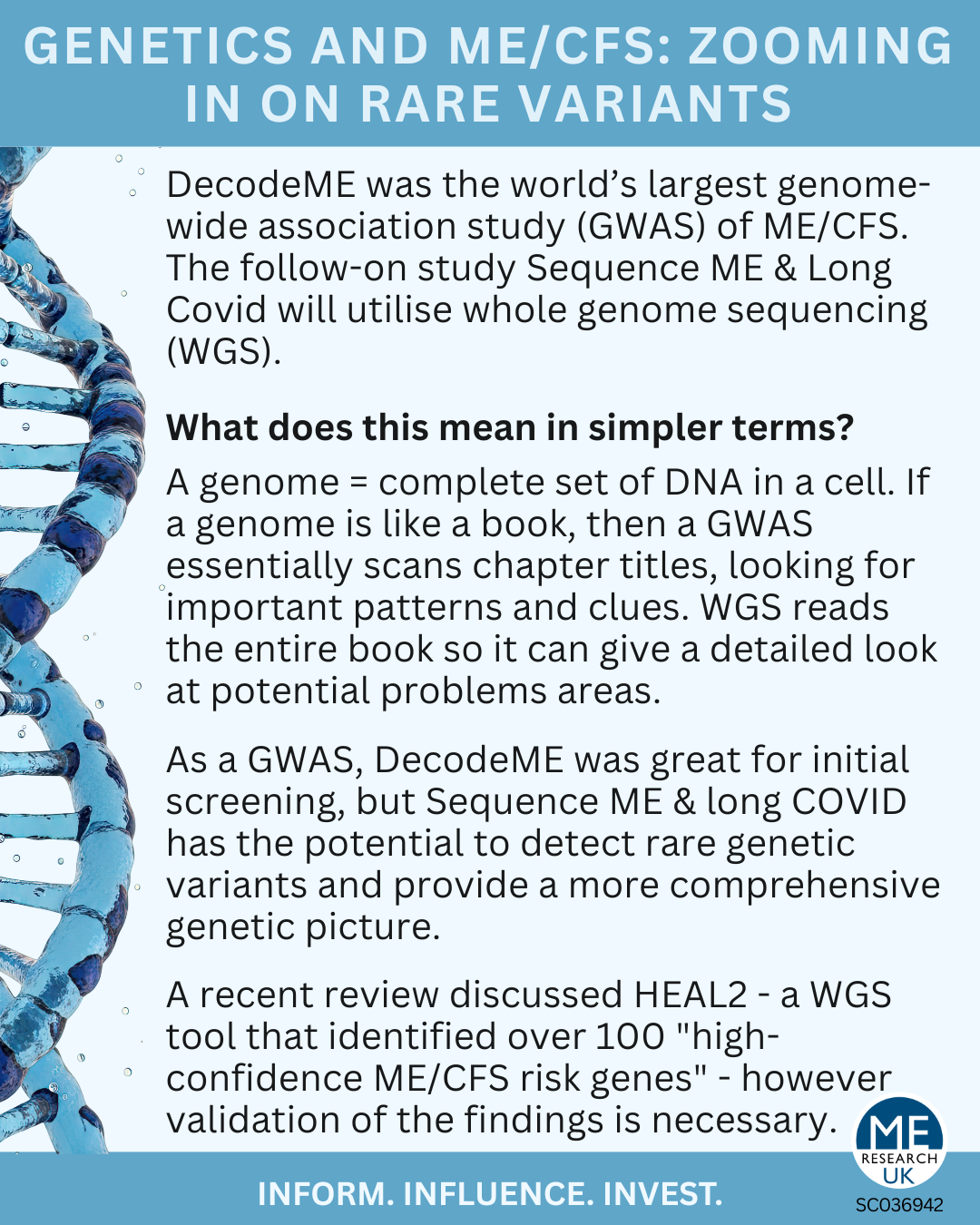
Genetics (the study of segments of DNA called genes) and epigenetics (how environmental and other factors impact gene activity) are becoming increasingly important in ME/CFS research, especially considering the DecodeME study and recent announcement of funding for the follow-up SequenceME & Long Covid project. Therefore, ME Research UK thought it helpful to cover genetic aspects of a recent review, from several researchers in the USA, that encouraged increased use artificial intelligence (AI) and a shift towards a molecular understanding of ME/CFS.
Genetic and epigenetic architecture of ME/CFS
Genes, families and genetic predisposition
The review notes ME/CFS can cluster in families but the underlying genetics associated with this are yet to be fully elucidated with robust reproducible research. Advances in high throughput sequencing (the ability to analyse massive amounts of DNA/genetic information simultaneously) add to the understanding that ME/CFS is multifactorial and furthermore is associated with “a complex interplay of numerous rare genetic variants, which interact with dynamic epigenetic modifications, resulting in a predisposition to environmental triggers”.
Zooming in on rare variants: Moving from genome wide association to whole genome sequencing
A genome wide association study (GWAS) is a research approach, typically including thousands of participants, that involves scanning genomes (complete set of DNA within a cell) to find genetic variations linked to a disease or characteristic. DecodeME, the largest GWAS of ME/CFS to date, “found that people with ME/CFS are more likely to carry certain DNA differences in eight regions of their genome” potentially suggesting “immunological and neurological processes are involved in the genetic risk”.
Caveat: the review explains that even conclusions from GWASs need to be looked at critically to examine whether findings are reproducible and furthermore GWASs related to ME/CFS ” have not provided the full picture of genomic contributions to disease onset and progression and the role of heritability.”
The review also highlights HEAL2, an AI tool – specifically a “novel deep learning framework” – that has been used for whole-genome sequencing (WGS) across multiple ME/CFS cohorts. WGS offers information depth and can help look for rare genetic variants that might be associated with a disease, whereas GWAS can be employed as initial screening for potential genetic loci (locations in DNA) associated with a disease. The authors state that HEAL2 has identified 115 “high-confidence ME/CFS risk genes” i.e. genes that suggest a higher likelihood of developing ME/CFS. These genes were particularly associated with critical areas – immune system and brain. Note the study referenced is a pre-print that involved 464 individuals with ME/CFS. Note: A pre-print is a paper that has not yet been peer-reviewed. The peer-review process aims to assess the validity and quality of articles for publication. Therefore, findings should always be interpreted with caution.
In simpler terms, if the genome is like a book, GWAS essentially scans book chapter titles, looking for general patterns and providing important clues. Whereas,WGS reads the entire book so it can find specific information that can give a more detailed look at where the problem lies. GWAS is faster and more cost-effective, whereas WGS is more comprehensive but significantly more resource-intensive and expensive.
SequenceME & Long Covid
As a GWAS, DecodeME was a great start as an initial screening study, and it follows that the team is further pursuing SequenceME & Long Covid as this study will utilise WGS. As stated in the study description –
“…DecodeME examined around one million common genetic locations across the genome. This is the first robust biological evidence pointing to the immune and neurological drivers of ME. But a GWAS is only the beginning, capturing a small proportion of the complete variation within the human genome. To identify causal variants, we urgently need to sequence the whole genome…Sequence ME & Long Covid will use long-read whole-genome sequencing, a more advanced and informative approach than the short-read methods typically used in large studies.” The aims of Sequence ME & Long Covid include locating genes with greater accuracy, identifying new biological mechanisms, exploring epigenetics, detecting rare genetic changes and identifying structural variations in DNA.
HEAL2 and SequenceME are distinct initiatives: HEAL2 is a tool to accomplish WGS and has been utilised in a study with less than 500 participants with ME/CFS. Whereas Sequence ME & Long COVID is large-scale research, which will employ WGS on several thousands of samples from the DecodeME study, with the help of “Oxford Nanopore’s long-read sequencing technology”.
Epigenetics
The review also highlights growing evidence that environmental trigger, such as infections and toxic exposures, may influence the onset and progression of ME/CFS through epigenetic mechanisms. One key process is DNA methylation, where chemical tags attach to DNA and alter gene expression without changing the underlying genetic code. “Methylation modifications have been shown to occur in or near genes involved in key pathways related to immune function and cellular metabolism, which could explain a link between these changes in ME/CFS “
Conclusion
Taken together, current evidence suggests ME/CFS is unlikely to be explained by a single genetic cause, but instead reflects a complex interaction between multiple factors including genetic and epigenetic variations. While GWAS studies such as DecodeME have provided important initial signals, particularly implicating immune and neurological pathways, emerging whole-genome sequencing approaches, as will be used in SequenceME & Long Covid, will provide a more detailed picture of the genetic architecture of ME/CFS, moving forward research related to the disease.