| Trigger Warning: This content contains discussion of death by suicide. Please take care while reading and skip ahead if you need to. If you need support, you can contact Samaritans (UK) at 116 123 (free, 24/7) or visit www.samaritans.org. |
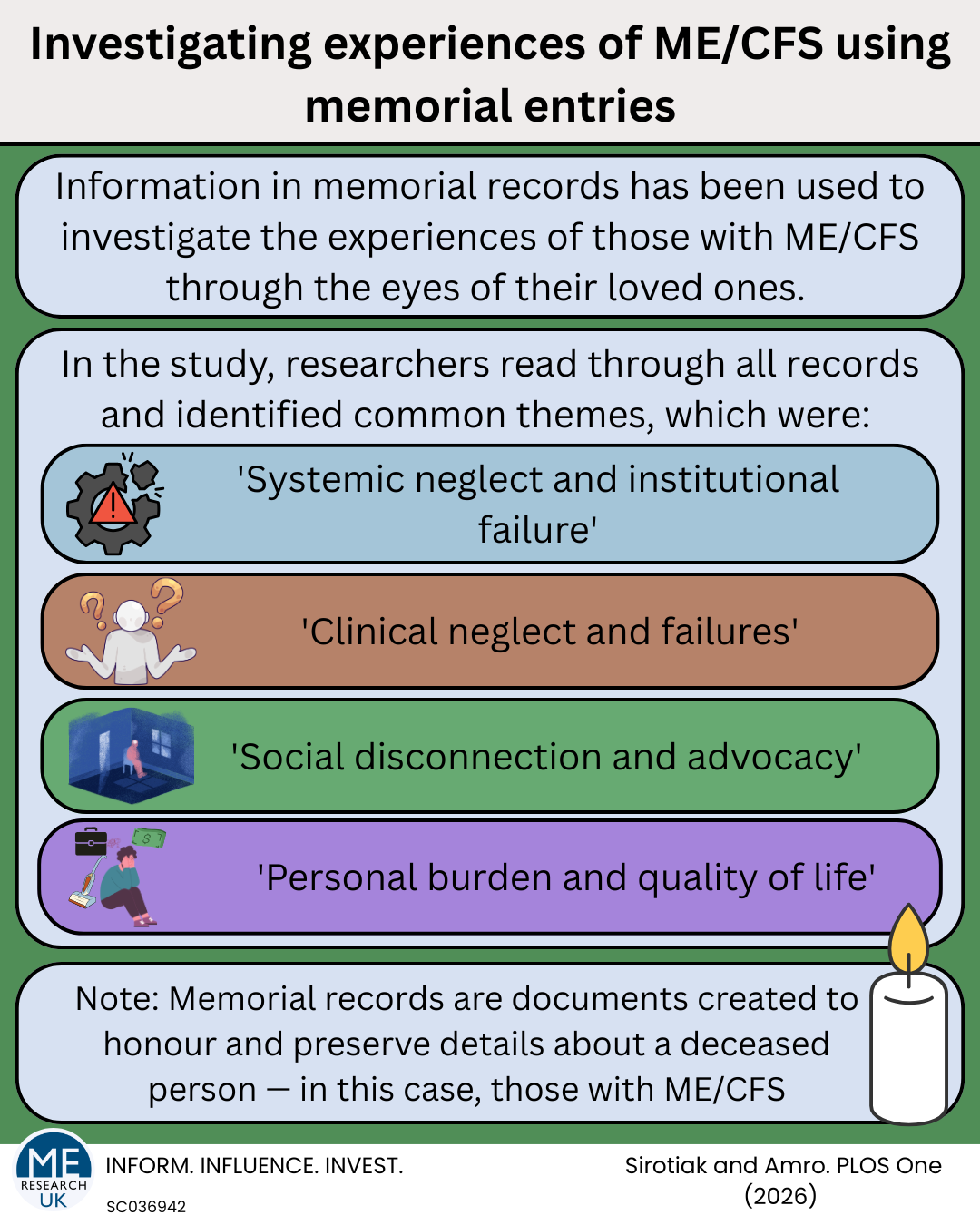
Two researchers at Iowa State University in the USA have published a study investigating the experiences of people with ME/CFS, using information from memorial records—documents created to honour and preserve details about a deceased person, which may include a biography, photographs, and family histories.
The records, published by the National Chronic Fatigue and Immune System Dysfunction Syndrome (CFIDS) Foundation, and are publicly available meaning that no ethical approval was needed for the study.
In October 2024 the two researchers—one of whom lives with ME/CFS themselves—downloaded 505 memorial entries for people who had ME/CFS. They then read through all records in detail, and worked together in identifying common themes, ultimately finding four. Importantly, the terms ‘CFIDS’, ‘ME’, and ‘CFS’ were all included as they were “treated interchangeably in the memorial lists“.
Theme 1: ‘Systemic neglect and institutional failure’
This theme indicated that systems, such as healthcare, insurance, and disability, failed to validate ME/CFS as a “legitimate condition“, and highlighted that the lack of funding and institutional support for ME/CFS further reinforced systemic neglect of the disease. Quotes supporting this theme included:
“The benefits agency made life hard, and the hurdles of having a disease so misunderstood left her depressed in addition to her devastating symptoms”
Theme 2: ‘Clinical neglect and failures’
Here, researchers identified misdiagnosis, dismissal of symptoms, and inappropriate treatment recommendations for ME/CFS, alongside a lack of knowledge and “general medical ignorance” about the disease. Quotes for this theme included:
“She was told, repeatedly, that her illness was “all in her head” and was sick for 1,115 working days……as she worsened with agonizing symptoms, several physicians believed she had something psychologically wrong with her”
Theme 3: ‘Social disconnection and advocacy‘
Within this theme, researchers highlighted the impact ME/CFS has on relationships through social isolation and loss of connection with loved ones. It also recognised the struggles for validation those with the disease experienced, leading to involvement in support groups and “awareness efforts“. This theme contained quotes such as:
“She was confined to one room and could not tolerate noise or light. Her window blind remained closed. She tried to stay in touch with friends until she could no longer as her pain and other symptoms worsened a great deal”
Theme 4: ‘Personal burden and quality of life’
This theme encompassed challenges in daily living, alongside difficulties with employment, housing, and caregiving. It also captured the experience of illness, including disease management and living with chronic pain. Life satisfaction emerged as a key aspect, reflecting emotional distress, financial strain, and, in some cases, suicidal thoughts or death. Regrettably, the researchers noted that the “frequent mention of suicide in the narratives is notable.”
Quotes in this theme included:
“After several doctors misdiagnosed her, she was finally diagnosed correctly but her ME worsened until she had to move back home with her parents”
Limitations of the research
The authors acknowledge that this research was limited because:
- It was not clear which diagnostic criteria, if any, the individuals listed on the memorial lists may have met.
- The information from memorial records is self-reported by those who knew the deceased, meaning accuracy ‘depends on the interpretations and perceptions of the acquaintance reporting the memorial information‘.
- The data was not collected for the purposes of the study meaning that the researchers were not in control of data quality.
- Potential for selection bias — where the participants in the study are not representative of the target population, leading to distorted or misleading results — because those who were on the memorial list may have had increased awareness or involvement in the CFIDS Foundation or other advocacy groups.
- Most deaths in the memorial lists occurred between 2000 and 2019, and it is unclear how experiences of those with ME/CFS would differ in during other periods of time.
Conclusions
Despite the limitations of the research, this study provides a unique insight into the lived experience and death of those with ME/CFS through the eyes of those close to them. The authors of the study clearly demonstrate that their findings are in agreement with those from other studies, such as those noting:
- The breakdown of relationships among people with chronic illnesses.
- Social isolation and lonliness in those with ME/CFS.
- Loss of independence, loss of function, and feelings of being left behind peers.
- Lack of support, frustration, and fear.
- Dismissal by health care providers.
Regrettably, the study also highlights the “frequent mention of suicide in the narratives“, something which builds on previous work by the research team that examined the causes of death for the 505 individuals with ME/CFS listed in the CFIDS memorial records. This study identified:
“ME/CFS appears to be associated with notable mortality, with suicide, cancer, and cardiovascular causes of death being particularly common. Many entries list ME/CFS or its complications as a cause of death, indicating that notable proportions of affected individuals and those close to them perceive ME/CFS as directly involved in mortality. Increased clinical awareness and targeted screening may be particularly important.”
In their latest paper, the research team made recommendations that further research is needed to gain a clearer picture of “the experiences and systems that contribute to mortality risk, specifically mortality by suicide“.