ME Awareness Week takes place every May during the week of May 12th, which marks International ME Awareness Day. The aim is to raise awareness about Myalgic Encephalomyelitis/Chronic Fatigue Syndrome (ME/CFS) – often shortened to ME – a complex and debilitating disease that extends far beyond fatigue and significantly impacts the lives of affected individuals.

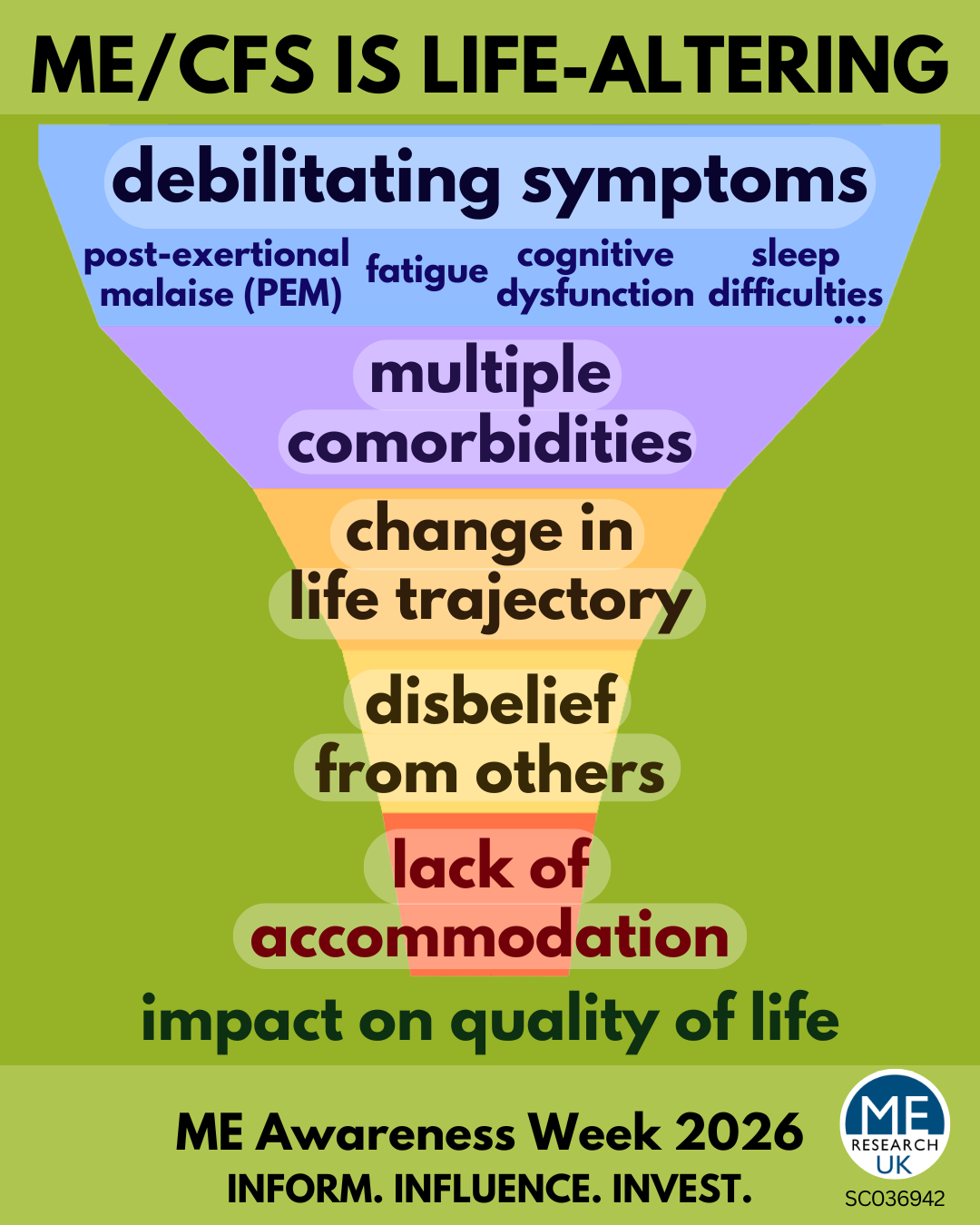
Post-exertional malaise (PEM), the hallmark feature of ME/CFS, is the delayed worsening of symptoms (and potential appearance of new symptoms) following minimal physical or mental exertion. It typically occurs 24 – 72 hours after the triggering event but may occur sooner. PEM can significantly reduce the level of activity/functioning of a person, and can last for several days, weeks, or longer.
The intense fatigue associated with ME/CFS is is not just tiredness, it is a persistent symptom that is not adequately relieved by rest and significantly impacts activities of daily living. The faulty “battery” analogy is a common way to describe ME/CFS, summed up as:
- Rapid drainage – The battery (energy of individual with ME/CFS) quickly decreases with minimal activities – this could even include showering or eating
- Slow recharge – The battery takes a long time to recharge (energy does not quickly replenish), despite rest
- Limited capacity – The battery never fully charges and may even only get up to 10-20% of capacity (individual never has “normal” energy levels even when functioning at their highest capacity, which is particularly apparent when they compare their current capacity to that before they developed ME/CFS)
NICE notes cognitive dysfunction (“brain fog”) and sleep difficulties as the other core symptoms of ME/CFS, and also acknowledges that individuals can have many other symptoms/signs (not exclusive to ME/CFS), such as pain, orthostatic intolerance (symptoms upon assuming an upright posture), autonomic dysfunction (improperly functioning nervous system), flu-like symptoms, sensory hypersensitivity, neuromuscular symptoms (such as twitching), and intolerance to alcohol/food/chemicals.

Read more about ME/CFS symptoms

People with ME/CFS often have comorbidities (co-occurring conditions) such as postural orthostatic tachycardia syndrome (POTS), irritable bowel syndrome (IBS), and fibromyalgia. Dealing with additional medical conditions further impacts quality of life.
It should be noted that whilst other conditions can co-occur – and it is often helpful if they are identified – misdiagnosing or missing ME/CFS altogether can result in missed opportunities for proper care, including crucial energy management strategies. A significant number of individuals with ME/CFS are all too familiar with the frustration of being misdiagnosed. Individuals may be initially diagnosed with conditions like anxiety or depression, instead of receiving a diagnosis of ME/CFS.

Read about comorbidities related to dysautonomia (autonomic dysfunction)

ME/CFS can severely disrupt a person’s life. For those of working age – the serious, complex, and often long-term nature of ME/CFS, means that the disease often impacts a person’s ability to work. Due to the debilitating nature of their symptoms, many people with the disease are only able to work part-time, whilst many others are unable to work at all.
The reality of ME/CFS is that even basic daily tasks can become tough barriers, leaving less room for a career, education, a social life, or other envisioned plans. Furthermore, up to a quarter of individuals with ME/CFS are house- or bed-bound. The different severities of the disease are reflected in the 2021 NICE guideline.

Read more about living with ME/CFS

Many individuals with ME/CFS feel that they have not been believed, supported or treated equally across different settings. The NICE 2021 guideline for ME/CFS states that it should be acknowledged that individuals with ME/CFS “may have experienced prejudice and disbelief and could feel stigmatised by people (including family, friends, health and social care professionals, and teachers) who do not understand their illness.”
Dr Melvin Ramsay, a British physician who was renowned for his research and advocacy on ME, published Postviral Fatigue Syndrome: The Saga of Royal Free Disease (later titled Myalgic Encephalomyelitis and Postviral Fatigue States: The Saga of Royal Free Disease). This book, which documents cases of ME following various confirmed or suspected infectious outbreaks, also documents the disbelief individuals with ME face and the impact of this. A quote from the book:
“… His mother applied for invalidity benefit and was seen by a senior neurologist who considered her to be a case of ‘near-delusional self-deception’ and described ME as a ‘figment of the imagination both on the part of the patients who think they are suffering from it and the doctors who make the diagnosis’.”

Read more about Dr Melvin Ramsay’s foresight about ME

There is limited appropriate healthcare professional training on ME/CFS and many NHS Boards state they do not have specific ME/CFS referral pathways and very few specially trained ME/CFS staff. Additionally, there is limited appropriate educational opportunities on ME/CFS for other professional groups e.g. social care, education, and welfare sectors and general employers.
The NICE 2021 guideline for ME/CFS details the impact of ME/CFS and offers recommendations for coordinated, individualised care. This includes considering the following:
- Social care needs assessments
- Aids and adaptations
- Inpatient care needs
- Employment and education
- Supporting for family and carers
Information should be tailored to each person’s needs and offered in various formats, such as written or audio. NICE advises that the timing, length, and frequency of appointments should be adjusted based on individual preferences, ensuring accessibility and accommodating sensory sensitivities.
Additional considerations are necessary for individuals with severe and very severe ME/CFS. People should be aware that individuals with severe or very severe ME/CFS experience profoundly debilitating symptoms that can significantly impact their mobility, ability to care for themselves, and ability to interact with others.

Read a summary of the NICE 2021 ME/CFS Guideline’s key recommendations for better care

Research shows that individuals with ME/CFS experience a marked decline in health-related quality of life. For those living with ME/CFS, this likely comes as no surprise.
At a conference held in Portugal, there was an insightful talk detailing experiences visiting people with severe ME from a researcher’s perspective, and recommendations for better care. Described was the profound alienation and isolation faced daily by those living with severe ME, compounded by a lack of understanding from healthcare professionals, family, and friends.

Read more about experiences of individuals with Severe ME/CFS
Read more about what makes ME/CFS so debilitating and the research being conducted