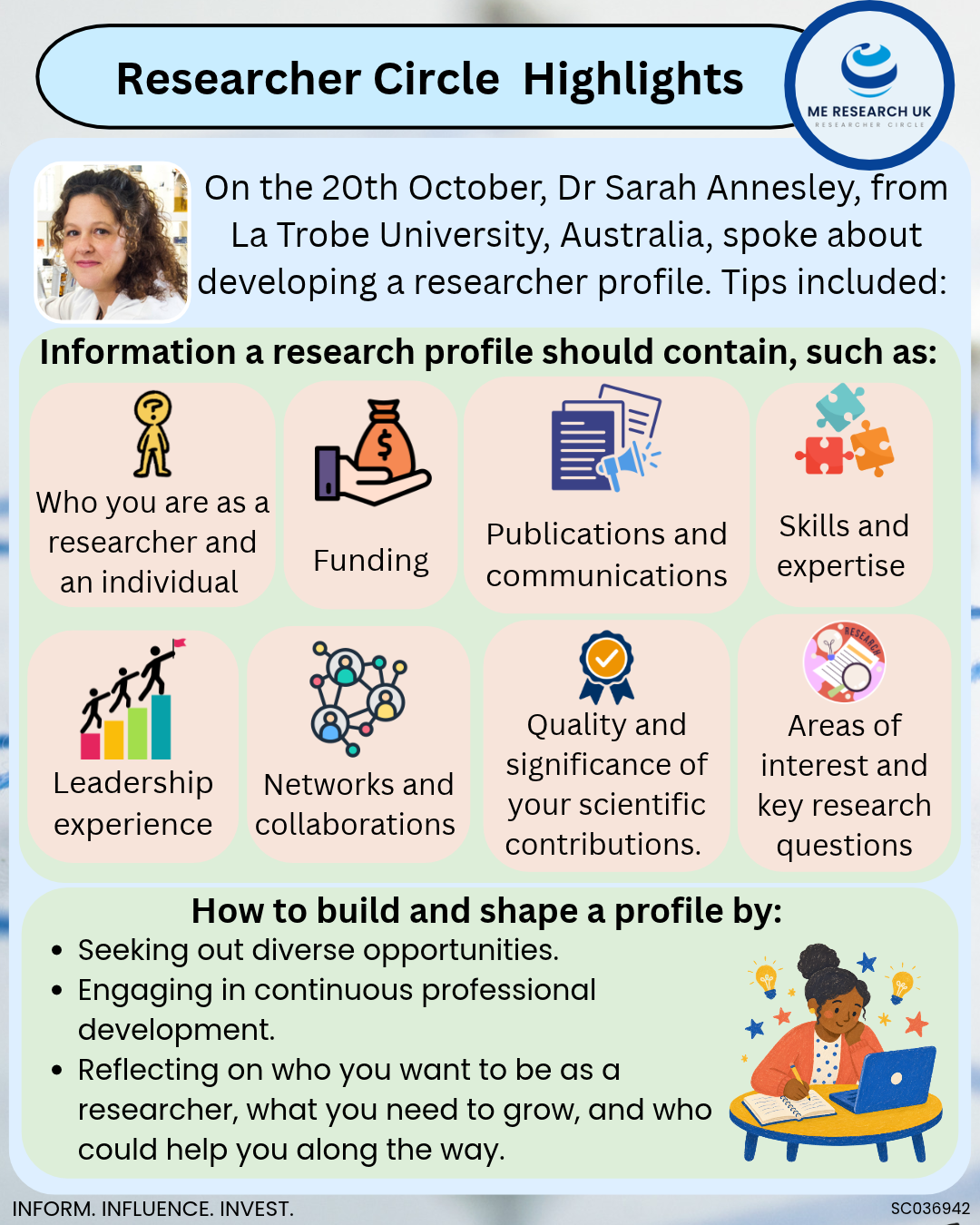
On the 20th October 2026, the seventh meeting of ME Research UK’s Researcher Circle took place. In this session, Dr Sarah Annesley from La Trobe University, Melbourne, Australia – who leads research funded by ME Research UK – spoke to the group about developing a researcher profile.
A researcher profile is (usually) a digital academic identity that aggregates your scholarly output, including journal articles, preprints, grants, peer reviews, and citation metrics, into one accessible page. This profile could be shared on social media like LinkedIn or X, displayed on a university or funder website, or used during job applications.
During the talk, Sarah explained that the following aspects are usually included in a researcher profile:
- Who you are as a researcher and individual: A short introductory paragraph that helps people to gain insight into how well you could fit as a team member or collaborator.
- Research questions and areas of interest: Where your interests lie as a researcher, both the general area and more specific interests.
- Quality and significance of contributions: A section reflecting on the questions that you have asked in your research and how this has moved the field forward. Here it was recommended that, in addition to information around projects and findings, outputs and impact should be evidenced. Sarah also noted that it is important to display understanding of how the work you have done connects to larger scientific questions.
- Skills and expertise: A list of the the technical and transferable skills you have with a coherent description demonstrating when and how you obtained these. You might also want to include the areas you want to develop further.
- Communication: Evidence of academic communication including publications (quantity and quality) and conference abstracts, and other forms of communication such as lay language summaries, short talks, lightning talks, and posters.
- Networks and collaborations: Here it is important to build a cohesive picture of who you have worked with. Think about other researchers, clinicians, lived experience experts, and industry partners. Include information on whether the links were national or international, within or across organisations, and whether they were multi- or cross- discipline.
- Funding: In this section, include information about successful applications and skills developed in this area (which could be through unsuccessful applications).
- Leadership experience: Here you can evidence your leadership experience, such as mentoring, supervision, and reviewing manuscripts, but also discuss your potential.
In each of the above areas, Sarah expanded on how researchers can keep building and shaping their profile to support their academic career. Tips included seeking out diverse opportunities and continuous professional development, and ongoing reflection on who you want to be as a researcher, what you need to grow, and who might be able to help you along the way.
Following the talk, the members had a discussion around the tips provided, especially discussing where to look for career development opportunities and small grants to support idea development.
The Researcher Circle will meet every regularly, and will alternate between more structured sessions with a speaker followed by time for questions and discussion, and informal ‘catch-ups’ which aim to provide a friendly forum to discuss progress and challenges faced, and to practice presentations.
As such, ME Research UK looks forward to welcoming the students for an online ‘catch-up’ in January!
The Circle is aimed early career researchers working on ME/CFS projects, and will:
- Fulfil ME Research UK’s aim to create an environment to encourage, support, and to facilitate the entrance and retention of early-career researchers in the field of ME/CFS research.
- Create an online space for students to network and learn about each other’s work.
- Provide an opportunity for skill development through talks given by members of ME Research UK staff, from established researchers in the field, and from other relevant experts.
- Provide a friendly forum to discuss challenges faced, to practice presentations, and to lay the foundations for future careers.