Researchers
Andrea Polli, Jolien Hendrix, Arne Wyns, Jente Van Campenhout, Sabine Allard, Joeri L. Aerts, Thessa Laeremans, Huanyu Xiong, Yanthe Buntinx, Joni Michiels, Jinane Ben Amar, Lode Godderis, Bernard Thienpont & Jo Nijs.
Institution
Pain in Motion (PAIN) Research Group, Department of Physical Therapy, Human Physiology and Anatomy, Faculty of Physical Education & Physical Therapy, Vrije Universiteit Brussel, Brussels, Belgium.
Publication
J Transl Med. 2026 Aug 22; 24:1222.
Funding
This paper acknowledged funding from ME Research UK alongside the Research Foundation – Flanders (FWO), the Strategic Research Program (SRP86) of the VUB, European College for Lymphatic Therapy, the Netherlands.
While this study is not directly funded by ME Research UK, the group used samples obtained during their previous ME Research UK-funded project.
Key findings
- Symptom profiles of ME/CFS and fibromyalgia overlapped but were not the same.
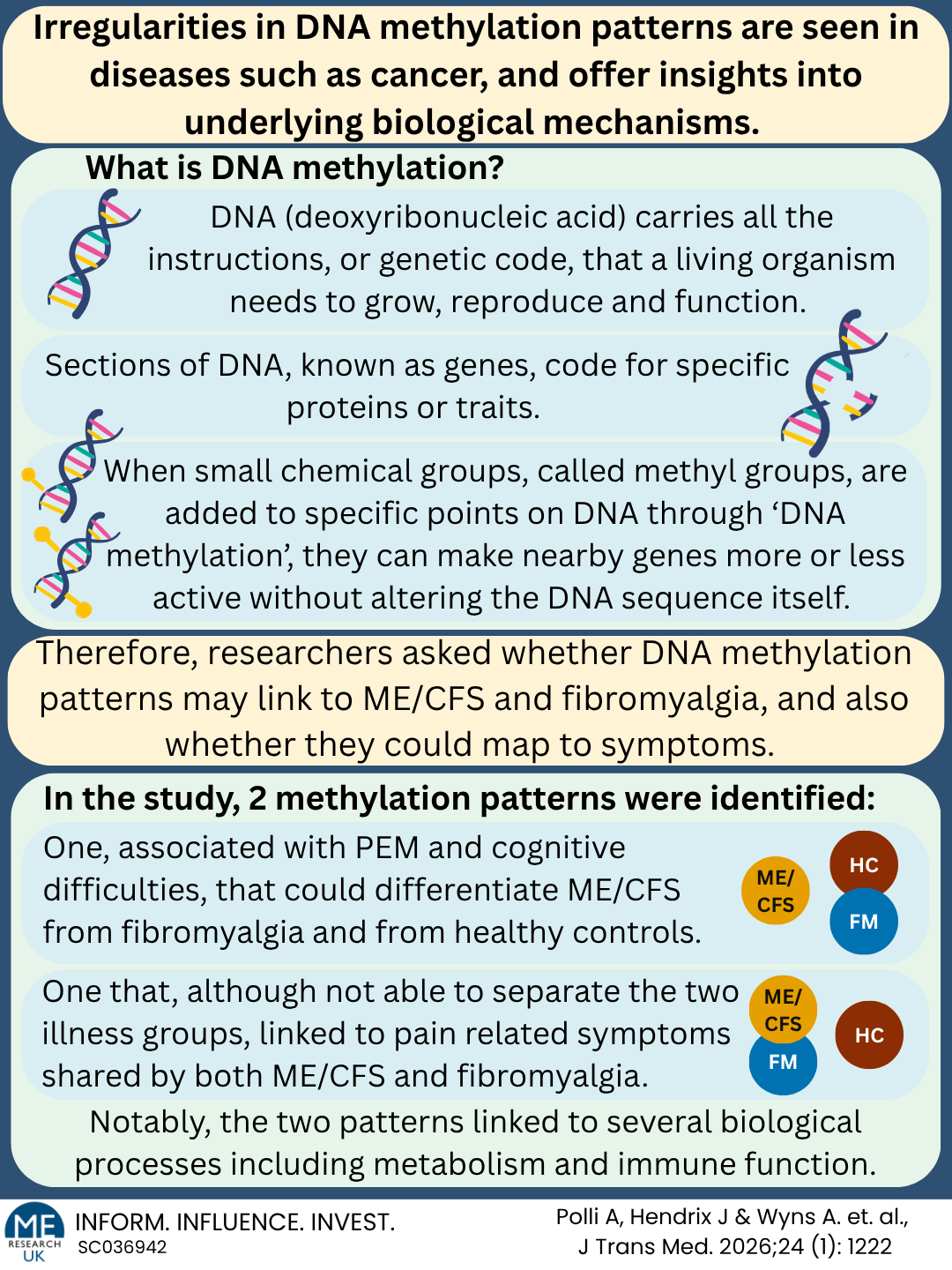
- The analysis identified two patterns in DNA methylation:
- One, associated with post exertional malaise (PEM) and cognitive dysfunction, that could differentiate those with ME/CFS from those with fibromyalgia and from healthy controls.
- One that, although not able to differentiate the two illness groups, appeared to link to the pain related symptoms shared by both those with ME/CFS and those with fibromyalgia.
- The two methylation patterns linked to several biological processes including metabolism and immune function.
About the study
ME/CFS and fibromyalgia are chronic illnesses with overlapping symptoms including severe fatigue, pain, unrefreshing sleep, problems with memory and concentration, and symptoms affecting several body systems.
Because the symptoms overlap and there is no single validated laboratory test that can confirm either diagnosis, the team of researchers led by Prof. Andrea Polli and Jolien Hendrix – who share first authorship on the paper – set out to try to identify biological patterns that might improve understanding of what the illnesses share and how they differ.
Notably, this study looked at whether patterns of DNA methylation in the blood are linked to a person’s diagnostic group, to the severity and type of their symptoms, or to both.
What is DNA methylation and why is it important?
DNA methylation is a chemical marking system that helps regulate how cells use genes—segments of DNA that code for specific proteins or traits. Genes contribute to characteristics ranging from eye colour to processes that keep vital organs, such as the heart, functioning.
Epigenetic changes, including DNA methylation, affect how genes are used without changing the DNA sequence itself. DNA methylation occurs when small chemical groups, called methyl groups, are added to specific points on DNA. These marks can make nearby genes more or less active without altering the DNA sequence itself. Methylation patterns vary between cell types and may also be influenced by age, health, environmental exposures, medication and other factors.
An epigenome-wide study, such as the one led by Polli and Hendrix, examines methylation at many sites across the genome to find patterns associated with a disease or symptom. However, such associations do not prove that altered methylation caused the illness. Instead, the patterns may reflect the illness, its effects, treatment, lifestyle or other biological differences.
What did they do?
The researchers looked at samples and data from 188 women:
- 71 with ‘physician-confirmed ME/CFS’ meeting the Centres for Disease Control and Prevention definition for CFS. Regrettably, this criteria does not require PEM – the cardinal symptom of ME/CFS – for a diagnosis of the disease to be made.
- 44 with fibromyalgia meeting the American College of Rheumatology definition for the illness.
- 73 healthy controls who were free of chronic pain and had a generally inactive lifestyle to “approximate the lower levels of activity commonly observed in patients”.
Using these samples, the team measured DNA methylation in peripheral blood mononuclear cells—a group of immune cells found in the blood, each with a single, rounded nucleus containing the cell’s genetic material.
Participants also completed clinical assessments covering symptoms and functioning, and the three groups of participants were compared on features including:
- PEM
- Cognitive symptoms
- Widespread pain
- The effect of pain on daily life
- Sleep disturbance
- Visceral symptoms (symptoms that originate from internal organs, often dull, aching, cramping, or pressure-like and can be difficult to pinpoint).
- Physical activity
- Pain-related thoughts and responses
- Signs of increased nervous-system sensitivity
Instead of looking at each methylation site separately, the team used a method called principal component analysis, which groups many related measurements into a smaller number of overall patterns, called ‘principal components’. The researchers then tested whether these patterns were linked to diagnosis or clinical features. Importantly, in their analysis, they considered the participants’ age, body mass index – a value based on a person’s weight and height – and differences in the types of immune cells in each blood sample.
The team also searched for regions of DNA where several nearby methylation sites changed together. They then explored which biological processes were linked to these regions. To check that the main findings were reliable, they repeated the analysis in several ways and considered factors such as medication use and other health conditions.
What did they find?
Three key findings emerged from the team’s analysis:
1. Symptom profiles of ME/CFS and fibromyalgia overlapped but were not the same.
While both groups had a significantly higher symptom burden than the healthy control groups, those with ME/CFS had more pronounced post-exertional malaise and cognitive symptoms and reported lower levels of physical activity, and those with fibromyalgia had more symptoms associated with pain.
2. There were two methylation patterns that stood out.
- Principal component 5 (PC5):This pattern distinguished the ME/CFS group from both the fibromyalgia and healthy control groups. Importantly, it appeared to track a cluster of features, including PEM and cognitive difficulties, that were more characteristic of ME/CFS than of fibromyalgia.
- Principal component 6 (PC6):This pattern, which was associated with a wider set of symptoms including widespread pain and sleep disturbance, separated both illness groups from healthy controls, but did not clearly separate ME/CFS from fibromyalgia. The authors suggest that unlike PC5, PC6 may reflect biological features shared across the two illnesses, including a pain-related element.
3. Region-level analysis pointed to several biological systems.
The team found that PC5 and PC6 were associated with 591 and 54 differentially methylated regions, respectively. Notably, this does not mean that 591 or 54 genes have been proved to cause disease, rather these results highlight genomic regions whose methylation varied with the broader statistical patterns.
When the researchers examined the biological functions represented by these regions, they found links to several systems – including metabolism, cytokine signalling, and immune regulation – that they explain are plausibly involved in illnesses, like ME/CFS and fibromyalgia, that involve pain, fatigue and multisystem symptoms. However, it is essential to note that these results are exploratory rather than demonstrating that any one pathway is malfunctioning or causing symptoms.
Limitations
The research team acknowledge several limitations of their study, including:
- Because data were collected at one time, the study cannot show whether methylation differences came before the illness, resulted from it or changed with symptoms.
- As the study included only women, the findings may not apply in the same way to male participants or to the wider, diverse population with ME/CFS or fibromyalgia.
- The fibromyalgia group was smaller than the other two groups, and u`nequal group sizes can make some differences harder to detect.
- Methylation in blood immune cells may differ from patterns in the brain, muscles or other tissues involved in symptoms.
- Principal components are statistical summaries, this means that PC5 and PC6 combine results from many methylation sites, and they are not simple, single biomarkers.
- While the analysis in this study was thorough, with multiple checks conducted, separate studies must reproduce the patterns identified in different groups of participants before they can be considered for clinical use.
ME Research UK also notes that the use of the Fukuda criteria to identify participants with ME/CFS is an additional limitation of this study as not all those in the ME/CFS group experienced PEM.
Conclusions
This study found two noteworthy patterns of DNA methylation in blood of people with ME/CFS and those with fibromyalgia. One pattern was more closely associated with ME/CFS and with PEM and cognitive symptoms. The other was shared by ME/CFS and fibromyalgia and was linked with a broader range of symptoms, including pain, sleep disturbance and visceral symptoms. The results suggest that the two illnesses may have both distinct and shared epigenetic features.
Findings offer promising directions for research, but they do not yet provide a diagnostic test or prove that methylation changes cause either illness. More research is needed to replicate these results in diverse groups of participants and using criteria for ME/CFS which require the presence of PEM for a diagnosis of the disease to be made.