In a special 2 part episode of “Long COVID the answers” podcast, Dr Funmi Okunola has interviewed Professor Rob Wüst, Associate Professor of Muscle Physiology in the Department of Human Movement Sciences at the VU University in Amsterdam in the Netherlands – and ME Research UK grant holder – and Professor Mark Faghy, Professor of Clinical Exercise Physiology at the School of Sport, Exercise and Health Sciences at the Loughborough University in the UK about their work on ME/CFS and long COVID, and the upcoming International Society for Long COVID and Post-Acute Infection Syndromes (ISLC-PAIS) conference, which both Rob and Mark have been involved in organising, and takes place in Amsterdam next week (26-29th August 2026).
Part 1
In part 1 of the interview, Funmi talks to Rob and Mark about the biological evidence for post exertional malaise (PEM), which is often referred to as the cardinal symptom of ME/CFS.
Professor Rob Wüst
Rob explains what mitochondria and PEM are for the audience and discusses his work around muscle abnormalities in people with ME/CFS, and in those with long COVID. In this talk, Rob also explains why exercise can be harmful for people with PAIS such as long COVID, and for those with ME/CFS:
“So when it comes to mitochondria, they get better, and they produce more and more energy when we train better…. when we train, when we go outside, in healthy people, training our mitochondria makes them stronger and makes them less fatiguable.
Now, what happens in people with, post-acute infectious syndromes, such as long COVID or ME/CFS, we know there is something wrong with the adaptation to exercise.
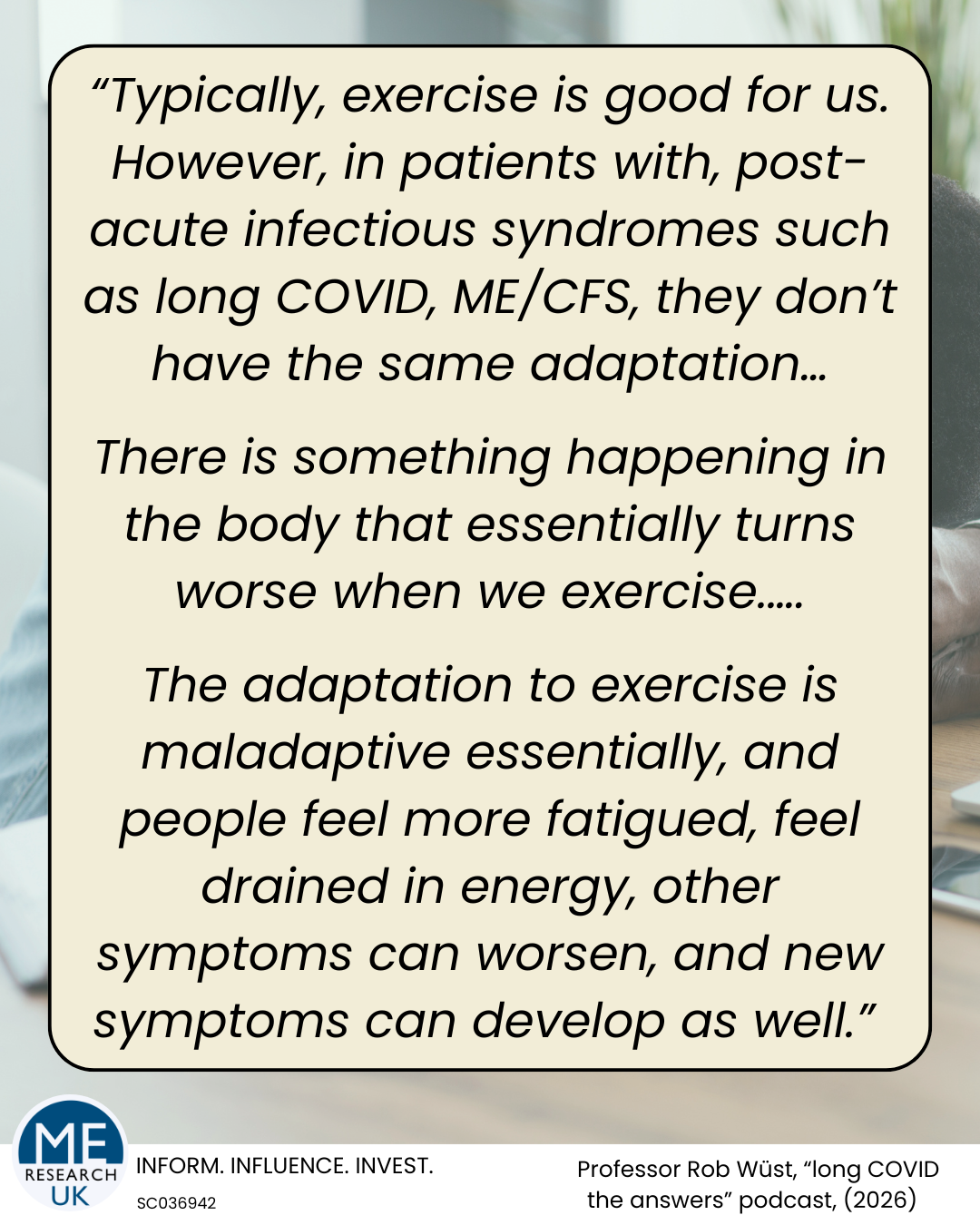
So typically, exercise is good for us. However, in patients with, post-acute infectious syndromes such as long COVID, ME/CFS, they don’t have the same adaptation…There is something happening in the body that essentially turns worse when we exercise.….The adaptation to exercise is maladaptive essentially, and people feel more fatigued, feel drained in energy, other symptoms can worsen, and new symptoms can develop as well. And that means that people are not going to recover easily from exercise above a certain intensity.
…. we know that there is a certain threshold, above this post-exertional malaise can develop. It doesn’t have to be physical exercise, but also, exertion from mental or cognitive, exercise. They can initiate this post-exertional malaise. But we know that the threshold can be different for different people. Also, the triggers can be different. Some people have more physical complaints rather than mental complaints. and others have more, they develop, post-exertional malaise after cognitive exertion quicker than physical exertion.”
Rob also talks about his team’s 2024 research paper, entitled “Muscle abnormalities worsen after post-exertional malaise in long COVID”,which waspublished in the journal Nature. As the title suggests, this paper found that muscle abnormalities seen in those with long COVID worsen after PEM. More recently, Rob’s team have shown – in research co-funded by ME Research UK – that these abnormalities in people with ME/CFS and in those with long COVID cannot be explained by prolonged inactivity, with Prof Wüst emphasising that:
“Our study underscores that patients with post-COVID and ME/CDS should not be treated as if they have lost fitness”
Professor Mark Faghy
Mark talks about the work he and his colleagues – including people with lived experience of PAIS – have done to ensure that the research they conducted is “patient-centred”. In fact, in 2024, Mark’s team won the Nature Inclusive Health Research Award for their program entitled “Profiling the Determinants of Long COVID”.
In the interview, Mark states:
“We truly value the kind of the voice of the patients in every aspect of our research design from early as just developing ideas and research questions, our patients are heavily involved in that process, and they come on that journey with us, and often direct that journey if I’m completely honest, around, you know, ‘what are we asking?’, ‘Is that relevant?’, ‘Is that important?’, through to the design, ‘how are we going to test that question?’, ‘How are we going to ask that question?’, making sure that we do that in a way that is inclusive….. ‘how do we bring in the hard-to-reach groups?’, ‘how do we bring the more severe patients? truly testing us in our ability to research and to research in that kind of inclusive way.”
Ensuring research is conducted in this way can increase representation of underserved groups, making findings more relevant to the population living with ME/CFS.
Part 2
In the second part on the interview the focus is on the ISLC-PAIS conference which aims to “bring(ing) together leading researchers, clinicians, and interdisciplinary experts through keynotes, parallel scientific & impact tracks, focused symposia, and in-depth exchange”, and a paper entitled “Current status and future perspectives on the mechanistic and pathophysiological understanding of long COVID” that both Mark and Rob were involved in which aims to provide evidence that long COVID is not a psychological illness, rather, as Mark explains, a “physiological, physical condition”.
Please note that the views and opinions expressed during the podcast are of the contributors, and sharing of the videos does not equate to an ME Research UK endorsement.
Additionally, ME Research UK will attend the ISLC-PAIS conference in person and will publish a summary of the conference highlights in due course.