In the recent weeks, ME Research UK has highlighted articles relating to epistemic injustice, and the harm this can lead to for people with ME/CFS. Therefore of interest is a paper, published in ‘The American Journal of Bioethics‘ that suggests two ways in which language could be used to improve justice in healthcare for people with ME./CFS.
What is epistemic injustice?
Epistemic injustice is harm done to a person which is related to their own knowledge or personal experience. For example; when people with with ME/CFS describe their symptoms, they are all too often not believed, or medicine and society lack the right concepts to understand their experience.
There are two types of epistemic injustice:
- Testimonial injustice: This occurs when prejudice leads someone to give less credibility to a person’s account. For example, the experiences of people of a particular gender or ethnic group, or those with a diagnosis such as ME/CFS, may be unfairly dismissed or doubted.
- Hermeneutical injustice: This occurs when society lacks the knowledge or concepts needed to understand a particular experience. For example, limited large-scale, high-quality research may contribute to poor understanding of ME/CFS. As a result, people with the disease may be ignored or treated unfairly.
Notably, epistemic injustice t is said to be a concept closely related to stigma – sadly, something commonly experienced by those with ME/CFS.
Epistemic injustice in healthcare
Epistemic injustice is a particular concern in healthcare. For example, a study, published in 2024, of five people with moderate to severe ME/CFS described the following experiences:
- Facing negative stereotypes and prejudice because of their ME/CFS diagnosis.
- Being incorrectly told by healthcare professionals that ME/CFS is psychological and being advised to undergo psychological interventions.
- Feeling that healthcare professionals did not listen to them.
- Receiving care that fell far short of patient-centred practice, in which decisions reflect each person’s specific health needs and desired outcomes.
- Having new symptoms attributed to ME/CFS without further investigation, meaning that other potentially treatable illnesses may have been missed.
- Being pressured to exercise despite harmful consequences, then being labelled uncooperative when their health did not improve.
How does the new research suggest language can improve fairness for people with ME/CFS in healthcare
Recognising the harm caused by epistemic injustice, the paper in The American Journal of Bioethics argues that unfairness in healthcare is shaped not only by whose knowledge is believed, but also by the language used to describe illness and care.
The authors suggest that people with ME/CFS may be dismissed when healthcare professionals use language that downplays their symptoms. Gaps in medical knowledge and a lack of shared terms can also make the experiences of people with ME/CFS harder to describe and understand, potentially leading to delayed or missed diagnoses.
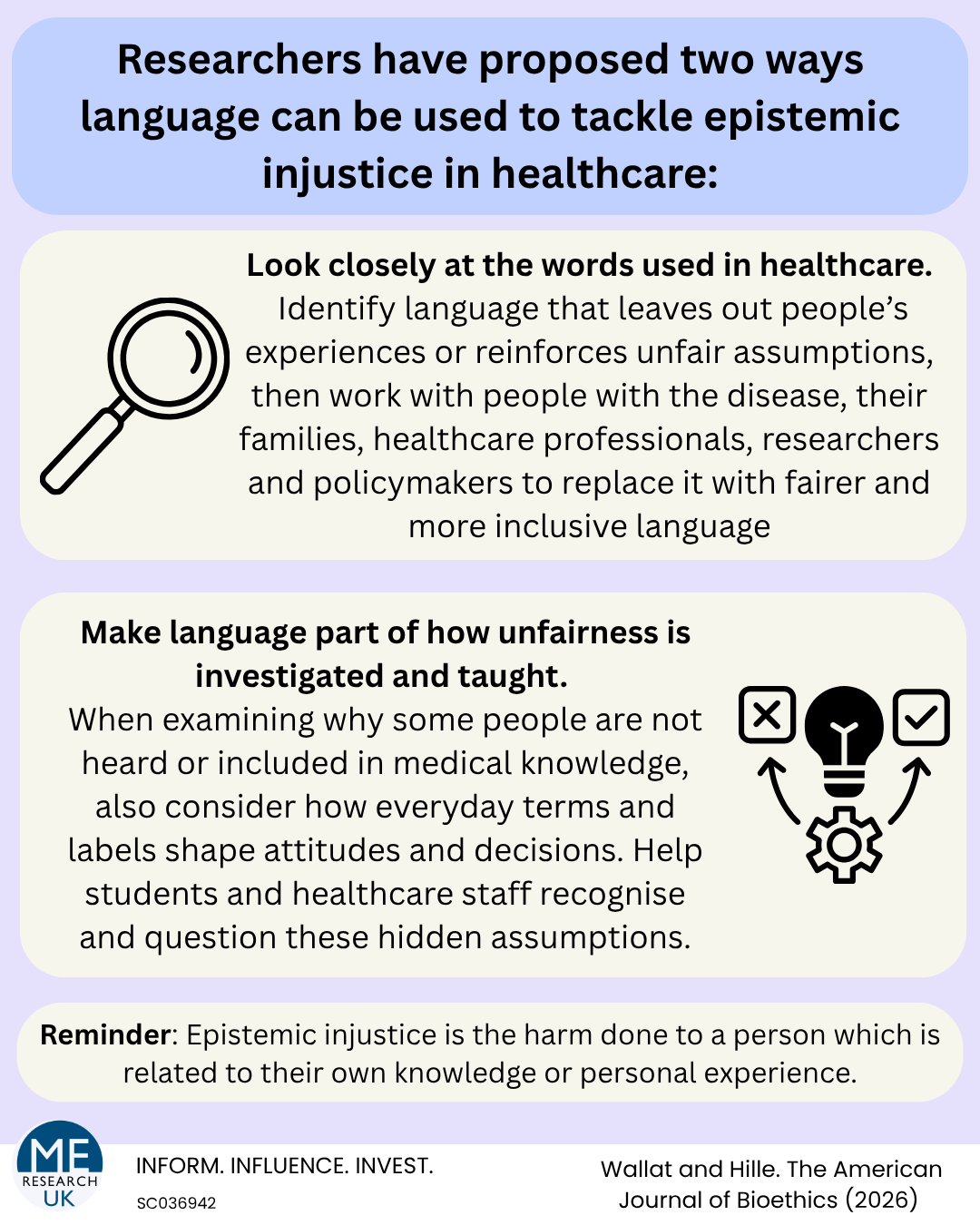
The researchers propose two ways language can be used to improve justice in healthcare:
- Look closely at the words used in healthcare. Identify language that leaves out people’s experiences or reinforces unfair assumptions, then work with people with the disease, their families, healthcare professionals, researchers and policymakers to replace it with fairer and more inclusive language.
- Make language part of how unfairness is investigated and taught. When examining why some people are not heard or included in medical knowledge, also consider how everyday terms and labels shape attitudes and decisions. Help students and healthcare staff recognise and question these hidden assumptions.
In summary, the newly published paper suggests that improving justice in healthcare requires more than telling professionals to listen better. It also requires changing the language and concepts that shape what can be said, understood, and acted upon. For people with ME/CFS – and others with poorly understood illnesses – that change may help make their experiences more visible, credible, and clinically meaningful.