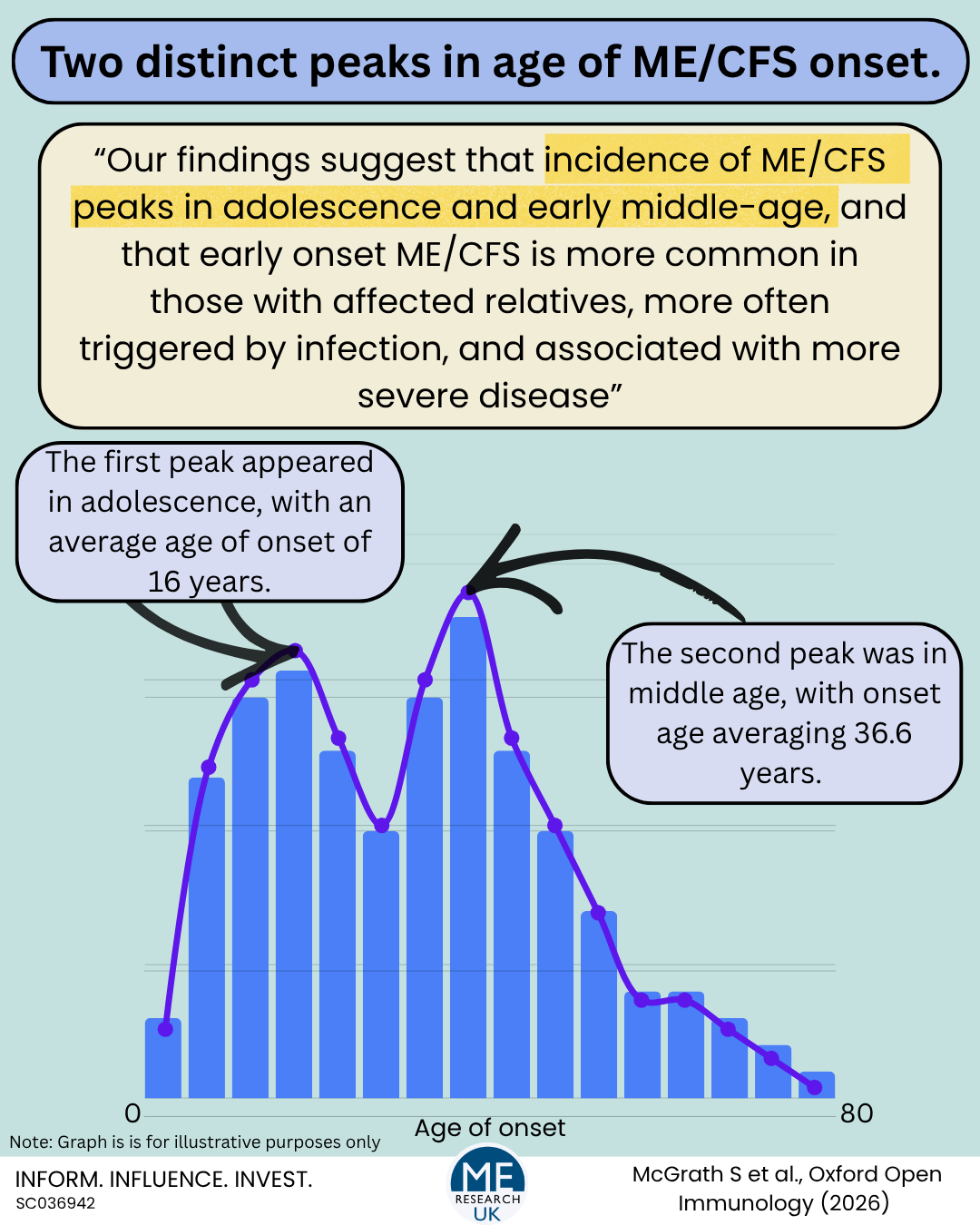
Previously discussed by ME Research UK, research from Norway in 2014 has suggested that, ME/CFS onset is most common in two distinct age groups; between 10 and 19 years, and between 30 and 39 years. However, when males and females were analysed separately, only the younger age of onset group was seen in males – something which may be due to sex differences in reproductive events:
- The 10-to-19-year age group usually includes puberty for both males and females.
- The 30-to-39 age range often includes pregnancy and postpartum period for females, but no key hormonal events for males.
Importantly, this study looked at age the diagnostic code G93.3 for “post viral and related fatigue” was given, and this may not accurately reflect the age of disease onset.
More recently, another team including patient representative for the DecodeME study, Simon McGrath, set out to assess whether these two distinct peaks (known as a ‘bimodal’ pattern) in age of onset could be seen in other groups of participants with self-reported ME/CFS. Here, the researchers looked at survey data from over 9,000 people across 10 European countries, including Norway.
When looking at data from all countries together, ME/CFS onset was indeed found to peak twice; once at around age 16, and again at about 36 years of age. When considered separately, the researchers noted that the ‘bimodal’ pattern could be seen in 7 of the 10 countries included.
Although the team did consider sex in their analysis, rather than looking at males and females separately, they considered whether the ratio of male to female ME/CFS cases in the early and late onset peaks in was comparable to that seen in the 2014 Norway study, where a higher proportion of females were seen in the second onset peak. Findings suggested that, unlike the Bakken study, the proportions of males and females were consistent across the two groups, and this was true for all included studies.
The research team also assessed whether the bimodal onset pattern could be seen in a subsample of 6,455 people from the DecodeME study, all of whom had a confirmed diagnosis of ME/CFS. Here, results provided ‘consistent and strong evidence for a bimodal distribution of ME/CFS onset’. Data was not analysed separately for males and females in the this sample from the DecodeME study.
Interestingly, the study also found that those with earlier onset ME/CFS had a greater risk of having severe or very severe forms of the disease and were more likely to have a relative with ME/CFS.
Strengths and limitations acknowledged by the research team:
- The first study to consider age of onset rather than age at diagnosis.
- Survey data included those with ‘self-reported ME, regardless of whether they had been diagnosed or not’. (Although 89% indicated that they had received a clinical diagnosis for the disease).
- Although sex was considered in the analysis, males and females were not considered separately, which may affect the findings, and at present there is not enough evidence to draw conclusions around sex differences in age of ME/CFS onset.
- The researchers state that due to limitations of the sample from the DecodeME dataset, it is likely that those with early onset ME/CFS are under-represented.
The researchers conclude:
“Our findings suggest that incidence of ME/CFS peaks in adolescence and early middle-age, and that early onset ME/CFS is more common in those with affected relatives, more often triggered by infection, and associated with more severe disease”