Researchers
Daniel Missailidis, Christopher W Armstrong, Dovile Anderson, Claire Y Allan, Oana Sanislav, Paige K Smith, Tammy Esmaili, Darren J Creek, Sarah J Annesley, Paul R Fisher.
Institution
La Trobe University, Bundoora, Victoria, Australia
Publication
J Transl Med. 2026 Jan 8;24(1):145
Funding
This work was supported by ME Research UK (SCIO charity number SCO36942) with the financial support of The Fred and Joan Davies Bequest alongside the Judith Jane Mason & Harold Stannett Williams Memorial Foundation.
It is worth noting that the research in this paper built on the teams ME Research UK funded project, which used proteomics and transcriptomics, by incorporating other ‘omics’ approaches – metabolomics and lipidomics.
Key findings
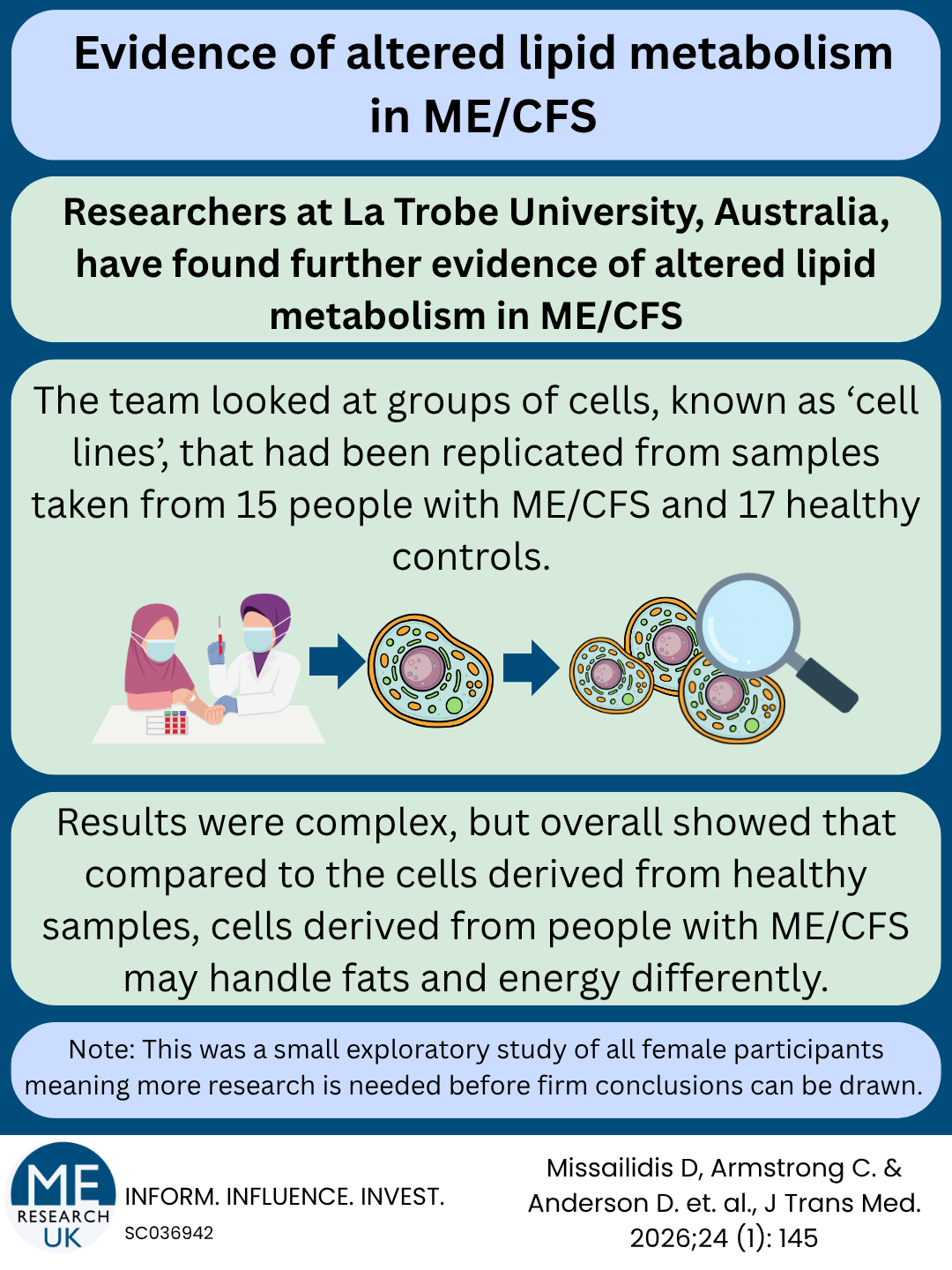
- The cells derived from people with ME/CFS contained more fats than those from healthy controls.
- Fats in cells derived from people with ME/CFS were more ‘saturated’, meaning they could pack more tightly together in cell membranes. This may lead to issues with cell signaling, but more research is needed.
- One type of fat, called PC (O-38:4) which is found in cell membranes, was much lower in cells derived from people with ME/CFS. This finding may be useful in future research but requires more investigation.
- The cells derived from people with ME/CFS showed changes in genes and proteins that control how fats are made and used.
- Overall, while more research is needed, the study suggests that cells derived from people with ME/CFS may handle fats and energy differently.
About the study
Previous studies have found biological differences in people with ME/CFS, including changes in immune function, energy use and the use of fats as fuel. However, results have varied and the mechanisms underlying the disease are not yet fully understood.
Using laboratory cell lines, a population of cells that can be grown repeatedly in a laboratory setting, dividing outside the body they originally came from. These cell lines are immortalized, meaning they can divide indefinitely under the right conditions
Earlier work from the team at La Trobe University suggested that lymphoblastoid cell lines (LCLs) – long-lasting laboratory cell lines made from B cell, a type of immune cell – derived from people with ME/CFS, produced more proteins involved in breaking down amino acids and fatty acids for energy. Notably, these observations are consistent with existing findings showing biological differences in energy use in people with ME/CFS, including the use of fats as fuel
Building on their earlier work, the team’s new study, led by Dr Daniel Missailidis, tested whether direct measurements of small molecules and lipids would show the same pattern of altered energy use.
Notably, the study focuses on ‘lipids’, a large group of fat-like molecules. Some lipids store energy, while others form cell membranes or help control inflammation, growth and immune responses.
What did they do?
The researchers compared LCLs from an all-female cohort: 15 people who met the Canadian Consensus Criteria for ME/CFS and 17 healthy controls.
This was a case–control design, meaning that measurements from the ME/CFS group were compared with measurements from a group of healthy participants without the disease.
The team used several linked advanced analytical techniques, known as ‘omics’ approaches:
- Metabolomics measured small, water-soluble molecules involved in cellular chemistry.
- Lipidomics measured non-polar, fat-like molecules.
- These new measurements were then integrated with previously generated transcriptomic data (generated during the team’s ME Research UK-funded project which received funding in 2021), showing which genes were ‘switched on’ (i.e., being read into RNA), and proteomic data, showing which proteins were present.
In their 2026 paper, the researchers explain that combining these layers of ‘omics’ analysis can reveal a consistent biological pathway even when no single measurement provides the full explanation.
What did they find?
The results of the study were complex, but in summary:
- Altogether, findings indicated changes in 15 cell processes.
- Most types of fat were higher in the ME/CFS cell lines, these included fats used to store energy and fats involved in cell signaling.
- It is important to note that the study could not show whether this was caused by the cells making more fat, breaking down less fat or moving fat differently.
- The fats in the ME/CFS cell lines were generally found to be more saturated.
- Notably, in cell membranes, saturated fats can pack more tightly together making the cell membrane stiffer and less fluid. This rigidity can hinder cellular functions and even cause damage to the cell.
- One fat found in cell membranes, called PC (O-38:4), was much lower in the ME/CFS cell lines. It separated the two groups well in this small study, so it may be worth studying further. However, it is not yet a proven test for ME/CFS, and the result must be checked in larger studies, and in cells from living tissue or blood rather than lab cell lines.
- Fat, gene and protein results all showed changes in how cells handle membrane fats. Because the different results agreed, the finding is more likely to reflect a real change in how the cells handle fats.
Limitations
This was a small exploratory study that generated future research questions, rather than enabling direct conclusions to be drawn. Limitations of the project include:
- Small sample size of 15 people with ME/CFS and 17 healthy controls.
- Used cell lines in a laboratory setting, known as ‘in vitro’, which may react differently to the same cells in the human body, ‘in vivo’.
- The study did not account for measures of body composition, such as skinfold thickness or waist-to-height ratio. The researchers were also unable to use body mass index (BMI). Although BMI cannot distinguish between muscle, bone and fat mass, it is calculated from a person’s weight and height and, at population level, correlates reasonably well with body fat. In addition, the study did not consider either the amount or type of dietary fat consumed. These limitations are not discussed in detail in the research paper.
Conclusions
The results from this study indicate that people with ME/CFS may have altered lipid metabolism, and that there could be a link between this and immune dysfunction.
However, the findings are based on observations from a specific laboratory cell model derived from a small group of female participants with ME/CFS meaning that it is an early mechanistic study which will inform future research.
Importantly, the study team explain that their findings give researchers more specific questions going forward, such as:
- Whether fresh B cells or other immune cells from larger and more diverse ME/CFS cohorts show the same lipid accumulation.
- Whether the changes vary with illness severity, duration or post-exertional symptom worsening.
Notably, before any firm conclusions can be drawn, findings must be replicated in studies of people and primary cells, and comparisons should be made with other disease controls in addition to healthy controls.