Researchers
Dr Bo Bertilson, alongside colleagues Björn Bragée, Peng Li, Danielle Meadows, Anna Widgren, Per Sjögren, Per Hamid Ghatan, Wenzhong Xiao and Jonas Berquist.
Institution
Bragée Clinics, Sweden
Publication
Bragée, B., Li, P., Meadows, D. et al. Proteomic signatures in cerebrospinal fluid and their clinical associations in patients with ME/CFS. Sci Rep 16, 15848 (2026). https://www.nature.com/articles/s41598-026-46965-1
Funding
This work was supported by ME Research UK, the Open Medicine Foundation, and the Amar Foundation. Open access funding provided by Uppsala University.
Key findings
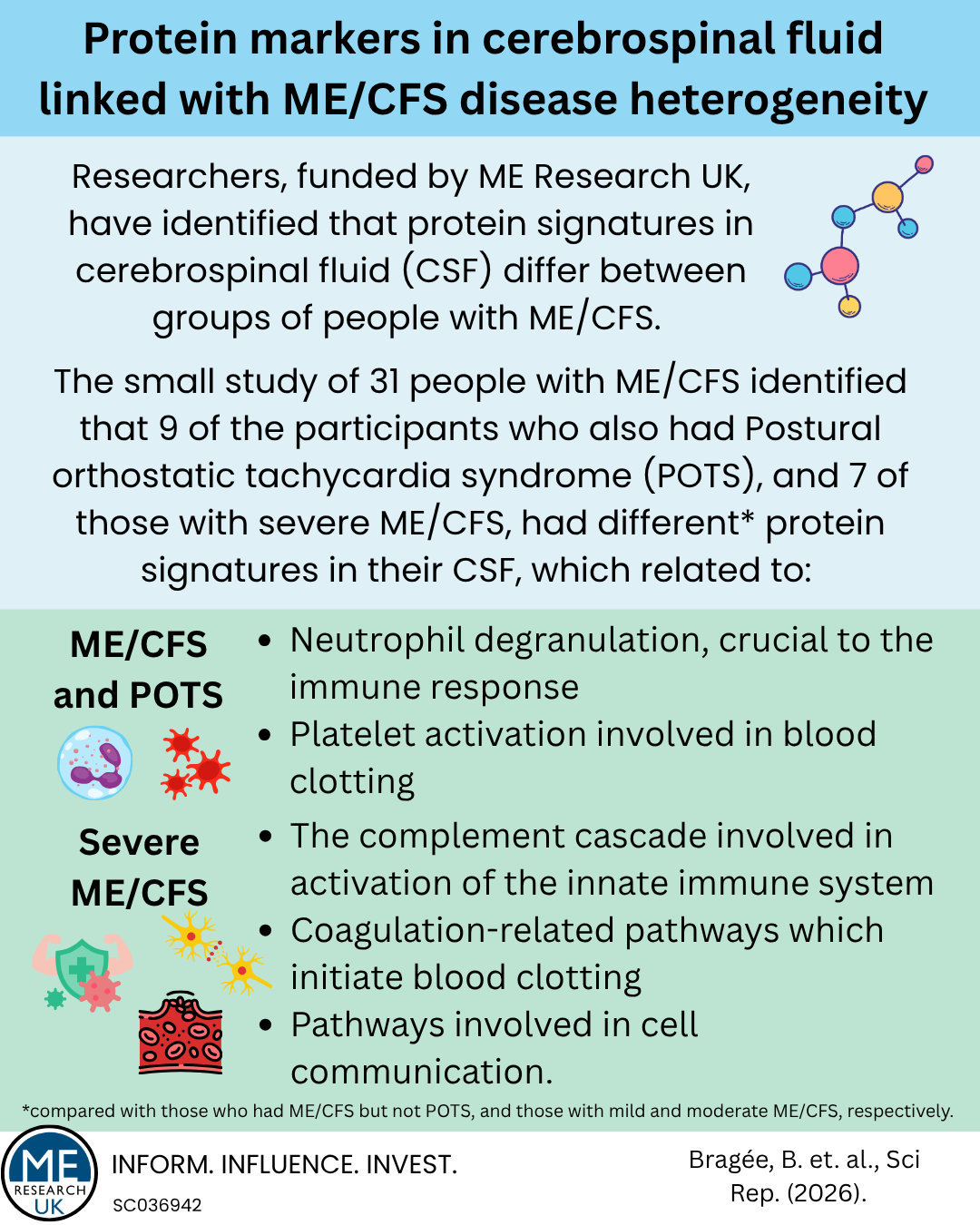
- Researchers looked at samples of cerebrospinal fluid (CSF) from a small group of 31 participants who met the Canadian Consensus Criteria for ME/CFS, 9 (29%) of whom also had had Postural Orthostatic Tachycardia Syndrome (POTS).
- In participants who had ME/CFS and POTS, a process – neutrophil degranulation – crucial to the immune response, and activation of a system called platelet activation, which causes the blood to be ‘sticky’ – often needed when the blood needs to clot to form a scab over a wound – were increased.
- In those with severe ME/CFS, the activation of several pathways was found to be higher.
- These pathways included: the ‘complement cascade’ which is related to activation of the innate immune system; the body’s first line of defence against pathogens; coagulation-related pathways which, upon injury, work together to provide a framework for tissue repair whilst also ensuring that bleeding is stopped efficiently; and pathways such as ‘IGFBP-mediated insulin-like growth factor transport’, involved in how cells communicate with each other (cell signalling).
Background
In 2023, Dr Bo Bertilson, a researcher and clinician at the Department of Neurobiology, Care Sciences and Society, Karolinska Institutet, and his colleagues at Bragée Clinics in Sweden received funding from ME Research UK for a project investigating potential biomarkers of ME/CFS. The study uses a technique called mass spectrometry to identify chemical substances in blood plasma—the liquid component of blood—and cerebrospinal fluid (CSF) – the clear fluid that surrounds and cushions the brain and spinal cord. CSF is of interest in ME/CFS as it also delivers essential nutrients to nervous system tissues and removes waste products, helping to support the role of the nervous system in regulating and coordinating bodily functions.
A paper has now been published acknowledging this funding, detailing a project which examined ‘proteomic signatures’ – specific proteins associated with disease – in samples of CSF from people with ME/CFS.
Methods
Researchers recruited 31 people with ME/CFS who met the Canadian Consensus Criteria (CCC) for the disease, 29% (9) of whom also had Postural Orthostatic Tachycardia Syndrome (POTS; a co-morbidity of ME/CFS characterised by an abnormal rise in heart rate, in addition to other symptoms, when a person transitions to an upright position). Participants were also categorised into mild (3, 10%) , moderate (21, 68%) , and severe (7, 23%) ME/CFS a based on “clinical consensus, supported by symptom profiles”.
Following this, the team used a medical procedure known as a ‘lumbar puncture’ to collect samples of CSF from each participant. The researchers then went on to evaluate protein signatures within the fluid using a technique called mass spectrometry.
Findings
Results showed that there were differences in two distinct groups of participants; those with ME/CFS and POTS, and those with severe ME/CFS.
Findings indicated that in participants who had ME/CFS and POTS, a process – neutrophil degranulation – crucial to the immune response, and activation of a system (platelet activation) which causes the blood to be ‘sticky’ – often needed when the blood needs to clot to form a scab over a wound – was increased.
In those with severe ME/CFS, activation of several pathways was found to be higher. These pathways included:
- The ‘complement cascade’ which is related to activation of the innate immune system; the body’s first line of defence against pathogens.
- Coagulation-related pathways which, upon injury, work together to provide a framework for tissue repair whilst also ensuring that bleeding is stopped efficiently.
- Those, such as ‘IGFBP-mediated insulin-like growth factor transport’, involved in how cells communicate with each other (cell signalling).
Limitations
Although the research did identify differences between those with ME/CFS and POTS and those who had ME/CFS but not POTS, and in those with severe ME/CFS compared to those with mild and moderate forms of the disease, there are limitations, which were acknowledged by the research team.
These included:
- Lack of healthy control group: In their paper, the research team explain that it was not possible to collect CSF samples from healthy controls due to ethical issues restricting them to only completing lumbar punctures on individuals experiencing symptoms.
- Lack of a control group who had POTS but not ME/CFS: This meant that it was not possible for the researchers to assess whether the same differences observed in those who had ME/CFS and POTS would also be seen in a population who only had POTS and not ME/CFS.
- Small sample size, especially in the subgroups: In this study, the overall sample size was small at only 31 people, and although significant associations were observed, the results should be validated in larger groups of participants.
ME Research UK also notes that based on the information provided in the research paper, the severity groups used by the research team are not directly comparable with those used in other studies, or in more widely recognised criteria such as the 2021 NICE guidelines in the UK.
Conclusions
This study found that in a small group of people with ME/CFS, those with severe forms of the disease, and those who have POTS in addition to ME/CFS have significantly different proteomic signatures in their cerebrospinal fluid. The researchers conclude that their findings provide insight into the biological processes behind why ME/CFS differs so much between people with the disease – a concept known as disease heterogeneity. The team explain that more research is needed to validate their findings in larger groups of participants with the relevant control groups; healthy controls, and those who have POTS but not ME/CFS.