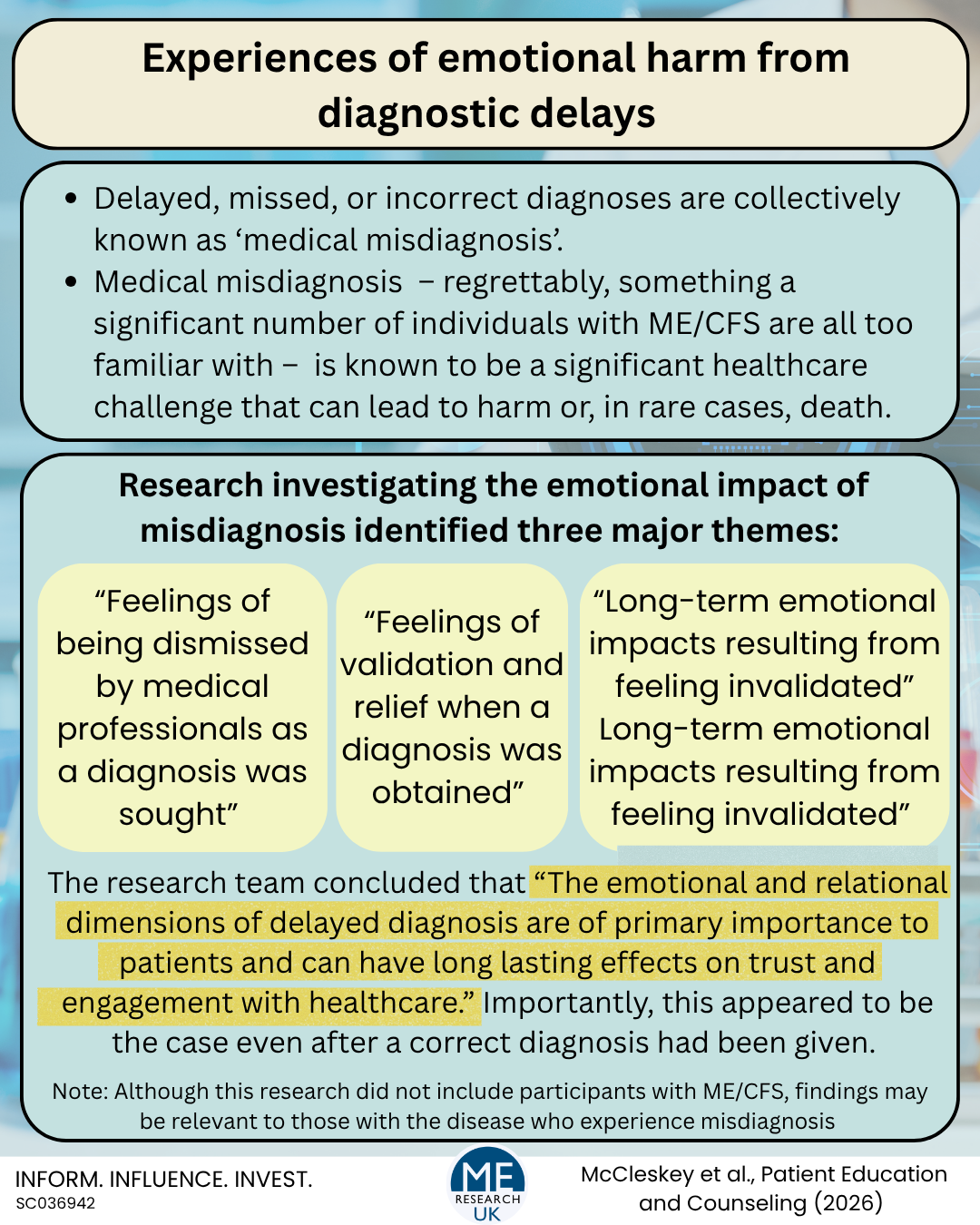
Medical misdiagnosis – regrettably, something a significant number of individuals with ME/CFS are all too familiar with – is known to be a significant healthcare challenge that can lead to harm or, in rare cases, death.
Misdiagnosis encompasses delayed, missed, or incorrect diagnoses, and although studies have looked at clinical and medical-system level factors that could lead to misdiagnosis, less is known about the impact on the patient experience.
Therefore, of interest – although not directly related to ME/CFS – is a paper published in the journal ‘Patient Education and Counselling’, which aimed to investigate the psychological and emotional impact of misdiagnosis in 23 patients with one of 5 medical conditions: pre-eclampsia, myocardial infarction, ankylosing spondylitis, sepsis or lung cancer.
Results revealed there was indeed ‘emotional harm’ from delayed diagnosis, and that this primarily stemmed from feeling dismissed by clinicians rather than the delay itself.
In relation to the emotional impact of misdiagnosis, three major themes were observed by the researchers:
- “Feelings of being dismissed by medical professionals as a diagnosis was sought,
- Feelings of validation and relief when a diagnosis was obtained,
- Long-term emotional impacts resulting from feeling invalidated” Long-term emotional impacts resulting from feeling invalidated”
The research team concluded that:
“The emotional and relational dimensions of delayed diagnosis are of primary importance to patients and can have long lasting effects on trust and engagement with healthcare.”
Importantly, this appeared to be the case even after a correct diagnosis had been given:
“Despite the validation of receiving a diagnosis, patients described long-term emotional impacts resulting from feeling invalidated, manifesting primarily through mistrust”
Notably, in their discussion, the researchers highlighted the potential impact of gender in misdiagnosis, stating that:
“Prior research has shown that women’s symptoms, particularly pain and cardiac complaints, are more likely to be dismissed or psychologized raising the possibility that themes of invalidation and mistrust reflect, in part, gendered dynamics in clinical encounters.”
To reduce the risk of harm through misdiagnosis, patient-centred strategies which prioritise validation, effective communication and partnership between patient and health care professional are essential. It would also be important to ensure these strategies were effected for different illnesses, and worked equally across all groups of the population. Where interventions work better for one group than others, they risk widening avoidable, unfair and systematic differences in health between different groups of people, known as health inequalities. For example, research has identified ‘racial disparities in the diagnostic process for ME/CFS”, this means that if a strategy improved diagnosis for white people with ME/CFS but did not for minority ethnic groups with the disease, a group who already experience reduced rates of diagnosis, this may widen inequalities in diagnosis between the two groups, further disadvantaging ethnic minority groups,
ME Research UK notes that although it is not possible to be sure the themes identified in this study would be the same for people with ME/CFS, there is a clear overlap with other research into misdiagnosis. One study in particular exploring the impact of psychosomatic and psychiatric misdiagnoses a the well-being of people with systemic autoimmune rheumatic diseases (SARD; many of which, such as Sjögren’s syndrome and Lupus, have symptoms which overlap with ME/CFS) found that having a psychiatric or psychosomatic misdiagnosis was linked with a higher chance of under-reporting symptoms, and of health care avoidance – often resulting from “distrust and fear that symptoms would be disbelieved or misattributed again”.