Regrettably, many people with ME/CFS face ‘persistent disbelief’, where their symptoms are constantly doubted, minimised, or treated, erroneously, as mainly psychological by clinicians, relatives, employers, and wider society.
A paper, published in the journal ‘Medicine, Health Care and Philosophy’, argues that this persistent disbelief is not only unfair because it questions patients’ knowledge of their own bodies, but it is also emotionally harmful.
When people are repeatedly disbelieved, they may be forced to manage not only their illness, but also the feelings, expectations, and reactions of others.
Two terms used throughout the paper are ‘epistemic injustice’ and ‘affective injustice’.
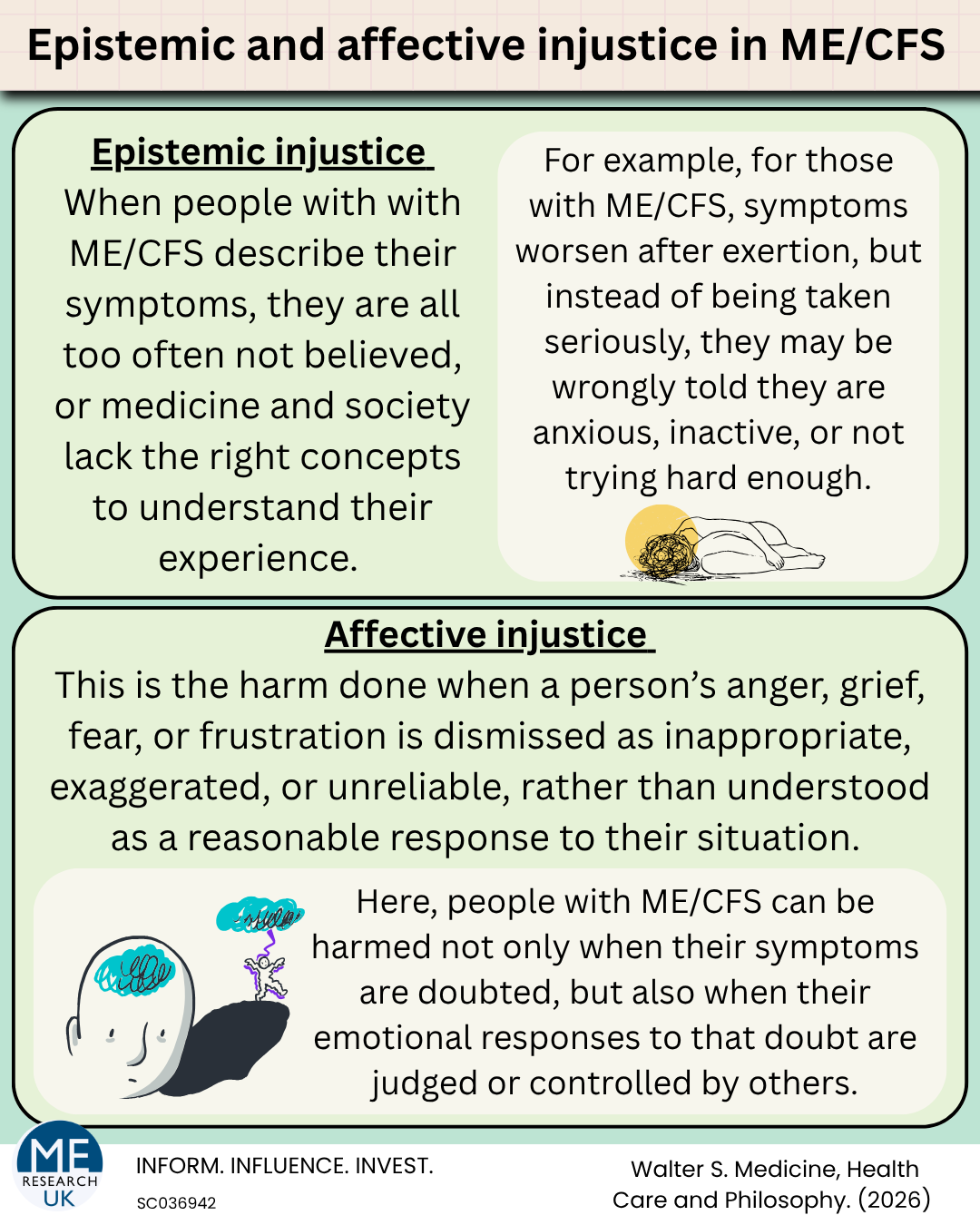
- Epistemic injustice: Being treated unfairly as someone who knows something. In ME/CFS, this can happen when people with the disease describe their symptoms but are not believed, or when medicine and society lack the right concepts to understand their experience. For example, for those with ME/CFS, symptoms worsen after exertion, but instead of being taken seriously, they may be wrongly told by others that they are anxious, inactive, or not trying hard enough.
- Affective injustice: means being treated unfairly in relation to one’s emotions: for example, when a person’s anger, grief, fear, or frustration is dismissed as inappropriate, exaggerated, or unreliable, rather than understood as a reasonable response to their situation. In this context, it helps explain how people with ME/CFS can be harmed not only when their symptoms are doubted, but also when their emotional responses to that doubt are judged or controlled by others.
While previous research has explored epistemic injustice in people with ME/CFS, this new paper moves beyond that and looks at unfairness in how people’s emotions are received, judged, or demanded. In short, people with ME/CFS may feel anger, grief, fear, frustration, or exhaustion in response to being ill and repeatedly dismissed. Yet those emotional responses may themselves be criticised by others as excessive, irrational, or taken wrongly as proof that the illness is psychological.
People with ME/CFS are therefore caught in the middle: expressing distress may lead others to dismiss them as unstable or overreacting, while appearing calm may cause the severity of their suffering to be overlooked. To be regarded as credible and reasonable, they are expected to remain composed and manage other people’s reactions—even when their illness has already depleted their limited energy.
Why is this important?
It will come as no surprise, that persistent disbelief can make illness and disease harder to live with – something not limited to ME/CFS.
For those with ME/CFS, persistent disbelief can be isolating, damage trust in healthcare and loved ones, delay appropriate support, and make people feel they must constantly prove that the disease — which research shows is a biological disease — and it’s the symptoms are real.
The paper therefore asks readers to recognise that disbelief does more than silence patients’ testimony. It also shapes how they are allowed to feel, how they must present themselves, and how much emotional work they are expected to carry.
Key takeaway
People with ME/CFS are harmed not only by the disease itself, but also by the repeated demand to justify and defend their lived experience, and emotionally manage other people’s disbelief.
Taking ME/CFS seriously means recognising people with the disease as credible witnesses to their own experience—and acknowledging the emotional toll of repeatedly having to prove that experience is real.
It is important to note that this paper is what is known as a ‘scientific contribution’ – an original peer-reviewed article that presents new data, methods, or theories that advance knowledge in a specific field – rather than a study which recruits participants and investigates a research question.