In the third meeting of ME Research UK’s ‘Researcher Circle’, which took place virtually last week, Dr Emma Slack, Science Writer and Research Engagement Officer at ME Research UK, spoke to members about ways to work well and stay motivated during your PhD.
There are several ways to stay motivated at work including goal setting, celebrating achievements, and –perhaps most importantly – keeping a work-life balance.
A work-life balance is notoriously hard to maintain in research as there is always more a scientist could be doing. However, to be able to achieve the highest standard throughout a PhD, and then during a career in research, it is essential to balance hard work with personal wellbeing.
Notably, an inability to maintain a work-life balance can cause ‘burn-out’ – a state of emotional, physical, and mental exhaustion caused by prolonged (often work related) stress – leading to reduced motivation and energy.
It is important that researchers learn to implement methods to manage workload and wellbeing at the beginning of their careers not only to prevent burn-out, but also to ensure that they are able to sustain high-quality research over time.
In the session, Dr Slack spoke about how to maintain a work-life balance in a research setting, and shared 10 tips to support working well, these were:
- Managing your energy;
- Reduce/minimise distractions;
- Use a realistic ‘to do list’;
- Focus on one thing at a time;
- Group similar tasks together and do them all at once as switching between task types can be draining;
- Prioritise healthy habits;
- Take regular breaks to boost productivity or use time management methods such as the Pomodoro Technique
- Where possible, refine your workspace; de-clutter, include natural light, and add a plant or two;
- Get a change of scenery when focus dips;
- Let go of perfectionism; high quality always, but be aware that the desire to do “spotless” work can limit productivity.
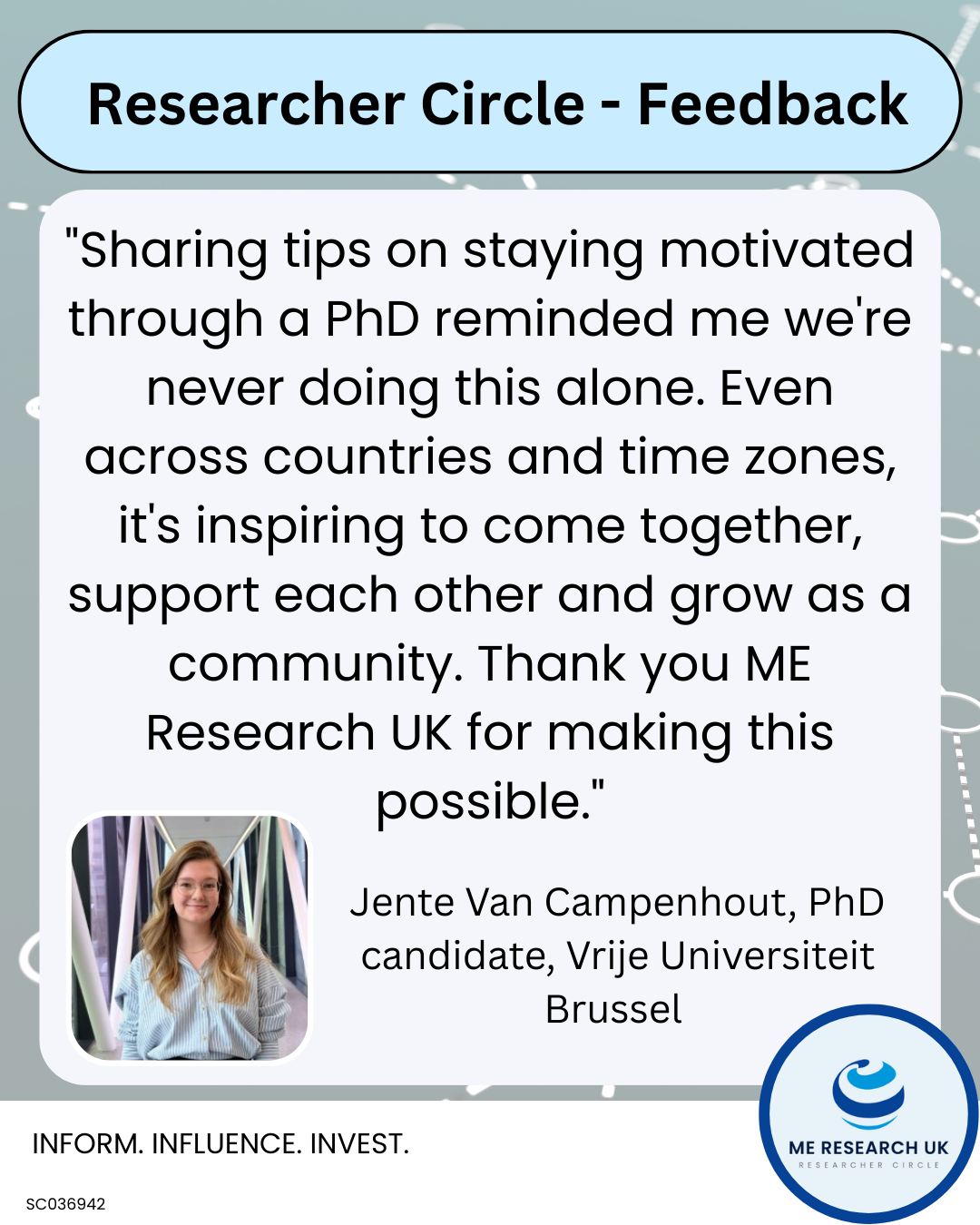
Following the session, Jente Van Campenhout, a PhD level researcher who is working on an ME Research UK-funded project investigating links between mitochondrial function and the autonomic nervous system in ME/CFS, said:
“Sharing tips on staying motivated through a PhD reminded me we’re never doing this alone. Even across countries and time zones, it’s inspiring to come together, support each other and grow as a community. Thank you ME Research UK for making this possible.”
The Researcher Circle will meet every other month and will alternate between more structured sessions with a speaker followed by time for questions and discussion, and informal ‘catch-ups’ which aim to provide a friendly forum to discuss progress and challenges faced, and to practice presentations.
As such, ME Research UK looks forward to welcoming the students for an online ‘catch-up’ in April!
The Circle is aimed (initially) at PhD-level students working on projects funded by ME Research UK charity, and will:
- Create an online space for students to network and learn about each other’s work.
- Provide an opportunity for skill development through talks given by members of ME Research UK staff, from established researchers in the field, and from other relevant experts.
- Provide a friendly forum to discuss challenges faced, to practice presentations, and to lay the foundations for future careers.
- Fulfil ME Research UK’s aim to create an environment to encourage, support, and to facilitate the entrance and retention of early-career researchers in the field of ME/CFS research.