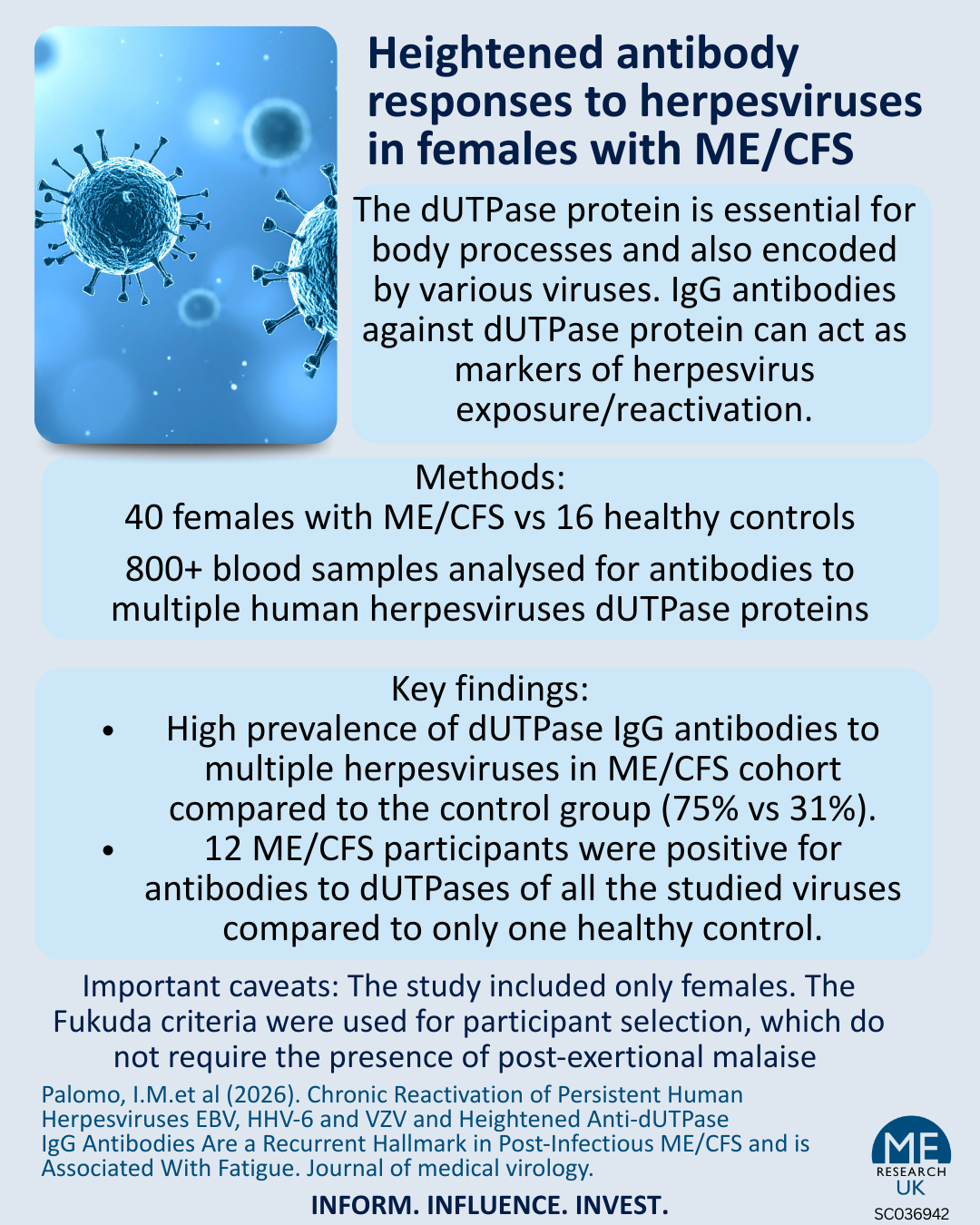
A recent study analysed over 800 blood samples from 40 females with ME/CFS compared to 16 healthy controls. The study primarily examined differences in antibodies to human herpesvirus proteins, and it found that participants with ME/CFS exhibited significantly altered antibody levels (indicating viral reactivation) compared to controls.
Study Caveats
Important considerations to be noted:
- The study included only females, so results may not generalise to males.
- The Fukuda criteria were used for participant selection, which do not require the presence of post-exertional malaise (PEM) – now considered the cardinal feature of ME/CFS. This means that although some participants may have experienced PEM, the study does not confirm it (as it also is not mentioned within the paper in relation to participant characteristics). As a result, interpretation of results must be made with this limitation in mind.
- The sample size is small, therefore larger studies would be needed to confirm findings
Study in detail
Methods
The dUTPase protein is an enzyme that is essential for body processes but also encoded by various viruses, such as herpesviruses, to help them on their mission of wreaking havoc. IgG antibodies against dUTPase protein can act as markers of herpesvirus exposure/reactivation. The purpose of this study was to expand on and validate previous findings showing heightened levels of IgG antibodies against the dUTPase protein of multiple herpesviruses in a different study cohort, as well as to determine potential associations between blood levels of dUTPase IgG antibody and self‐reported fatigue and pain severity scores. They also looked at an HERV‐K, an endogenous (meaning produced inside) retrovirus, and a range of cytokine/chemokines (signalling proteins).
The disease cohort, included 40 females between ages 19-65, with a mean age of 42, from the College of Community Health (CCHA) patient database pre-screened with Fukuda criteria. Healthy controls, 16 in total, were selected from an existing database to “match participants with ME/CFS by age.” Blood samples were obtained and analysed for dUTPase proteins encoded by a number of viruses (EBV, HHV‐6, VZV and HERV‐K) and other factors.
Findings
- High prevalence of dUTPase IgG antibodies to multiple herpesviruses in ME/CFS cohort compared to the control group (75% vs 31%).
- “More striking” 12 ME/CFS patients (30%) were positive for antibodies to dUTPases of all the studied viruses EBV, HHV‐6, VZV and HERV‐K compared to only 1 person in healthy controls (6%). That being said, there were less considerably less controls than ME/CFS PARTICIPANTS.
- “Group comparisons revealed significant differences in fatigue severity between antibody‐positive and antibody‐negative individuals for EBV, HHV‐6 and VZV but not HERV‐K. Pain scores also differed significantly for EBV and HHV‐6 positive individuals, whereas no differences were observed in VZV or HERV‐K dUTPase [antibody]‐positive individuals.”
- There were no noteworthy findings related to the signalling
Conclusion
This study reinforces previous findings that ME/CFS is associated with heightened antibody responses to multiple herpesviruses. The study also suggests a subset of participants with ME/CFS show antibodies to all studied viral dUTPases, and correlations were noted with antibody levels and symptom severity. However, interpretation is limited by the study exclusively being females and the use of Fukuda criteria.