The 2nd International Conference on Clinical and Scientific Advances in ME/CFS and Long COVID (November 12th – 13th) is currently being held in Porto, Portugal, and ME Research UK has been attending remotely.
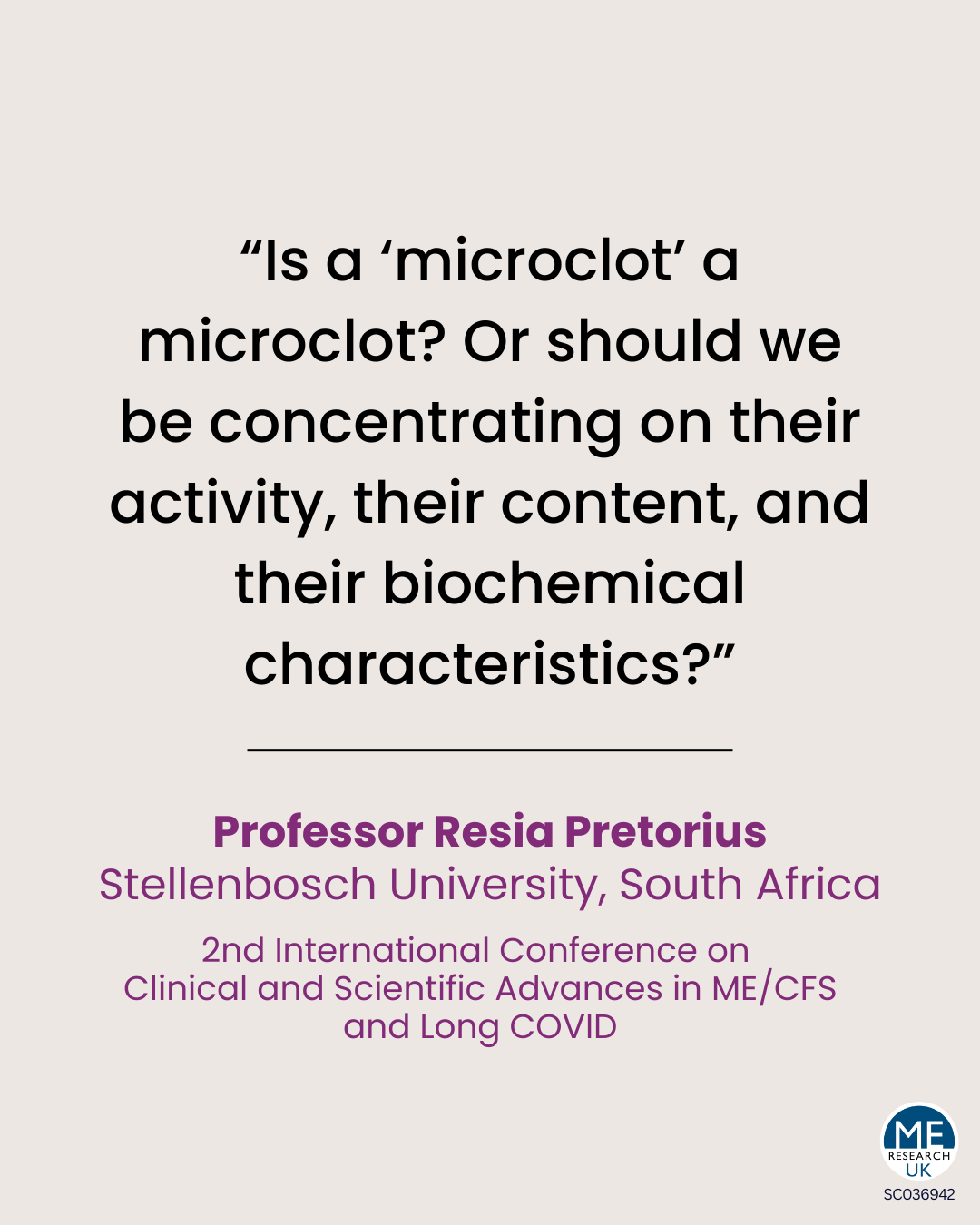
Professor Resia Pretorius of Stellenbosch University, South Africa, is widely recognised for her work exploring the hypothesis that microclots may contribute to the pathology of long COVID. Whilst this remains an area requiring further research and independent replication, it has generated considerable interest within ME/CFS and long COVID research communities.
To a lay audience, microclots might be thought of simply as tiny clumps that block blood vessels and cause symptoms. However, Professor Pretorius’ presentation shows that the underlying mechanisms are complex. We have provided the gist of a portion of her detailed talk:
Professor Pretorius highlighted, microclots are heterogenous i.e. they are not all the same. How might they form:
When inflammatory molecules circulate around the body, these can damage the cell membranes of red blood cells, white blood cells, and endothelial cells, making them pro-thrombotic (promoting blood clotting) and resulting in debris that can persist within the circulation. In healthy individuals, the immune system clears this debris effectively. In ME/CFS and long COVID, however, immune system dysfunction allows this debris to linger.
This debris may essentially trap pro-inflammatory (inflammation-promoting) molecules, which also promote blood clotting and are amyloidogenic (producing deposits of a protein called amyloid that can inappropriately accumulate). Prothrombotic/amyloidogenic substances – fibrinogen and serum amyloid A – are implicated in this process, contributing to the problem of the debris not being easily removed from the circulation.
Instead of conventional fibrin clot formation with degradable clots, there could be a pathological process where fibrin becomes insoluble, contributing to dense matter deposits that stay longer in circulation, and potentially cause problems.
Microclot complexes can “seed” onto ordinary cells binding them together obstructing blood flow and thus impairing oxygen delivery.
Watch Professor Resia Pretorius’s talk including discussion on published research and preprints