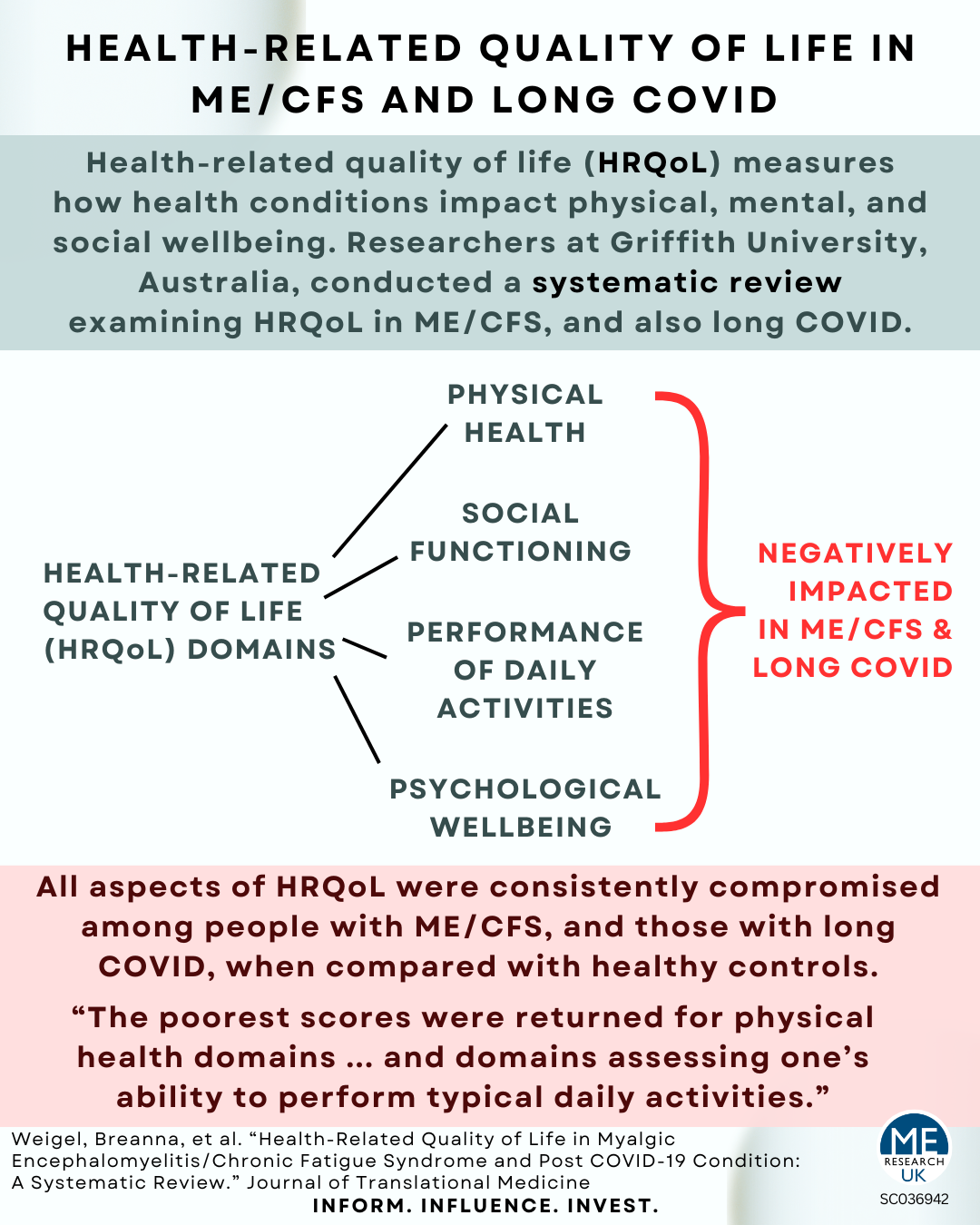
We previously reported on research showing that individuals with ME/CFS and long COVID experience a marked decline in health-related quality of life (HRQoL). For those living with these conditions, this likely comes as no surprise.
We further explore the impact of ME/CFS in the following articles:
- Impact of ME/CFS on Quality of Life
- Quality of life in young patients
- Debilitating nature of ME/CFS and the research being conducted
But what exactly does HRQoL mean, and does it differ from the term quality of life (QoL)?
According to A Centers for Disease Control and Prevention (CDC) 2003 paper, HRQoL is “perceived physical and mental health over time.” The CDC HRQoL-4 measure, used in large-scale surveys, “asks about self-rated general health and the number of recent days when a person was physically unhealthy, mentally unhealthy, or limited in usual activities.”
The paper further states, “Continuous monitoring of population HRQOL gives public health agencies current health data they need to assess, protect, and promote population health. Tracking population HRQOL over time also helps identify health disparities, evaluate progress on achieving broad health goals, and inform healthy public policy. These applications complement those of clinical research and practice, where HRQOL assessment measures patient-centered outcomes from medical, surgical, and behavioral interventions.”
The Encyclopedia of Behavioral Medicine references the World Health Organization’s (WHO) 1948 definition of health – “the state of complete physical, mental, and social well-being – not merely the absence of disease or infirmity.” “Since then, QoL has become increasingly important in health-care practice and research. The term “health-related quality of life”… (HRQoL) narrows QoL to aspects relevant to health.”
The encyclopedia, further elaborates – “Two aspects of HRQoL are central in most definitions. First, it is a multidimensional concept … which describes the physical, role functioning, social, and psychological aspects of well-being and functioning (Bullinger 1991; Calman 1987; Spilker 1990). Second, in contrast to QoL, HRQoL can include both objective and subjective perspectives in each domain (Testa and Simonson 1996). The objective assessment focuses on what the individual can do, and it is important in defining the degree of health. The subjective assessment of QoL includes the meaning to the individual; essentially it involves the translation or appraisal of the more objective measurement of health status into the experience of QoL. Differences in appraisal account for the fact that individuals with the same objective health status can report very different subjective QoL.”
Limitations and Critique
Despite its wide use, HRQoL remains conceptually and methodologically contested. As noted in the Encyclopedia of Behavioral Medicine, there is no universally accepted definition. The concept blends subjective experience and objective functioning, and the same health condition, e.g. ME/CFS, may yield different HRQoL ratings depending on individual interpretation.
Measurement tools vary widely, thus this lack of standardisation can weaken comparisons across studies. Furthermore, while QoL and HRQoL are distinct in theory, they are often used interchangeably in practice, which could reduce clarity in research, policy and general discussions.
Nevertheless, HRQoL remains a useful tool to understand the lived experience of illness, especially in complex, chronic conditions like ME/CFS and long COVID, where a lack of definitive biomedical markers (or adequate vocabulary to describe symptoms) may not reflect the full impact on daily life.