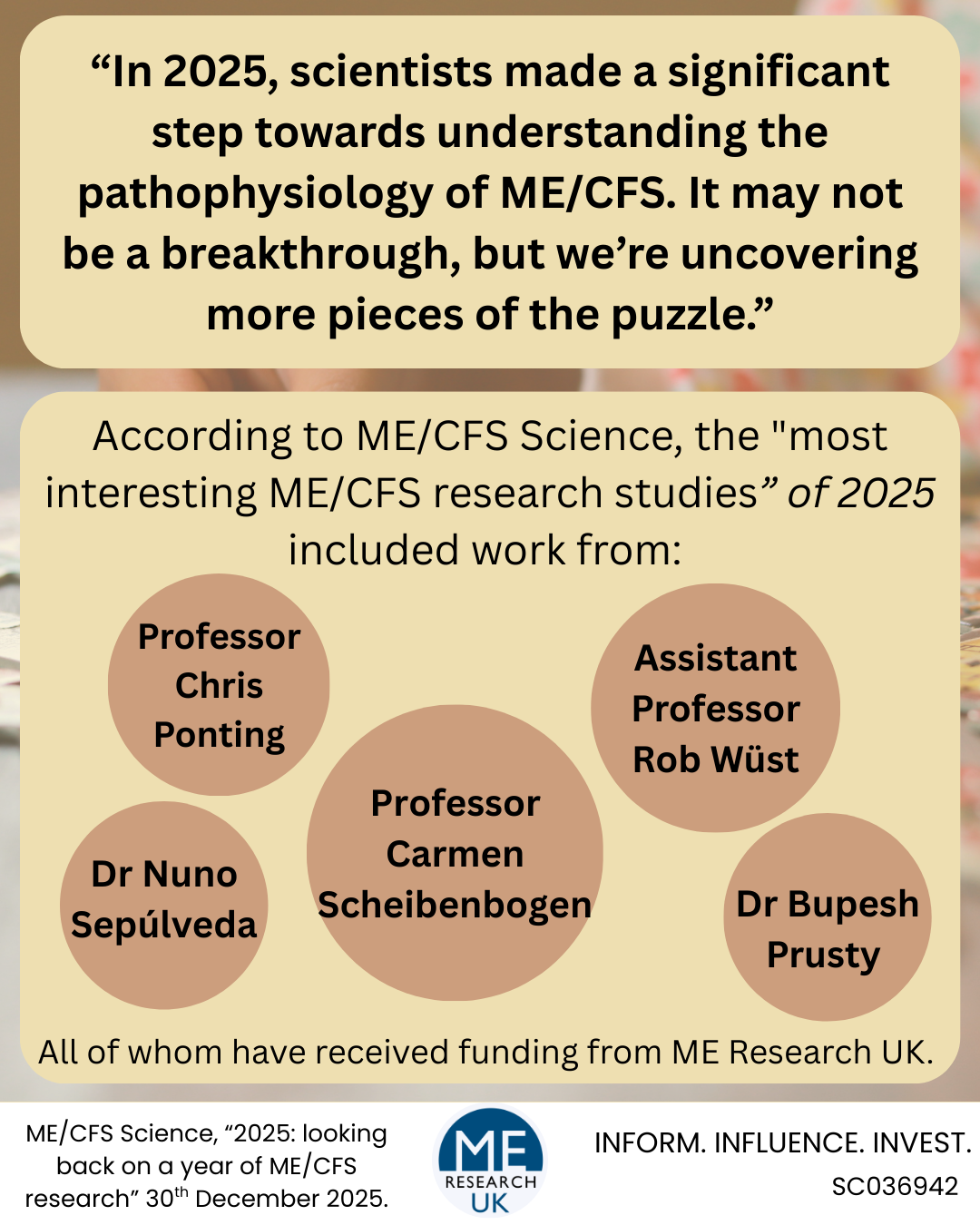
ME/CFS Science have published an article entitled “2025: looking back on a year of ME/CFS research”, in which the “most interesting ME/CFS studies of the year” are reviewed.
According to the article, “in 2025, scientists made a significant step towards understanding the pathophysiology of ME/CFS” using the analogy of a jigsaw to describe that although we cannot see the whole ME/CFS picture “It’s like fitting the corners and outer layer: we cannot yet see what the puzzle is, but we’re starting to get a glimpse of what it will show”.
Unsurprisingly, findings from the DecodeME study – the largest ME/CFS study ever conducted – were the first to be acknowledged. The DecodeME team – including PhD student Gemma Samms who, supervised by Professor Chris Ponting, is carrying out ME Research UK funded work at the University of Edinburgh – have published several papers this year, including one which suggested that genetic variations, especially those relating to the brain, in people with ME/CFS, may tell us something about the biological mechanisms that cause the disease.
Another key study mentioned was from Assistant Professor Rob Wüst and colleagues at Vrije Universiteit Amsterdam. Here, properties of skeletal muscle in people with Long COVID and those with ME/CFS were found to differ significantly from those in healthy individuals on bed rest. Importantly this study provides evidence that the cardinal symptom of ME/CFS, post exertional malaise (PEM), is not due to deconditioning.
Also highlighted was exploratory work from Dr Bupesh Prusty – currently working on an ME Research UK funded project – which suggested that antibodies from people with ME/CFS may lead to fragmentation of the energy powerhouses (mitochondria) within the cells of the body which line our blood vessels (endothelial cells), and from a team, including former ME Research UK-funded researchers Professor Carmen Schebenbogen and Dr Nuno Sepúlveda, which indicated that people with ME/CFS appear to have increased antibodies against the virus – Epstein Barr Virus (EBV) – which causes glandular fever. Acknowledged by the ME/CFS Science article, it is important to recognise that the work from both Dr Prusty’s group, and that from Prof. Schibenbogen’s teams, is early-stage and more research is needed to investigate these areas in more detail.
It is worth noting that the publications referenced from Dr Prusty, and from Assistant Professor Rob Wüst, are both pre-prints, which means that they have not yet been through peer review and so are subject to change.