Research suggests that approximately 25% of those with ME/CFS have the severe form of the disease. The impact of severe ME/CFS on an individual’s life is profound, leaving many confined to their homes, bedbound, or even immobile.
Regrettably, very little research has been conducted in people with severe ME/CFS, partly because their health burden makes it difficult for them to engage in studies; especially studies which do not actively seek to use inclusive methodology – for example, by following recommendations set out by Helen Baxter of the 25% ME group.
One of the few studies that has been carried out in people with Severe ME/CFS, is an ME Research UK-funded project by Victoria Strassheim and colleagues, published in 2021, which used interviews to explore lived experience of five people with severe ME/CFS. Although the type of research study conducted – a qualitative study which aims to gather detailed information on participant’s experiences – does not require large sample sizes, the authors note that the findings are not generalisable to all people with severe ME/CFS.
Earlier this year, a different team of researchers published a study also investigating lived experiences of people with ME/CFS, but this time using a method which they hoped would allow them to capture information from more people; analysing data from posts made on social media.
Recognising that social media platforms are “particularly suited to collecting data on people with severe ME/CFS, whose presence is otherwise limited due to extreme functional impairments”, the team searched X (previously Twitter) between 16th March and 15th May 2023 for posts using the hashtag “#severeME”.
Once identified, posts were downloaded and grouped together, allowing the researchers to consider them in detail and identify common themes.
Findings
In total, 342 posts were identified from 161 individuals (140 with ME/CFS and 12 caregivers). One overarching theme was identified and entitled “A stolen life” reflecting that the “people with severe ME/CFS, and their caregivers, shared powerful accounts of ongoing struggles, suffering, and abandonment, describing life stolen by a disabling illness in the context of a largely unsupported and unkind social environment.”
Within this, four sub-themes emerged:
Functional debilitation”: This sub-theme reflected ‘extreme physical impairment’ in people with severe ME/CFS. For example, posts stated:
- “I spend 90% of my day in bed”
- “She hasn’t even been downstairs in 2.5 years”.
- “I has #Severe ME I couldn’t walk, talk or chew my own food properly”
“Exclusion from care”: In this sub theme, posts highlighted the medical neglect that people with severe ME/CFS face. For example:
- “Very severe ME = a form of paralysis that medical professionals have no knowledge of”
- “32 years #severeME and now #longCOVID healthcare has always gaslighted us”
- “many doctors write us off & don’t understand that we can’t just ‘push through’ it”
“The interpersonal toll”: Reflecting the social stigmatisation and delegitimisation faced by people with severe ME/CFS, this sub theme included posts such as:
- “Anyone would think that a disease as severe as this would be well known, but we’re invisible”
- “People judge you on that one meeting. Don’t see me on bad days when I don’t eat and try and make it to the toilet.”
- “The more severely affected you are, the more invisible you are.”
“Redress”: Here, calls for change relating to research, recognition and respect were discussed. Posts included:
- “Urging serious commitment to medical research, increased support, and being heard. NO MORE WAITING!”
- “Give the #MillionsMissing #pwME their lives back.”
- “There is no treatment. There is no cure. There isn’t enough research into why it happens or how to fix it.”
Strengths and limitations
While this project underscores the importance of using social media as a tool to access the voices of those typically left out of research, in this case people with severe ME/CFS, the research team explain that this also means that the findings are limited to those with internet access. Additionally, data from X runs the risk of possible overrepresentation of certain demographics of social media users, such as those of a young age, with higher average education and socioeconomic status.
Conclusions
Overall, the research team concluded that:
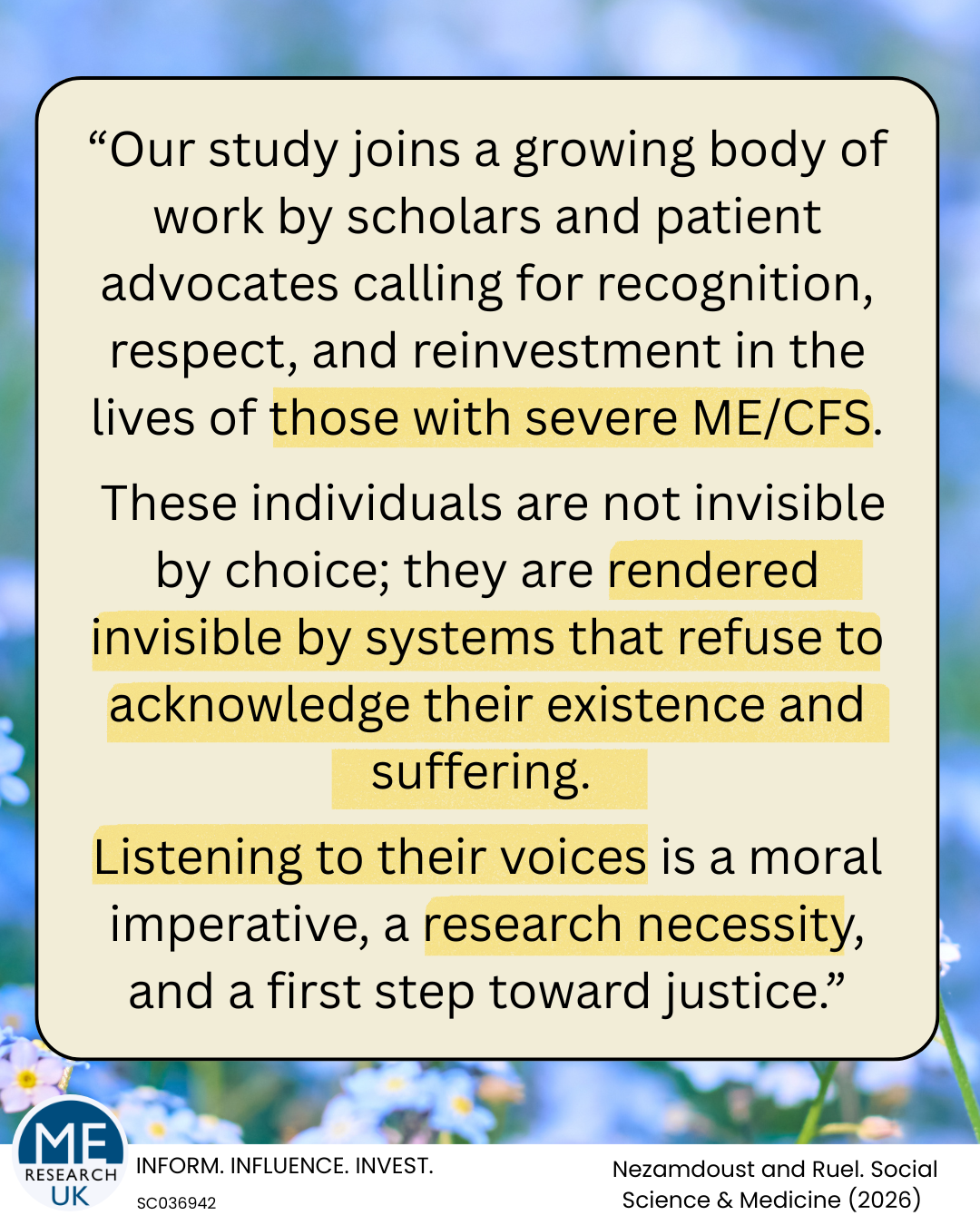
“This study aimed to illuminate the lived experiences of people with severe ME/CFS, as an understudied, hard-to-reach population, by analyzing their narratives on social media. Our findings reveal that the experiences of severe ME/CFS extend beyond the devastating physical symptoms to encompass a broader landscape of emotional, social, and institutional hardship.”
The research team also noted that once of their most striking findings related to ‘deligitimation’ (or invalidation) of ME/CFS, explaining that:
“Participants expressed intense frustration with the doubt and disbelief that have followed them across clinical, social, and familial settings. Several participants described repeatedly being told by family members that they were “lazy” or “overreacting,” while others recounted friends and employers minimizing their suffering or withdrawing entirely once the severity of their condition became apparent”