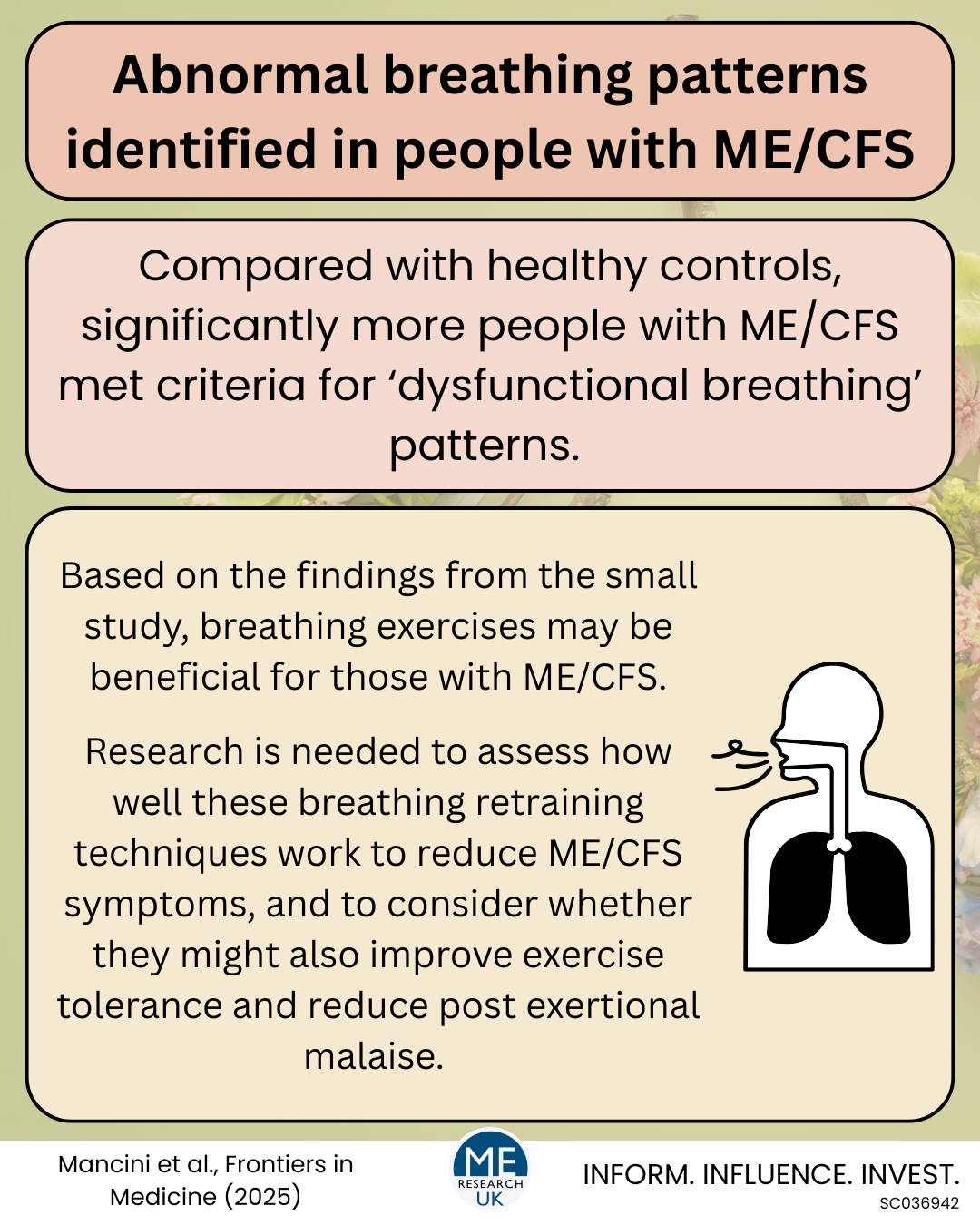
“Scientists have discovered that most people with chronic fatigue syndrome also struggle with hidden breathing problems. These abnormalities may intensify fatigue and could help explain why symptoms worsen after exertion” states an article published on the website ‘SciTechDaily’.
The SciTechDaily piece relates to a paper published in the journal ‘Frontiers in Medicine’ by a team of researchers, including Dr. Donna Mancini and Dr. Benjamin Natelson of Icahn School of Medicine. The scientists found that just under half of the 57 participants meeting the 2015 IOM case definition for ME/CFS displayed dysfunctional breathing patterns; this was significantly more than amongst the 25 healthy participants as shown in the table below.
| 57 people with ME/CFS | 25 healthy controls | Significant difference between those with ME/CFS and healthy controls? | |
| Dysfunctional breathing | 24 (42%) | 4 (16%) | Yes |
| Hyperventilation | 18 people (32%) | 1 (4%) | Yes |
| Both dysfunctional breathing and hyperventilation | 9 (16%) | 0 (0%) | not stated |
Notably, 33 of the 57 patients with ME/CFS (58%) had either hyperventilation or dysfunctional breathing, this compared to only four of the 25 healthy controls (16%), demonstrating a significantly higher level of these respiratory abnormalities in the ME/CFS group.
The authors of the research suggest that although the diagnosis of dysfunctional breathing is challenging, based on the findings from their small study, breathing exercises – such as those used in yoga – may be beneficial for those with ME/CFS. Research is needed to assess how well these breathing retraining techniques work to reduce ME/CFS symptoms, and whether they might also improve exercise tolerance and reduce post exertional malaise.