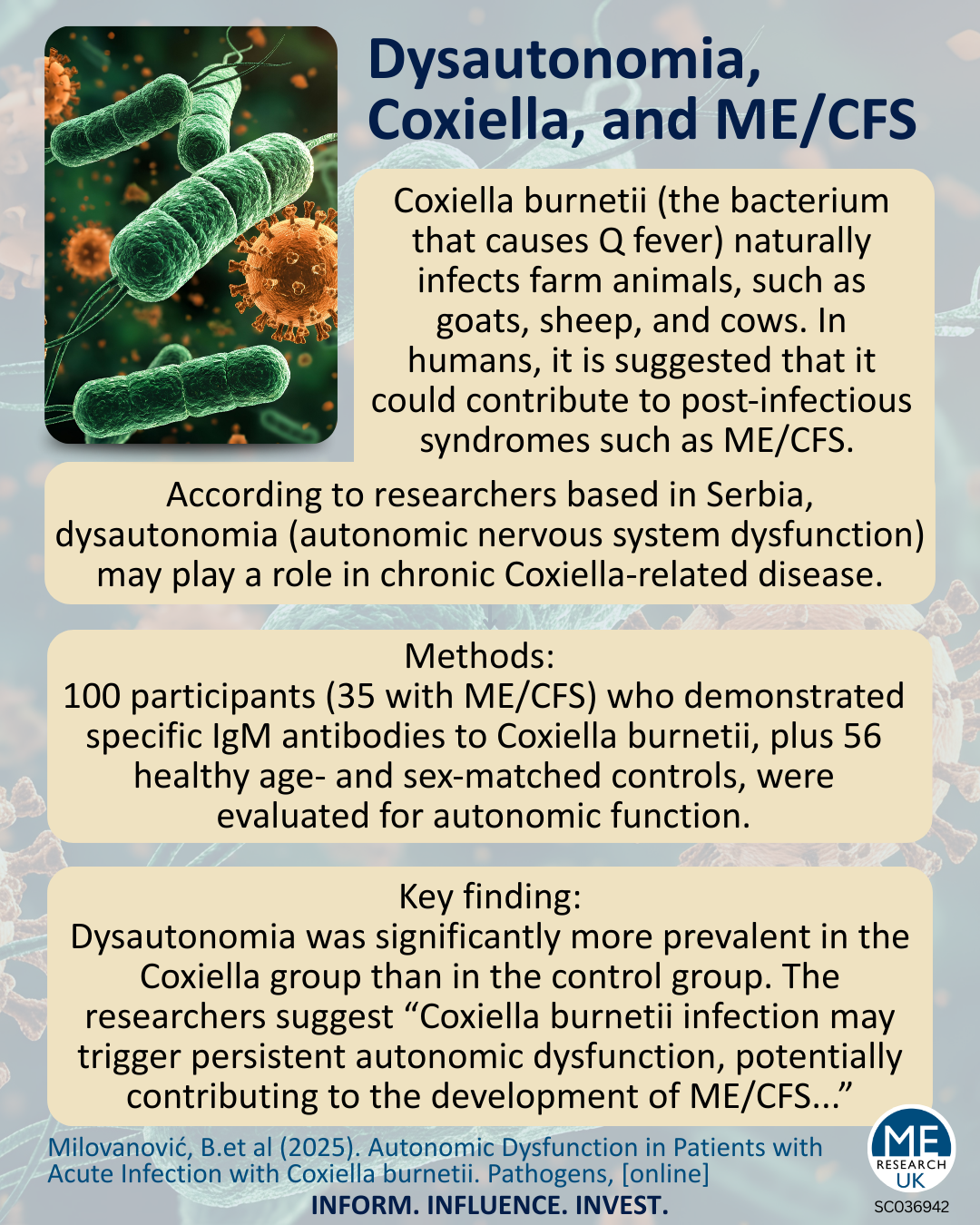
Coxiella burnetii (the bacterium that causes Q fever) naturally infects farm animals, such as goats, sheep, and cows. In humans, it is suggested that it could contribute to post-infectious syndromes such as ME/CFS. Autonomic nervous system dysfunction may play a role in chronic Coxiella-related disease.
Researchers from Serbia conducted a study to assess autonomic function in individuals presenting with polymorphic symptoms (e.g. fatigue, cognitive impairment, myalgia), dysautonomia, or ME/CFS who had serological evidence of acute infection with Coxiella burnetii.
Methods
A total of 156 participants were evaluated, which included 100 patients who demonstrated specific IgM antibodies to Coxiella burnetii, plus 56 healthy age- and sex-matched controls. 35 of the Coxiella group had ME/CFS, although the paper does not state which, if any, criteria were used to confirm diagnosis. It is mentioned that the “ME/CFS patients were not followed from the time of infection; infection was confirmed retrospectively through serology rather than prospective tracking.”
All participants underwent the following tests/analysis:
- Cardiovascular autonomic reflex tests (CART)
Non-invasive tests to evaluate the autonomic nervous system’s control of the heart and blood vessels in response to a variety of physiological stressors. CART components include sympathetic nervous system assessment (handgrip test, orthostatic hypotension test) and parasympathetic assessment (valsalva manoeuvre, deep breathing heart-rate response, standing heart-rate response). - Beat-to-beat analysis of heart rate and blood pressure
Involves individual measurements of heart rate and blood pressure in real-time, which can show sudden changes in these parameters, baroreflex function, and responses to posture/stress - 24-hour Holter ECG
Wearable device that records the rhythm of the heart over 24 hours - Heart rate variability
Measurement of the variation in time between heartbeats
Additional test in the Coxiella group:
- Tilt table test
The gold standard test for PoTS – involves a person’s heart rate (HR) and blood pressure (BP) being monitored whilst they are strapped to a special table which gradually tilts from flat to upright
Findings
- Autonomic dysfunction was significantly more prevalent in the Coxiella group, that included individuals with ME/CFS, than in the control group.
- Dysfunction mainly involved the parasympathetic branch of the autonomic nervous system.
- Abnormal results in nearly all autonomic tests, except the Valsalva manoeuvre (one element of parasympathetic assessment), were significant in the Coxiella group in comparison to the control group.
- Heart rate was significantly higher in the Coxiella group. Whilst long-term (likely referring to 24-hour) heart rate variability did not differ significantly between groups, short-term heart rate variability was consistent with autonomic nervous system impairment in the Coxiella group.
Conclusion
The researchers state that the findings “suggest that Coxiella burnetii infection may trigger persistent autonomic dysfunction, potentially contributing to the development of ME/CFS and syncope in affected individuals. Further longitudinal studies are needed to clarify pathophysiological mechanisms and clinical implications.”